Chinese Humanoid Robot Startups Competing Globally
Chinese makers dominate global sales with cost structures Western competitors cannot match.

China's humanoid robot industry did not happen by accident, and it did not happen overnight either. It is the product of a policy bet that turned into a manufacturing and cost advantage the rest of the world is now struggling to match, and the gap is widening rather than closing.
China's Market-Defining Position from an Early Policy Bet
Administrative measures set things in motion. China's 14th Five-Year Plan named humanoid robots as a key area for technological breakthroughs, which set the policy stage well before any company had shipped a commercially viable unit. What followed was not a single announcement but a sequence: the "Robot+" initiative and an "AI + Manufacturing" roadmap arrived next, aiming at pilot production lines and a target of doubling manufacturing robot density by 2030.
Then came a part that gets less attention but matters just as much.
None of this reads as a one-cycle push, either. Central leadership has signaled continued commitment to embodied AI as a national priority beyond the current planning cycle, which points to policy continuity rather than a burst of enthusiasm that fades once the news cycle moves on. That continuity is arguably the single hardest thing for a rival economy to replicate: capital and firms can move fast, but sustained state attention across multiple planning cycles is a different kind of asset.
The supply chain depth that makes Chinese cost advantages hard to replicate
Policy alone does not explain the cost gap that now separates Chinese humanoid robots from everyone else's. Lian Jye Su, an analyst at Omdia quoted by Rest of World, attributes China's lead to "a combination of policy support, public investment, mature supply chain, and advancements made in AI software and hardware". That is a fair summary, but the supply chain piece deserves particular attention because it behaves like a flywheel rather than a fixed advantage.
Su describes Chinese vendors as "using more and more local components in their robotics design, which helps with cost efficiency, supply chain security, and driving local innovation and time to market". Each generation of local sourcing lowers cost, which funds the next generation of local sourcing. It is a reinforcing loop.
Unitree is the clearest case study. The company designs and produces in-house the actuators, motors, reducers, and motor drivers that make up a large share of the cost of a humanoid robot, and externally sourced components account for a comparatively small share of its total manufacturing cost. The consequence is stark: Unitree's production cost is reported to be substantially below that of leading non-Chinese competitors, and that is not a gap software or marketing can close. Cost structure, once built into the hardware supply chain this deeply, does not get out-marketed. It gets out-manufactured, or it stays open.
Products shipped by the leading companies, and their prices
The scoreboard for 2025 is not close. Nearly 90% of every humanoid robot sold globally that year came from Chinese manufacturers, with total global sales landing somewhere between 13,000 and 18,000 units.
Unitree, based in Hangzhou, sits at the top of that list. The company sold 5,500 humanoid robots in 2025, making it the world's top seller for the year. Price tells its own story here: the average selling price fell sharply between 2023 and 2025, with the base G1 model announced at roughly $13,500, and an upper-body-only configuration introduced in 2026 at a fraction of that price. Price compression of that kind is the strategy. It is the strategy.
Scale is following price down. Unitree's 2026 shipment target is 20,000 units, backed by committed capacity expansion toward 75,000 humanoid and 115,000 quadruped robots annually, which should pull upstream demand for joint modules, dexterous hands, and sensors along with it. The company's STAR Market IPO cleared on June 1, 2026, making it the first "embodied AI" company approved for China's A-share market, and NVIDIA named Unitree's H2 Plus body as the hardware foundation for its open Isaac GR00T Reference Humanoid Robot platform in the same window. That NVIDIA endorsement matters beyond the headline: it puts Chinese hardware at the center of an open platform that developers outside China will build on too.
AgiBot ranks second globally for 2025, and its production numbers move at a pace that outstrips almost anything comparable in the industry's history. The company sold 5,168 units in 2025, reached its 10,000th robot off the line by March 2026, and announced 15,000 units just months later in early June 2026. What used to take competitors years to reach, AgiBot compressed into a matter of months. Its A2 platform carries 49 degrees of freedom, 200 TOPS of onboard compute, and a 10 kg dual-arm payload, and set a Guinness World Record in November 2025 for walking over 100 kilometres.
The deployment side is just as telling. BYD has committed to deploying 20,000 humanoid units in 2026, up from a base of 1,500 in 2025, and UBTECH's Walker S2 units have been confirmed inside BYD factories, though BYD has denied reports of that specific 20,000-unit internal target and is developing its own humanoid robot in parallel; SAIC Motor is deploying AgiBot units on its own factory floors.
The broader field of Chinese startups
Unitree and AgiBot are the two names that dominate sales tables, but the field underneath them is deep and each company is making a distinct bet on where the market goes next.
UBTECH, based in Shenzhen, is the longest-established name in Chinese humanoid robotics. Its Walker S2 carries 52 degrees of freedom, stands 1.76 meters tall, handles a 15 kg payload, and can swap its own battery autonomously, which keeps it running on a factory floor without a human intervening for downtime. In July 2026, the company unveiled an ultra-biomimetic consumer line called "U-World U1" in Shenzhen, drawing more than roughly 13,000 pre-orders within days at prices approaching RMB 1 million. That launch is not a side project. UBTECH has explicitly stepped back from competing with Unitree on low-margin industrial pricing and is repositioning toward premium and consumer buyers instead, a strategic fork that says as much about the market's maturity as any sales figure does. When a company this established chooses to exit a price war rather than win it, that is a signal the segment below it has already been decided.
Fourier, out of Shanghai, comes from research and rehabilitation robotics rather than industrial manufacturing. Its platforms have progressed from GR-1 through GR-2 to GR-3, and the GR-1 in particular became a favorite among research institutions because of its open SDK, ROS 2 compatibility, and modular architecture.
The company has attracted significant investment ahead of a potential public offering, and it ranks first on the LexisNexis patent index.
Galbot has raised over $1 billion from a mix of backers spanning technology firms, industrial conglomerates, and state-backed funds. Combined, Galbot and AgiBot have raised a combined total of nearly $2 billion in under three years.
The funding surge and China's robotics economy
The money is the mechanism behind the hardware story. It is the mechanism that produces the hardware story. Chinese humanoid-related investment reached roughly 39.8 billion RMB, or about $5.5 billion, across 325 deals in 2025, a 326% jump year over year. China now accounts for a large and growing share of global robotics venture investment, with 2026 widely characterized as the year Chinese robotics companies pivot from early-stage venture rounds toward mass production.
Globally, robotics startup funding in 2026 was tracking well ahead of the prior full year's total even before the calendar year ended, with months of the year still to go. Money is not just accelerating. It is accelerating faster than it did the year before, which is a different and more consequential thing.
What stands out in the investor list is not any single name but the mix. Technology firms, industrial conglomerates, state-backed funds, and traditional venture firms all appear in the same funding rounds, often the same round for the same company. That pattern points to capital chasing the supply chain itself, the actuators, the sensors, the reducers, not just the finished robots wearing a recognizable brand.
Patent rankings and what they show about who is ahead
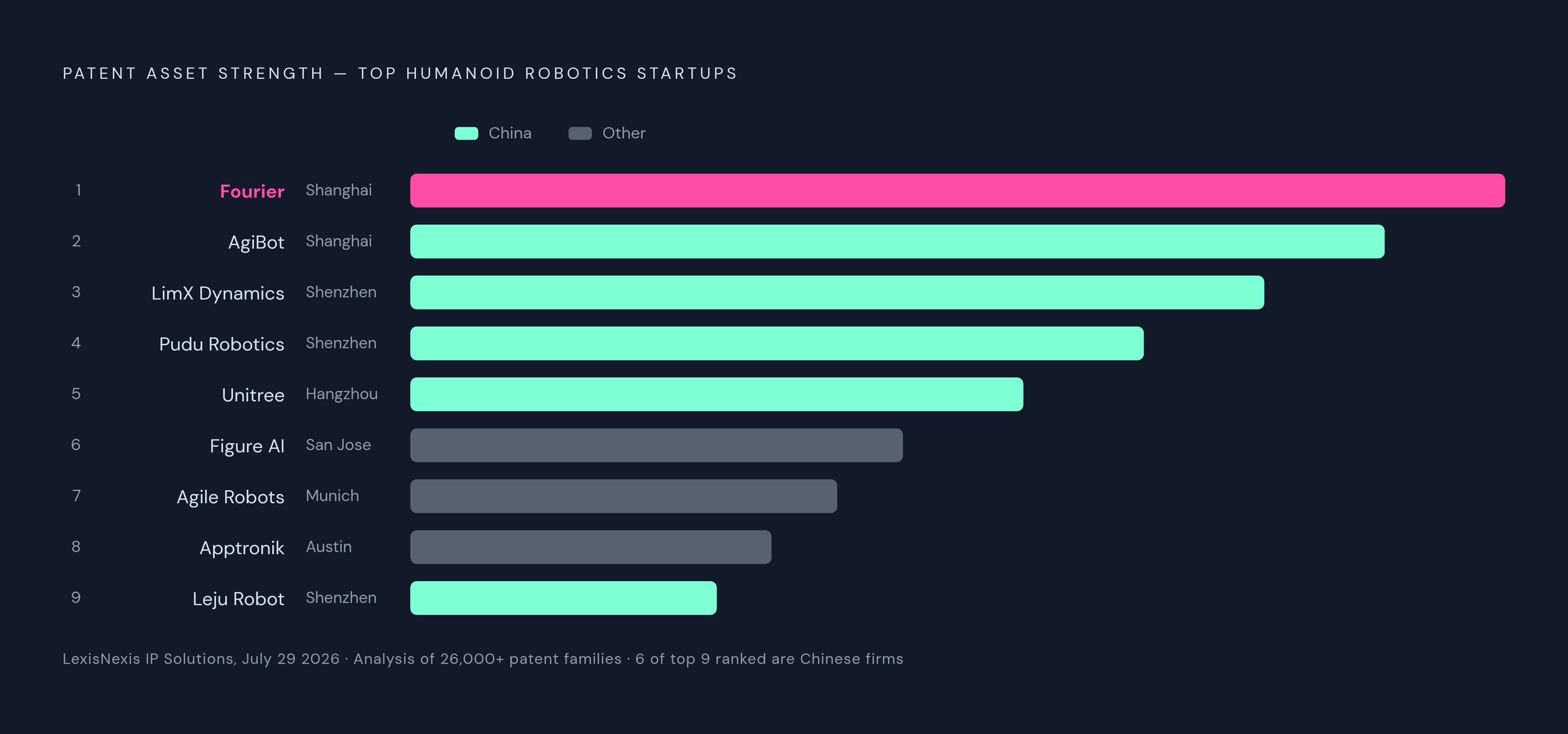
Sales figures and funding rounds are one measure of position. Patents are another, and LexisNexis Intellectual Property Solutions offered the most rigorous version of that measure yet, analyzing more than 26,000 patent families and publishing its Patent Asset Index ranking on July 29, 2026.
Of the top 10 humanoid robotics startups by patent strength, six are Chinese. Fourier ranks first, AgiBot second, LimX Dynamics third, Pudu Robotics fourth, and Unitree fifth, with Fourier and AgiBot based in Shanghai, LimX Dynamics and Pudu Robotics based in Shenzhen, and Unitree based in Hangzhou. Figure AI of San Jose comes in sixth, Agile Robots of Munich seventh, and Apptronik of Austin eighth, before Leju Robot of Shenzhen closes out ninth.
A ranking like this deserves a caveat that matters more than the list itself. Patent depth measures filed intellectual property, not shipped units, and not revenue. Fourier's first-place patent position sits somewhat apart from its sales figures, which trail Unitree's and AgiBot's by a wide margin. A company can hold the deepest patent portfolio in its category and still not be the company selling the most robots, because the race for intellectual property and the race for market share are not the same race, even when the same companies happen to be running both. What the ranking does confirm, without much room for argument, is where the innovation is concentrated geographically, and on that question the list is close to unanimous.
Sources
- China is running the EV playbook on humanoid robots — and it’s working
- China sweeps global humanoid robot start-up ranking as US imposes ban
- These 10 Chinese Robotics Startups Are Winning The Most VC Funding
- Global Times | Shanghai Stock Exchange to review Unitree Robotics IPO on June 1, with over 4.2 billion yuan fundraising plan | SHANGHAI STOCK EXCHANGE
- lexisnexisip.com