Stair Climbing Performance Across Humanoid Platforms
Deep Robotics and rivals are finally making stair climbing work.
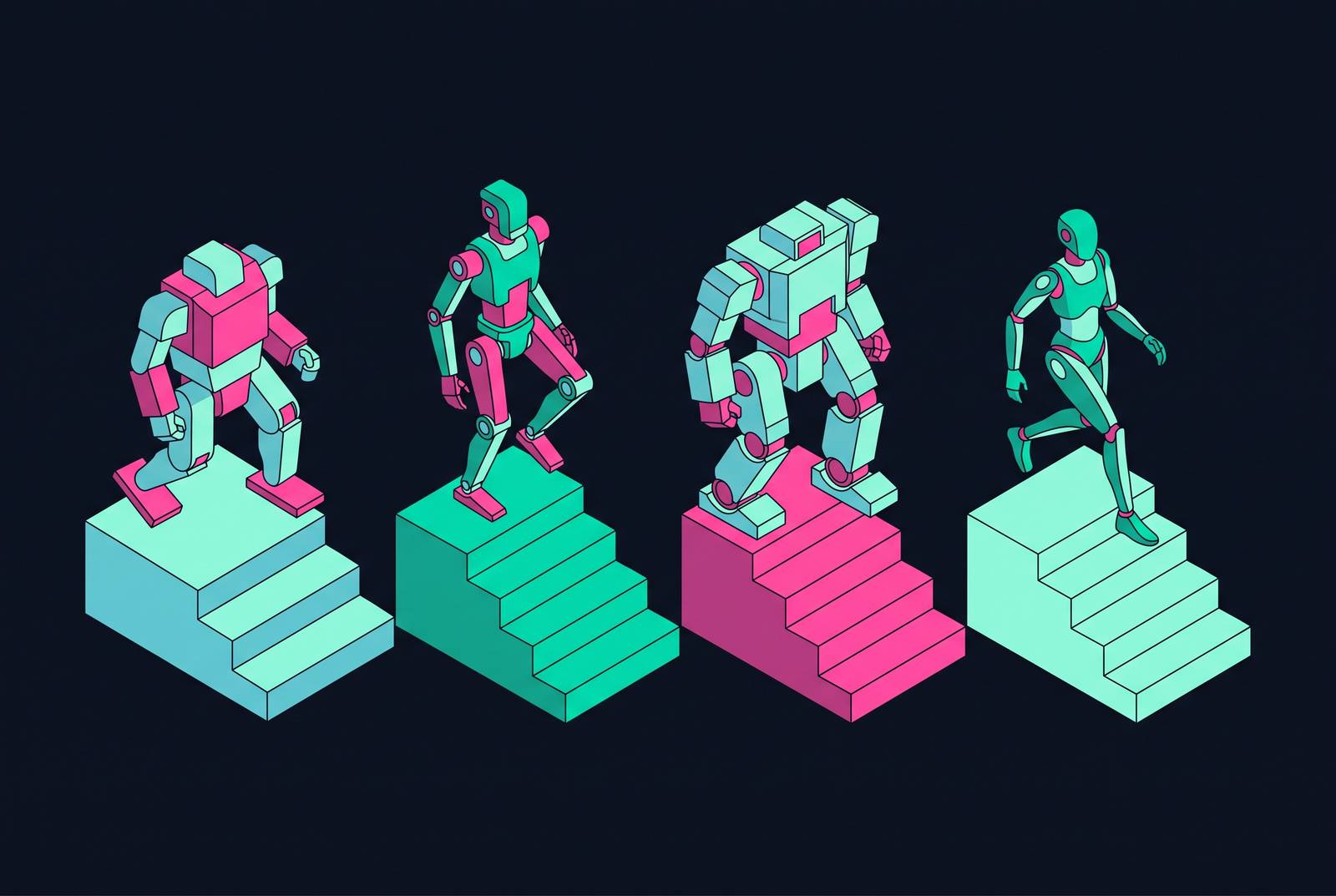
Stair climbing is where humanoid robotics moves from being a demo to being an infrastructure question, because the capability now determines deployment viability rather than serving as a showcase. Looking at how each platform on the market handles those four dimensions shows exactly where the field stands right now, and it's a more uneven picture than the highlight reels suggest.
Stair climbing as a capability threshold for humanoid robots
Buildings, tools, doorways, aisles: nearly everything in the built environment assumes a body shaped like a human's, and stairs are the clearest expression of that assumption. A robot that can climb them inherits access to that entire infrastructure without anyone needing to redesign a single hallway or loading dock for its benefit. That's the practical reason stair climbing gets used as a proxy for deployment readiness. A platform that handles a staircase is, by extension, demonstrating the same category of transition it will face stepping over a warehouse threshold, onto a factory catwalk, or across a construction site with uneven grading.
Walking up stairs takes a person no thought. And clearing that bar doesn't mean clearing every bar. Some of the platforms discussed below climb stairs competently but still struggle on gravel, slopes, or loose terrain, so "it can do stairs" is not shorthand for "it can go anywhere.""
The four technical dimensions that drive the gap between capable and struggling platforms
Start with perception. Can the robot actually sense the geometry of the step in front of it, the height of the riser, the depth of the tread, closely enough to act on that information, or is it relying on blind proprioceptive feedback and hoping the foot lands where it should? The main sensing tools in play are LiDAR, depth cameras, and RGB-D setups.
Second comes gait planning. Sensing the stair is one problem; turning that sensed geometry into an adjusted foot placement, the right swing-foot clearance, and the right stride timing, all in real time, is another. A system that just runs a pre-planned walking template regardless of what it sees is not really solving stair climbing, it's getting lucky on stairs that happen to match its assumptions.
Third is geometry conditioning, which is really a question about representation. Does the robot encode the terrain as a high-dimensional latent feature learned in training, as a heightmap, or as a small set of interpretable numbers, step height, step depth, yaw angle relative to the robot's own heading? This sounds like an implementation detail, but it isn't. If the robot sees step height, step depth, and yaw angle relative to its own heading as interpretable numbers, it generalizes to a staircase it has never seen before; if it relies on a raw heightmap or latent encoding tied to training, it only works on stairs shaped like the ones in its training set.
Fourth, and often the dimension that kills a promising lab result, is sim-to-real transfer. Policies trained in simulation have to survive contact with real sensor noise, and stair risers are a specific, known trouble spot: solid-state LiDAR hitting a riser at a steep incidence angle can lose its return signal entirely, effectively blinding the robot at the exact moment it needs data most. Two strategies occur repeatedly to close that gap: modeling the physics of that sensor noise directly during training, and improving perception robustness so it holds up when reality doesn't match the simulator.
Platforms with demonstrated stair climbing
Boston Dynamics' Atlas is the hardware outlier of the group. At 150 cm and 89 kg, it carries 56 degrees of freedom, more than any other production humanoid covered here, paired with LiDAR, stereo cameras, force and torque sensors, and 800 TFLOPS of onboard compute running on NVIDIA's Jetson Thor. Balance and body-motion control draw on IMUs, joint-position data, and force sensing working together. A January 2026 partnership to fold in Google DeepMind's Gemini Robotics foundation models, following a 2025 whole-robot large behavior model built with Toyota Research Institute, is aimed at broadening what Atlas can generalize to, stairs included, but the company hasn't published stair-specific numbers. Pricing is roughly $150,000 by one reported figure, though a second number has also circulated without confirmation from the company, and production remains limited after the CES 2026 unveil, with a 30,000-unit-per-year factory targeted for 2028. In short: the most hardware-capable platform in this review, but stairs specifically remain an inference from its broader agility claims, not a documented benchmark.
Unitree's H1 and H1-2 take a different route, leaning on raw locomotion performance. The H1 holds a confirmed world speed record for bipedal humanoid running, 3.3 m/s, about 7.4 mph, and produces 360 N·m of knee torque at a torque density of 189 N·m per kilogram. That torque figure matters more for stairs than it might seem: forceful knee extension through each step-up is close to a hard requirement for reliable ascent, especially once step height increases, so a robot built for speed also happens to be built with the leg strength stairs demand. The H1-2 variant carries 27 degrees of freedom, inherits the backflip capability, and costs $128,900 against the base H1's $99,900. The H1 runs a LiDAR and depth camera configuration, and demonstration videos show the platform on stairs, uneven ground, and outdoor terrain.
It walks at 2 m/s. Its torque budget tells its own story: a 139 N·m knee peak is enough to support stair climbing and stumble recovery, but the ankle tops out at just 50 N·m, and that asymmetry is a notable constraint for demanding stair maneuvers. An independent Fraunhofer IPA evaluation of the G1 EDU-4 with Dex3-1 hands, running firmware version 1.04 as delivered in May 2025, assessed the platform's performance across a range of real-world mobility challenges. Collision forces above 500 Newtons are possible, a level significant enough to raise safety considerations. And yet the G1 is, by a wide margin, the most studied commercial humanoid in the research literature, with more than 30 papers published on it in 2025 alone from groups at Caltech, SJTU, HKU, Cornell, and elsewhere. That gap between the shipped firmware and the published research is the single clearest illustration in this whole field of how fast software is outrunning any fixed hardware snapshot.
At 175 cm and 65 kg with 31 degrees of freedom (six per leg, seven per arm, three at the waist), it walks normally at 1.5 m/s and has hit 4 m/s in lab testing, while its dual arms carry a combined 10 kg payload. It's rated for continuous stair climbing on steps up to 25 cm and slopes as steep as 20 degrees. Its perception stack pairs one LiDAR with three depth cameras and one wide-angle camera, backed by 275 TOPS of AI compute, and it carries an IP66 rating for dust and water across the full body, the most weatherproofing of any platform in this comparison. On August 13, 2026, Deep Robotics released an 18-second, uncut video of the DR02 climbing a full outdoor concrete staircase, no handrails, no restarts, no human help. The timing landed alongside the company's roughly $367.4 million STAR Market IPO application, and the outdoor stair footage reads as evidence aimed squarely at investors that the platform is ready for real deployment in field conditions. That IP66 rating is what makes the claim credible beyond a single clean video, since real stairwells come with rain, construction dust, and temperatures ranging from -20°C to 55°C, conditions that would degrade a less sealed platform's sensors and joints over time.
What recent research shows about the approaches that work
Reinforcement learning and model-based planning have historically pulled in opposite directions on stairs. Model-free RL produces motion that's dynamic and fast but can turn genuinely unsafe on stairs when the reward for stability is only implicit; model-based foothold planners are safer but tend to be so conservative they give up the speed RL was supposed to buy in the first place. FastStair's answer is to stop treating those as separate options and instead fold a model-based foothold planner directly into the RL training loop, using the model-based foothold planner as an explicit stability reward that steers exploration toward footholds that are both dynamically feasible and safe. A LoRA fine-tuning step then bridges the gap between low-speed and high-speed action distributions without giving up the safety properties learned early on. Deployed on the Oli humanoid, this got stable stair ascent at commanded speeds up to 1.65 m/s and carried the robot up a 33-step spiral staircase with a 17 cm rise, a run that won the Canton Tower Robot Run Up Competition. Speed and stability aren't fundamentally opposed on stairs; they only look that way when the planning and learning layers aren't properly coupled. The field's conservatism is a design choice.
A separate line of research tackles how policies are conditioned on stair geometry directly. Most existing policies either bury terrain information inside a high-dimensional latent feature or fall back on blind proprioceptive feedback, and neither generalizes well once the stairs stop matching the training distribution. The alternative is to strip terrain representation down to a handful of interpretable numbers, step height, step depth, and the robot's current yaw relative to the stair, and condition a PPO-based locomotion policy on those directly. The payoff is a robot that adjusts swing-foot clearance and stride characteristics proactively, before contact, rather than reacting after a foot lands wrong. Tested on a real Unitree G1, this approach produced 33 consecutive outdoor steps without failure under difficult conditions, and in simulation it converged fastest and reached the highest final reward compared to a heightmap-based alternative, which landed somewhere in the middle. That generalization property is what actually matters for real buildings, since no two staircases in the world are built to identical dimensions.
PolygMap approaches the same problem from the perception side rather than the policy side. It takes raw depth and LiDAR data and turns it into a compact polygon map of the stair treads in real time, then erodes those polygons to find safe foothold candidates and plans whole-body stepping motions at 20 to 30 Hz, all on onboard compute. The logic behind it is straightforward: get the geometry right and precise enough, and the downstream planning becomes far more tractable.
LadderMan pushes the whole category of problem somewhere harder. Ladders strip away nearly everything stairs offer, footholds are sparse, handholds are required rather than optional, and the upper body has to coordinate with the legs rather than just balance them, all tested on a Unitree G1. The pipeline runs in two stages: first, hybrid motion tracking learns several distinct climbing experts from a single reference motion, then those experts get distilled into one unified, depth-based visuomotor policy through a combination of imitation learning and RL. It's a reminder that stairs, for all the engineering they demand, sit closer to the easy end of what vertical terrain can ask of a legged robot, and that the same four dimensions, perception, gait planning, geometry conditioning, and sim-to-real transfer, keep resurfacing as the axes the field is actually solving along, regardless of which structure a robot is trying to climb.
Sources
- China's Deep Robotics humanoid robot conquers real-world stairs, terrain
- LadderMan: Learning Humanoid Perceptive Ladder Climbing
- Explicit Stair Geometry Conditioning for Robust Humanoid Locomotion
- PolygMap: A Perceptive Locomotion Framework for Humanoid Robot Stair Climbing · Pith
- articsledge.com
- spectrum.ieee.org
- FastStair: Learning to Run Up Stairs with Humanoid Robots