Diffusion Policy for Robot Manipulation Tasks
A denoising approach to action generation solved robot manipulation's hardest problem.

Robot manipulation policies have spent years failing at a problem that sounds simple: pick up an object, put it down somewhere else, and do it in a way that survives contact with situations the robot never saw in training. Diffusion Policy changed that by treating action generation as denoising, borrowing the same math that runs image generators, and the result was one of the most striking jumps in reported success rates the field had seen. The rest of this piece traces why the older methods broke, how the diffusion reframe fixed it, and where the open problems still sit.
Why robot manipulation policies struggled before diffusion models
Manipulation is hard for a reason that has nothing to do with motors or sensors: there is rarely one correct action. A robot reaching for a mug can approach from the left or the right, both work fine, but a policy trained to average those two options aims for the dead space between them, which is wrong. That is the multimodal action distribution problem, and it stacks on top of two more headaches: continuous action spaces with many dimensions that all have to be right at once, and training procedures that are notoriously fussy to tune.
The earlier fixes looked fine on paper and fell apart in the lab. Gaussian mixture models and energy-based methods like Implicit Behavioral Cloning could, in theory, represent a distribution with several separate valid answers. What actually happened is they collapsed toward a single mode and ignored the rest, which defeats the point of modeling multimodality at all. GANs were the other candidate on the table, and they came with their own baggage: adversarial training that fights itself, plus a sensitivity to hyperparameters that made reliable, consistent results difficult to achieve. Neither approach gave the field a dependable route from a stack of human demonstrations to dexterous robot behavior. What was missing was a representation that could hold the full shape of expert behavior, multiple valid strategies intact, without collapsing during training.
Diffusion Policy's reframing of action generation as a denoising problem
Diffusion Policy, introduced by Chi, Xu, Feng, Cousineau, Du, Burchfiel, Tedrake, and Song at RSS 2023 and later published in the International Journal of Robotics Research (Vol. 44, No. 10-11, 2025, pp. 1684-1704), starts from a different premise than everything before it. Instead of asking a network to output the correct action directly, it asks the network to learn the gradient of the action distribution's score function, then uses that gradient to walk a noisy guess toward something plausible.
The mechanics split cleanly into two halves. During training, the forward process takes real expert action sequences and buries them in Gaussian noise, one step at a time, until nothing recognizable is left. The network's job is to learn how to undo that burial. At inference time, the reverse process starts from pure noise and runs a chain of stochastic Langevin dynamics steps, each nudged by the learned score function, until what began as static settles into something coherent and executable. That's the whole trick: instead of committing to one output in a single shot, the policy edges toward an answer the way a sculptor works, removing material rather than building it up from nothing.
What the original benchmark results showed
The original paper didn't test this on one task and call it a day. It ran across a broad range of tasks and benchmarks: simulated and real-world settings, single-task and multi-task setups, fully actuated and under-actuated systems, rigid objects and fluids.
An average success-rate improvement of 46.9% over the prior state of the art, averaged across every benchmark tested, is the number that matters. That size of jump does not come from tuning a learning rate or bolting on more data. It comes from a field having optimized around the wrong core assumption for years, and something arriving that fixes the assumption rather than patching around it. Diffusion Policy's advantage was never incremental. It was structural.
The inference speed problem that benchmark numbers obscure
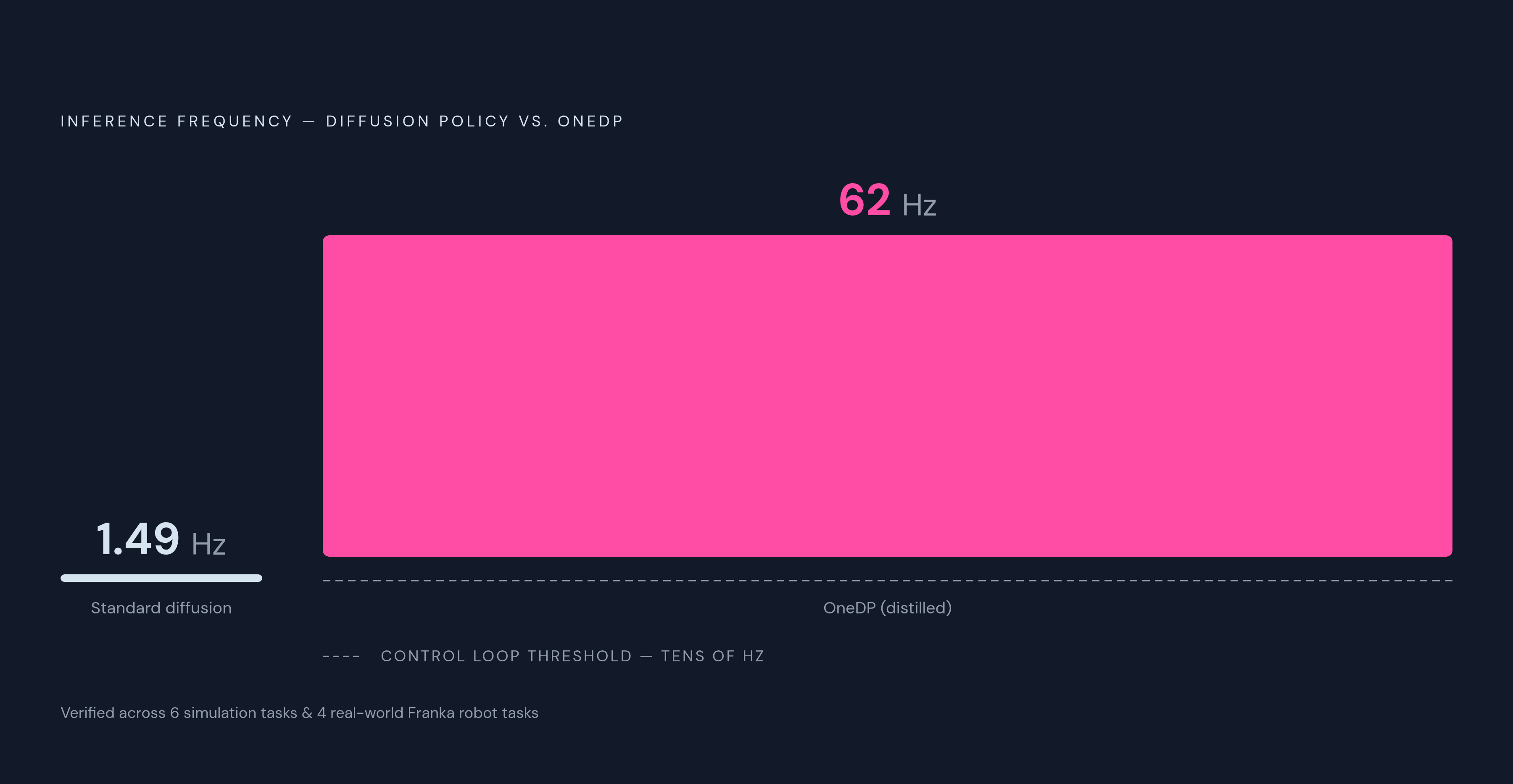
None of that comes free. A single denoising pass is cheap. Because a chain of dozens of them is costly to run, that arithmetic appears directly at deployment: traditional diffusion policies have been measured running at prediction frequencies as low as 1.49 Hz.
Set that number against what manipulation actually demands. Real control loops need to run at tens of Hz to keep pace with contact, disturbance, and the general disorder of a physical environment. At 1.49 Hz the robot is effectively blind between predictions, since the world keeps moving in the gaps the policy can't see. The workaround the field settled on is action chunking: run one diffusion pass to generate a whole sequence of future actions, then execute that sequence open-loop without re-planning in between. It buys temporal coherence inside the chunk, since the actions were generated together as a unit. It also means the robot can't react to anything that happens mid-chunk: an unexpected bump, a dropped object, contact it never planned for.
Distillation as the primary engineering fix for slow inference
NVIDIA's One-Step Diffusion Policy (OneDP), presented at ICML 2025 by Wang, Mandlekar, Xu, Zhu, and collaborators, is the clearest case of distillation solving the slow inference speed of diffusion policies outright. The idea borrows a trick now standard across generative modeling: take a fully trained, many-step diffusion policy as a teacher, and train a student network to minimize the KL divergence along that diffusion chain, so the student learns to jump straight to the answer the teacher only reaches after dozens of steps.
The distillation itself runs cheap. What it bought was not incremental: inference frequency rose from 1.5 Hz to 62 Hz, verified across 6 simulation tasks and 4 real-world tasks on a Franka robot. A policy sampling the world twice a second cannot close a real control loop, full stop. One running at 62 Hz can. Distillation doesn't change what the policy knows, it changes how fast the policy can act on what it knows, and for anything involving contact, that gap is close to the whole story.
Architectural variants that extend what diffusion policies can perceive and coordinate
Speed was one axis. Perception and scale are the other two, and different research lines have pushed on each separately.
3D Diffusion Policy (DP3), from Ze, Zhang, Xu and collaborators at RSS 2024, swaps RGB image conditioning for compact 3D point clouds. The reasoning is direct: tasks that need precise spatial judgment about occluded or oddly shaped objects benefit from explicit 3D structure rather than a flat image. The results back it up. It's since become a standard baseline, and a follow-on called RL-100 reports a 100% success rate after layering offline and online reinforcement learning fine-tuning on top.
Scale is the second axis. RDT-1B (Robotics Diffusion Transformer), from Liu, Wu, Li and collaborators at Tsinghua University, ICLR 2025, is the most direct attempt to push a diffusion policy toward foundation-model territory. It targets bimanual manipulation specifically, a domain where coordinating two arms and the general shortage of paired training data make any foundation-model attempt unusually hard. The backbone is a Diffusion Transformer (DiT): 28 layers, 32 attention heads, hidden size of 2048, 1.2 billion parameters total, making it the largest diffusion-based foundation model built for robotic manipulation so far. It was pre-trained on the largest multi-robot dataset collection available at the time, then fine-tuned on a self-collected bimanual dataset running over 6,000 episodes. A separate scaling effort, "Scaling Diffusion Policy in Transformer to 1 Billion Parameters for Robotic Manipulation" from Zhu and collaborators at ICRA 2025, landed at a similar parameter count from a different direction.
A third line attacks the problem through geometry instead of data volume. Equivariant diffusion policies, a cluster of 2024 and 2025 work including EquiBot (a SIM(3)-equivariant diffusion policy from CoRL 2024), the Equivariant Diffusion Policy line, and an SE(3)-equivariant policy formulated in spherical Fourier space, bake rotational and translational symmetry directly into the score network's architecture.
Building foresight and longer memory into diffusion policies
Standard diffusion policies carry a structural blind spot. They condition on a short window of recent observations and lean on an approximate Markov assumption, treating the current state as sufficient to pick the next action. That assumption fails in two directions at once. The policy can't reason about how the scene is about to change, and it can't recall something that happened earlier in a long task that might still matter.
ForeDiffusion goes after the forward-looking half. It injects predicted future-view representations straight into the diffusion process, so the policy conditions not just on where the scene is but on where it's headed. Training uses a dual loss, the usual denoising loss combined with a consistency loss measured against future observations, learned jointly rather than staged. On the Adroit suite and MetaWorld, it hit an 80% average success rate overall, and beat mainstream diffusion methods by 23% specifically on complex tasks. That gap between the overall number and the complex-task number is the real finding: foresight barely matters on easy tasks and matters a great deal on the ones where small errors compound across a long chain of contact-heavy steps.
Memory is the backward-looking half of the same fix. Research examining diffusion policy memory and context appeared in June 2026. Policies that only see a short history can get stuck looping, repeating a motion that already failed because nothing in the recent window tells them so. How much context is actually enough, and what it costs computationally to hold onto it, remains unresolved. Foresight looks ahead of the current frame, memory looks behind it, and both are patching the same Markov shortcut from opposite ends.
Contact-rich manipulation and the integration of tactile feedback
Contact is where diffusion policies hit their hardest test. Unmodeled interactions, force transients that spike in milliseconds, objects that slip or fracture mid-grasp: these events move faster than any denoising chain can track through vision alone, no matter how fast that chain runs.
The answer has been a slow-fast hierarchy, and Reactive Diffusion Policy states it most clearly, pairing a diffusion-based planning component with a high-frequency tactile or force correction loop that adjusts execution in real time, catching what the planner never saw coming. TacDiffusion takes a related but narrower approach, building a force-domain diffusion policy purpose-built for precise tactile manipulation. FA-RDP (A Frequency-Adaptive Reactive Diffusion Policy for Contact-Rich Manipulation), expected in 2026, pushes the slow-fast pattern further by letting the correction loop adjust its own rate instead of running at a fixed frequency regardless of what the contact actually demands.
All three efforts trade against the same weakness. Diffusion gives manipulation policies a principled way to represent uncertainty and hold multiple valid strategies at once, and every line of research covered here is spending engineering effort against the one cost that comes with it: iterative refinement takes time, and the physical world doesn't always wait around for it.
Sources
- ForeDiffusion: Foresight-Conditioned Diffusion Policy via Future View Construction for Robot Manipulation
Provided the ForeDiffusion results including the 80% success rate and 23% improvement on complex tasks.
- https://icml.cc/virtual/2025/poster/45971
Confirmed NVIDIA's OneDP (One-Step Diffusion Policy) presentation at ICML 2025, which the article cites for the 62 Hz inference result.
- https://arxiv.org/html/2303.04137v5
Provided details of the original Diffusion Policy paper including its authors, publication venue, and benchmark methodology.
- https://journals.sagepub.com/doi/full/10.1177/02783649241273668
Sourced the publication details of Diffusion Policy in the International Journal of Robotics Research, including volume, issue, year, and page numbers.
- https://arxiv.org/abs/2303.04137
The original Diffusion Policy paper, providing the core method, benchmark results, and the 46.9% improvement figure.
- https://arxiv.org/pdf/2303.04137
Source for the 46.9% benchmark improvement figure cited in the article.
- https://github.com/YanjieZe/3D-Diffusion-Policy
Provided the DP3 (3D Diffusion Policy) project details including the RL-100 follow-on result of 100% success rate.