Teleoperation Data Collection for Dexterous Skill Training
Teleoperation interfaces are the bottleneck limiting how fast robots can learn dexterous skills.
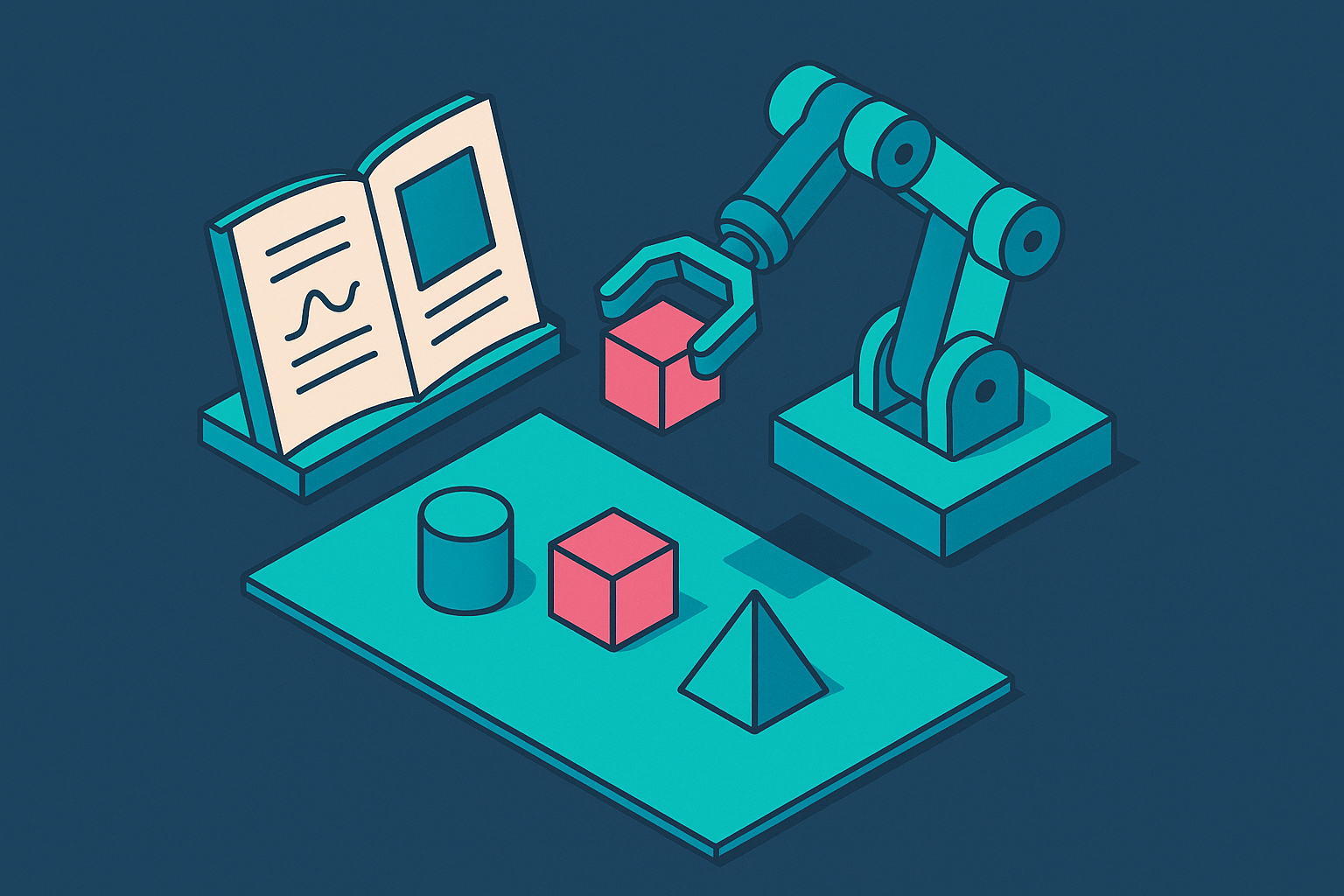
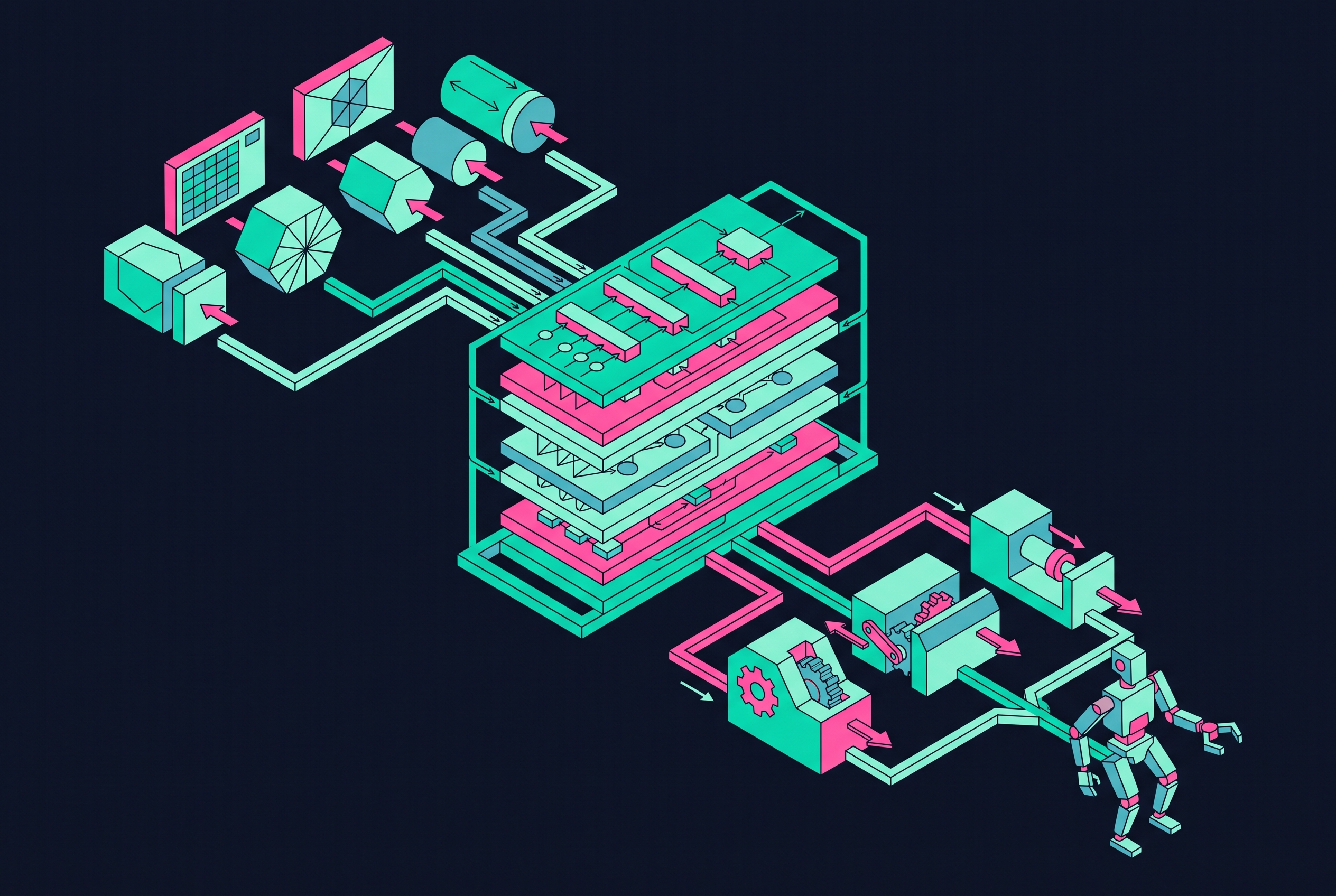
Robot learning has a data problem, and it is not the kind that more compute or a bigger model fixes. Synchronized joint angles, gripper forces, camera frames, and task context have to be physically recorded, one episode at a time, on real or simulated hardware. There is no internet-scale corpus of this to scrape. That ratio alone tells you the field is data-starved relative to the machines it's trying to teach.
Teleoperation sits at the center of this because it's the highest-fidelity way to generate the paired sensorimotor data a policy needs, and it is the slowest. That's a hard ceiling, not a soft average, and it means the efficiency of the interface sitting between the operator and the robot has an outsized effect on how much usable data a lab can produce in a given month. Simulation and human video exist as alternative sourcing strategies, but neither substitutes cleanly. Industry estimates put the exchange rate at roughly eight simulated samples to match the value of one teleoperated sample on in-domain tasks, and for contact-rich dexterous work, the gap widens further.
So the practical lever isn't "collect more data" in the abstract. The practical lever is choosing, building, and refining the interface that mediates between a human's intent and a robot's joints, because that choice determines throughput, error rate, and what kinds of skills can be demonstrated. This piece maps the major interface families now in use for dexterous skill collection, what each one trades away, and how those trade-offs surface downstream in trained policies. It does not crown a winner, because there isn't one; the right interface depends on the task, the robot, and the scale a team is trying to hit. Scale gap: over 3.9 million industrial robots operating globally (IFR World Robotics, 2024), yet the largest open robot manipulation dataset contains roughly 1 million episodes (Open X-Embodiment). Throughput ceiling: teleoperation produces 5–50 episodes per operator-hour even under good conditions (a hard rate limit that makes interface efficiency matter enormously) Robot Training Data Strategy: Teleoperation vs Simulation vs Human Video for Embodied AI | Shaip.
What makes dexterous skill demonstrations harder to capture than simple pick-and-place
Parallel-jaw pick-and-place is a comparatively forgiving demonstration task. Dexterous manipulation is not. It demands simultaneous command of high-dimensional finger articulation alongside global six-degree-of-freedom arm motion, and operators must regulate contact forces that they usually can only judge by eye. There's no haptic sense of how hard a robot's fingers are squeezing an object unless the interface explicitly feeds that signal back.
Multi-fingered robot hands compound the problem because they simply are not built like human hands. Link geometry, joint axes, range of motion, and actuation compliance all differ, so mapping a human hand's motion onto a robot hand, the process called retargeting, is a genuinely hard problem rather than a matter of scaling coordinates. Cognitive load piles on top of the mechanical mismatch: operators work with imperfect camera viewpoints, reduced depth perception, and the burden of coordinating many joints at once, a combination researchers behind the DexDirect system describe as a major source of operator fatigue and error.
As a result, dexterous demonstration collection tends to be slow, heavily dependent on the individual operator's skill, and difficult to scale. That is why diverse, high-quality dexterous datasets remain scarce even as demand for them grows. None of this is a software problem that a better policy architecture can quietly absorb. The interface mediating the human-to-robot handoff is itself a major source of variance in the data, and that variance propagates directly into whatever gets learned from it.
The two structural families of teleoperation interfaces
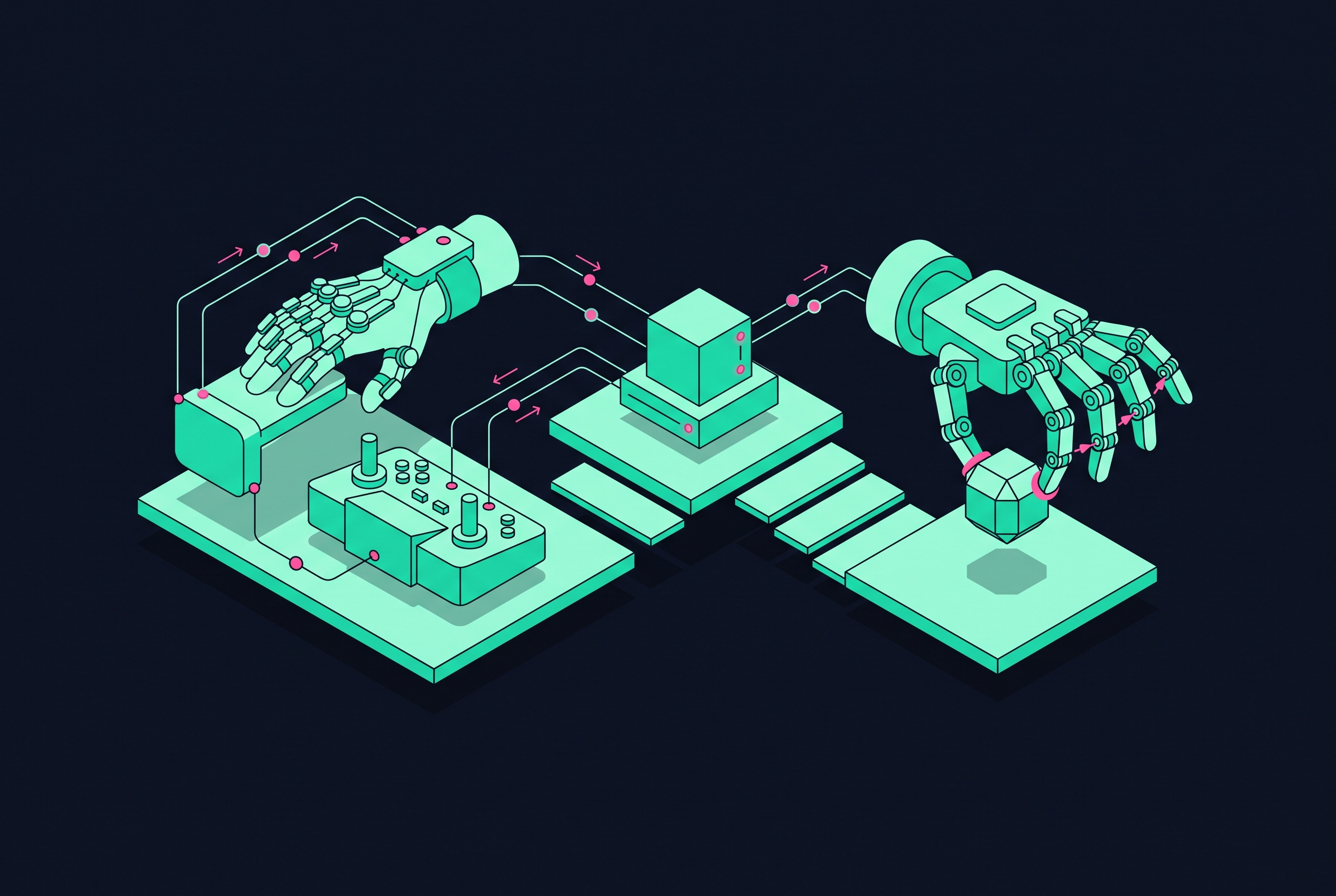
Broadly, teleoperation interfaces split into two structural families, such as ALOHA/ALOHA 2, Mobile ALOHA, GELLO, and Echo. The first is the isomorphic, or kinematic-replica, approach: build a physical copy of the robot's own kinematic structure, let the operator move it directly, and have the robot mirror joint positions one to one. ALOHA and ALOHA 2, Mobile ALOHA, GELLO, and Echo all belong to this family. Because the leader device shares the robot's joint geometry, there's minimal translation between what the operator does and what the robot executes, which makes for high precision on fine motor tasks and a short learning curve. The cost is that the hardware is built per robot, so expenses scale with the number of embodiments a lab supports.
The second family is versatile, or IK-based: it infers an end-effector pose from VR controllers, gloves, vision, or inertial sensors, and the robot follows that pose through inverse kinematics. VR and XR headsets, motion-capture gloves, and vision-based hand tracking all fall here. This family is far more cross-platform since the same operator rig can, in principle, drive different robots. But inverse kinematics introduces latency and accuracy limits, the mapping is less intuitive for the person doing the operating, and retargeting errors bleed directly into the collected data.
Kinesthetic teaching, physically grabbing the robot's arm and guiding it through a motion, sits outside both families. It skips the proxy device entirely, which removes an entire category of translation error, but it demands physical effort from the operator and doesn't transfer to a different robot without re-rigging the setup. The structural distinction between these approaches matters less as a taxonomy exercise and more as a predictive tool: knowing which family an interface belongs to tells you in advance whether its main error source will be joint-space fidelity, IK retargeting noise, or missing force representation.
Leader-follower arms: throughput at scale and the bimanual advantage
ALOHA 2, released in 2024, improved the gripper design, operator ergonomics, and robustness over the original.
The clearest evidence that this family scales past a research lab came from ALOHA Unleashed, a 2025 CoRL paper out of Google DeepMind ALOHA Unleashed, Google DeepMind, 2025 CoRL.
Mobile ALOHA pushed the same idea into whole-body teleoperation by adding a mobile base, and with just 50 demonstrations per task, co-training lifted success rates by as much as 90% on complex mobile manipulation tasks DexDirect. RoboCopilot, from Wu and colleagues in 2025, took the kinematic-replica idea in a different direction, building a bimanual system tuned for interactive imitation learning that lets control switch seamlessly between a human operator and an autonomous policy mid-task. What ties this family together is that the throughput advantage comes directly from the intuitiveness of joint-space mirroring: operators pick it up fast, non-experts can be trained into the operator pool, and the whole protocol can be standardized across sites. The trade-off between fast, standardizable training and retooling cost when robot embodiment changes holds, though. When the robot embodiment changes, so does the leader hardware, and that retooling cost doesn't disappear just because the approach works well. ALOHA (Stanford): sub-$20,000 hardware cost for the leader-follower pair; bimanual design captures two-handed tasks single-arm systems cannot Embodied AI Data Collection: Teleoperation Guide (2026).
VR and XR headsets: cross-embodiment flexibility and the simulation bridge
Industrial users got here first, in a sense. Baker Hughes in 2021 and Boston Dynamics in 2023 both described their XR teleoperation work explicitly as structured data collection for training autonomous policies, not merely as a remote-operation convenience. That framing matters: it signals that headset-based teleoperation was always meant to feed a learning pipeline, not just extend a human operator's reach.
Bunny-VisionPro, from Ding and colleagues at IROS 2025, demonstrated real-time bimanual dexterous teleoperation using an Apple Vision Pro headset aimed squarely at imitation learning, effectively proving out a production-ready VR pipeline for dexterous hands. The DexVerse benchmark, released in 2026, was a VR-based pipeline at scale. It integrated the Vision Pro through Isaac Lab's CloudXR-based teleoperation interface, streaming simulated feedback to the operator while capturing hand and wrist pose for IK-based robot control, and used optimization-based dex-retargeting to handle embodiment adaptation systematically. The project produced 3,180 trajectories spanning 61 tasks and 6 different hand types, each carrying synchronized multimodal observation streams, including proprioception, RGB, depth, point-cloud, and simulator state together.
The same operator setup can, through retargeting, target multiple robot hands, which matters enormously for labs juggling several embodiments at once. But the structural weakness sits in exactly the same place. Retargeting from a human hand to a robot hand is where morphological mismatch enters the data stream, and IK latency plus pose estimation error introduce fidelity problems that leader-follower rigs simply don't have to contend with. NVIDIA has leaned into this trajectory directly: Isaac Lab version 2.3 explicitly expanded its teleoperation tooling for data collection and added features supporting dexterous manipulation tasks, with clear integration points for VR-based pipelines.
MoCap gloves and exoskeletons: force fidelity and the calibration cost
For humanoid training pipelines specifically, exoskeleton-based teleoperation is the interface Shaip's 2026 guidance recommends for dexterous manipulation. DexCap, from Wang and colleagues in 2024, built a scalable and portable motion-capture system that records human hand motion for direct transfer to robots, and Prometheus, described in a paper by Satsevich and colleagues, went a step further by adding force feedback to a universal, open-source MoCap-based teleoperation system built on consumer-grade HTC Vive Trackers 2.0.
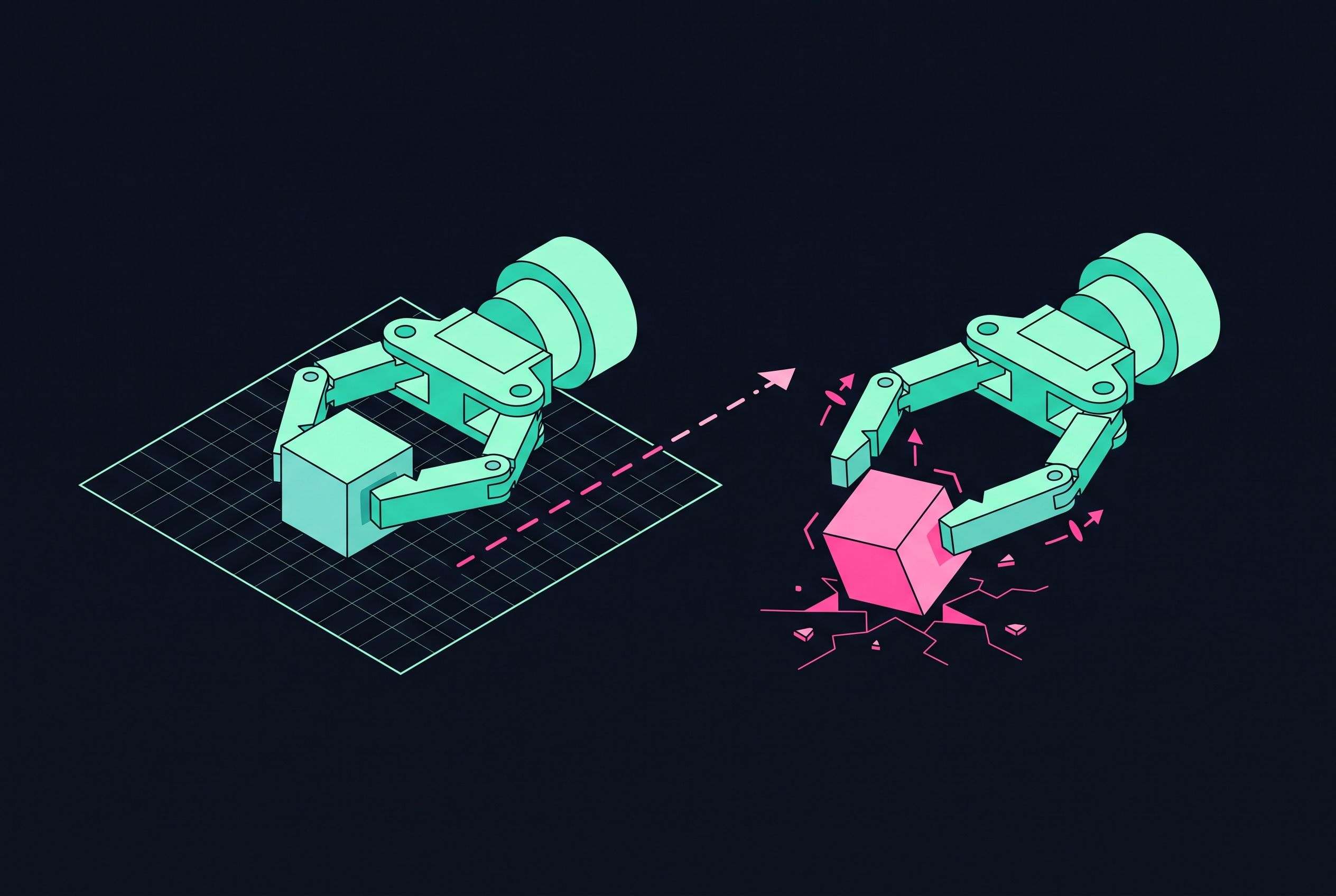
Prometheus solves the problem of controlling gripper force cheaply. It pairs custom-built force-sensitive fingers on a Robotiq gripper with a real-time compression-force signal sent back to the controller, so the operator actually feels how hard the gripper is squeezing, and the entire system, hardware, PCB specs, firmware, deployment instructions, is open-sourced. That matters because force feedback isn't a nicety. Without it, both the human operator and the policy trained on their demonstrations tend to apply excessive gripping force, which deforms objects and bakes physically invalid behavior straight into the dataset. DexForce, from Chen and colleagues in a 2025 IEEE RA-L paper, extracted force-informed actions directly from kinesthetic demonstrations, which is adjacent evidence for the same conclusion: the force signal in a dataset changes what a policy can actually learn to do. RH20T shows this can scale, too, with over 110,000 multimodal manipulation sequences collected using interfaces equipped with force-torque sensors and haptic feedback RH20T dataset.
The catch with MoCap gloves and exoskeletons is calibration. These systems generally require fitting to the individual operator, the rigs are hard to relocate once set up, and that operator-specific tuning caps how large an operator pool can realistically get. A lab can have the most force-faithful interface available and still be bottlenecked by how many people it can calibrate into the system.
Kinesthetic teaching and novel low-cost interfaces: reducing setup barriers without sacrificing fidelity
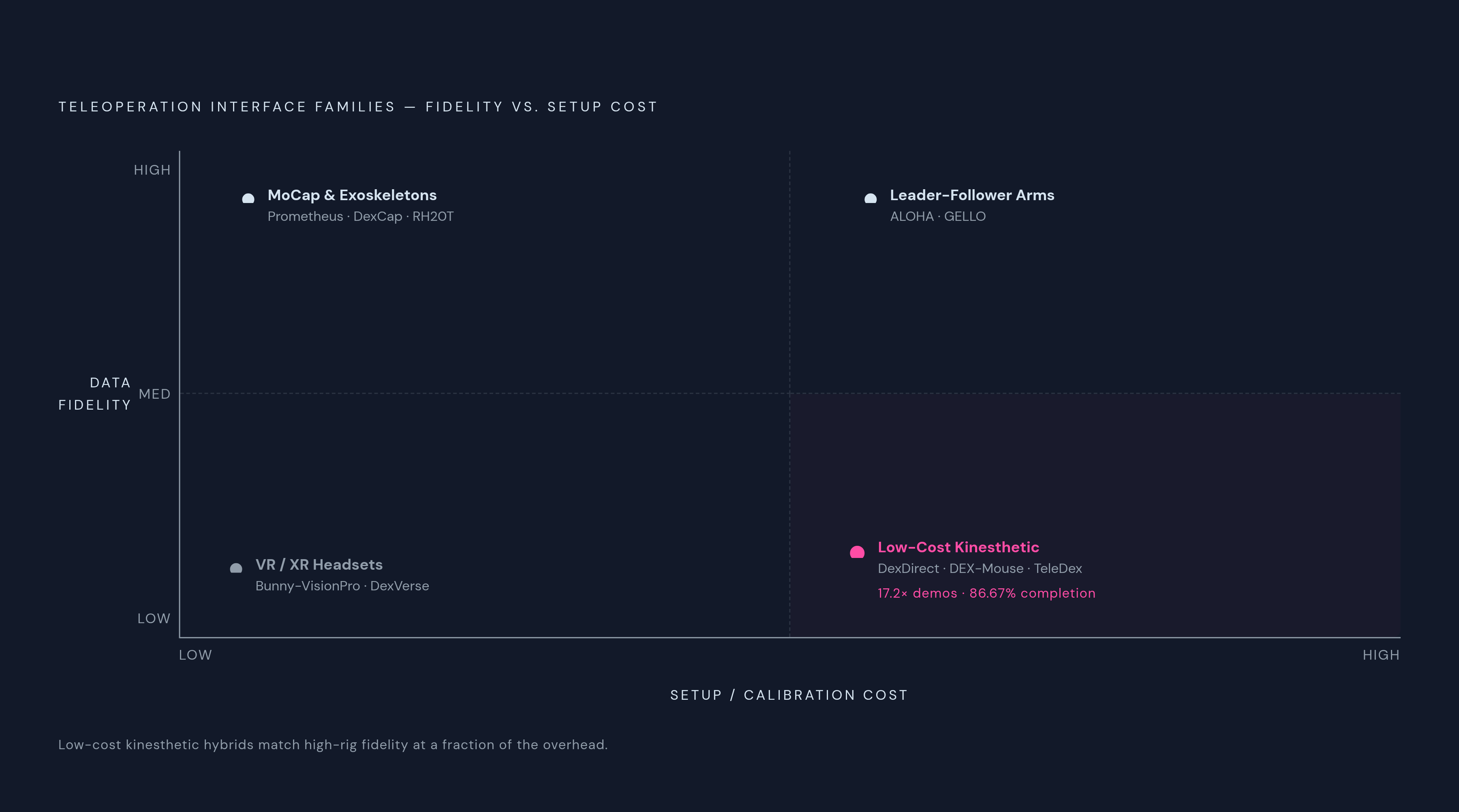
A newer cluster of interfaces is trying to get the fidelity of exoskeletons and the intuitiveness of kinesthetic guidance without either one's overhead. DexDirect, from Kim and colleagues at UCLA, is a useful example of the hybrid logic at work: the operator drags a gravity-compensated six-degree-of-freedom arm directly by a handle, while a single webcam retargets the operator's other hand onto a 16-joint, 13-degree-of-freedom dexterous hand. A diffusion policy trained on the resulting data reached a 90% success rate on cube pick-and-place DexDirect. The design logic is that kinesthetic arm guidance sidesteps the entire proxy-tracking loop, latency, pose error, workspace mismatch, while webcam-based finger retargeting sidesteps exoskeleton calibration cost.
DEX-Mouse, from Koh and colleagues, pushes the cost even lower. It needs no per-operator fitting or structural modification, and one configuration mounts the target robot hand directly on the operator's forearm, which produces data already aligned to the robot and simplifies retargeting down to a proportional mapping. That "forearm-attached" configuration hit an 86.67% task completion rate in a comparative user study, and it also reduced perceived operator workload compared to every spatially separated setup it was tested against DEX-Mouse. It, too, is fully open-sourced.
TeleDex, described by Rayyan and colleagues in 2026, lowers hardware and setup barriers further still and adds the ability to collect demonstrations during deployment itself, which supports fine-tuning a policy that's already running. Open Teach, from Iyer and colleagues at CoRL 2024, offers a versatile general-purpose teleoperation system, and AnyTeleop, from Qin and colleagues at RSS 2023, established an earlier general vision-based approach to dexterous arm-hand teleoperation. The pattern across this whole cluster is unmistakable: cost and setup friction are dropping fast, and the frontier has shifted toward matching or beating the data quality of expensive, calibration-heavy rigs without carrying their overhead. User studies: DexDirect collected 17.2× more successful demonstrations than purely vision-based (AnyTeleop) and 3.2× more than pose-tracking (TeleDex) baselines.
How the choice of interface shapes what a policy can learn
No interface is neutral with respect to the data it produces. The choice determines which sensor modalities show up in the dataset, how much force is captured at all, how much motion noise creeps into joint trajectories, and what the action space looks like to a learning algorithm downstream. Leader-follower systems deliver high-fidelity, low-noise joint-space trajectories, but typically carry no force signal unless someone has gone out of their way to instrument it separately. VR and IK-based systems capture end-effector pose and can bundle in rich, synchronized multimodal streams, the way DexVerse combined proprioception, RGB, depth, point-cloud, and simulator state, but retargeting error rides along as morphological noise baked into every trajectory. MoCap systems with force feedback, Prometheus and RH20T among them, add a contact-force channel that qualitatively changes what a contact-rich policy can even represent. Kinesthetic systems like DexDirect guarantee the arm trajectory is physically executable by the robot by construction, since it was the robot's own arm being moved, while finger data still comes in through vision-based retargeting.
Tactile sensing is emerging as the next modality gap the field is closing deliberately rather than by accident. DexTac builds contact-aware visuotactile policies through hand-by-hand teaching, and KineDex, from Zhang and colleagues in 2025, folds tactile information into visuomotor policies learned via kinesthetic teaching. VTDexManip, presented at ICLR 2025, assembled the first visual-tactile dataset built specifically for complex manipulation skill learning, 565,000 frames across 10 daily tasks and 182 objects, which shows the modality gap is now being addressed at the dataset-construction stage rather than patched over later VTDexManip (ICLR 2025).
None of this is abstract once you look at how specific policy architectures consume the data. ACT, the architecture behind ALOHA Unleashed, predicts action chunks spanning 50 actions, roughly a one-second trajectory window, which rewards smooth, temporally consistent leader-follower demonstrations and punishes jittery ones. Diffusion Policy, described by Chi and colleagues in a 2025 IJRR paper, trains directly on leader-follower teleoperated demonstrations and now serves as a standard baseline across recent benchmarks. RT-2, from Brohan and colleagues in 2023, was fine-tuned on 130,000 teleoperated episodes and picked up emergent generalization to instructions it had never seen. OpenVLA, from Kim and colleagues in 2024, trained on 970,000 episodes pooled from Open X-Embodiment and beat RT-2-X by 16.5 percentage points on real robot evaluation. The lesson generalizes past any one paper: a team picking an interface needs to trace the choice forward to the policy architecture it plans to train, because the data format an interface produces has to match what that learning algorithm actually needs to see.
The effect of operator quality and feedback loops on data value across interfaces
Interface design sets the ceiling, but the operator sitting inside that interface still decides how close the data comes to it. A leader-follower rig in the hands of a fatigued or careless operator produces the same jittery, inconsistent trajectories that a poorly calibrated IK pipeline does, and no amount of hardware precision corrects for a human who's rushing through a session to hit an episode quota. The ALOHA Unleashed protocol worked at the scale it did because it built a structure for non-expert operators to work independently and consistently over eight months ALOHA Unleashed, Google DeepMind, 2025 CoRL.
Force feedback interfaces make this dependency more visible, not less. Prometheus lets an operator feel gripping force directly, but that only improves the data if the operator responds to the feedback rather than ignoring it under time pressure. The same is true of DEX-Mouse's kinesthetic feedback and DexDirect's gravity-compensated arm guidance. Each interface offers information back to the operator, and the value of that information depends entirely on how attentive the person on the other end is to act on it.
Scale magnifies whatever variance exists in operator behavior. A single skilled operator on a well-tuned leader-follower rig can produce demonstrations that outperform a much larger batch collected by an inconsistent operator pool. DexDirect's user studies measured successful demonstrations when comparing interfaces. Throughput numbers alone, 5 to 50 episodes an hour, or 26,000 episodes across 35 operators, describe volume, not quality ALOHA Unleashed, Google DeepMind, 2025 CoRL DexDirect. The interface determines what's possible to capture. The operator, and whatever feedback loop the interface gives that operator, determines how much of that possibility actually ends up in the dataset.
Sources
- DexDirect: Direct Kinesthetic Arm Guidance for Efficient Dexterous Demonstration Collection
Provided the DexDirect system's design logic, operator fatigue findings, success rate figures, and comparative demonstration throughput statistics cited throughout the article.
- DEX-Mouse: A Low-cost Portable and Universal Interface with Force Feedback for Data Collection of Dexterous Robotic Hands
Provided details on the DEX-Mouse interface, including its forearm-mounted configuration, 86.67% task completion rate, and reduced operator workload findings.
- Prometheus: Universal, Open-Source Mocap-Based Teleoperation System with Force Feedback for Dataset Collection in Robot Learning
Provided details on the Prometheus system, including its force-feedback mechanism, open-source hardware, and HTC Vive Tracker-based MoCap teleoperation design.
- Robot Training Data Strategy: Teleoperation vs Simulation vs Human Video for Embodied AI | Shaip
Provided the throughput ceiling figure of 5–50 episodes per operator-hour and the recommendation of exoskeleton interfaces for humanoid dexterous manipulation pipelines.
- Streamline Robot Learning with Whole-Body Control and Enhanced Teleoperation in NVIDIA Isaac Lab 2.3 | NVIDIA Technical Blog
Provided information on Isaac Lab 2.3's expanded teleoperation tooling, including VR-based pipeline integration and dexterous manipulation support.
- Embodied AI Data Collection: Teleoperation Guide (2026)
Provided the sub-$20,000 hardware cost figure for the ALOHA leader-follower pair and context on bimanual design advantages.
- DexTac: Learning Contact-aware Visuotactile Policies via Hand-by-hand Teaching
Provided the basis for DexTac's contact-aware visuotactile policies learned through hand-by-hand teaching, cited in the section on tactile sensing.