Tactile Sensing in Humanoid Robot Fingers
Robots struggle to grasp objects safely without sensing friction and slip, not just pressure.
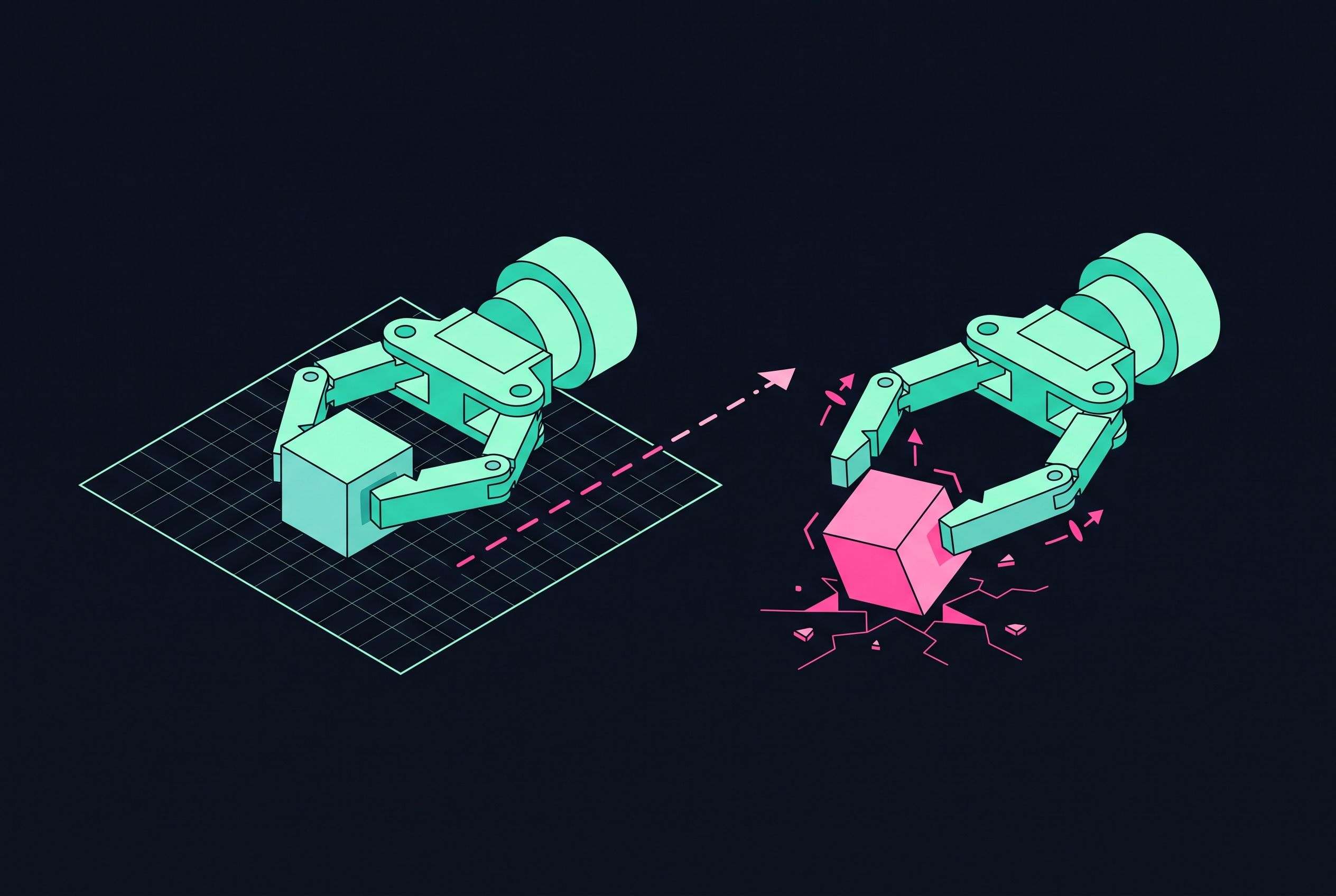
A human hand grasps reliably because it reads at least five things at once: how hard the finger presses (normal force), the lateral load pulling sideways across the skin (shear force), the first sign that an object is starting to slide (slip onset), the fine texture of the surface, and what material it is actually touching. A robotic finger that only measures how hard it is pressing can confirm that contact has happened, but it has no way to tell whether the object is about to slip out of the grip, whether the fingertip is deforming unevenly, or whether the grip needs correcting before the object falls. A 2025 ACM paper on dexterous hand design finds that sensors which detect pressure but not friction force leave dexterous hands liable to slip when grasping objects with smooth surfaces. That single finding explains why so much current research treats tactile sensing as a multi-signal problem rather than a single-number one.
The scale of the challenge becomes clear against the biological benchmark. A human hand has approximately 27 degrees of freedom and thousands of tactile receptors with fine force control, while current robotic hands achieve only approximately 11–16 degrees of freedom with limited tactile sensing. That mechanical shortfall gets most of the attention, but coverage of the F-TAC Hand points to something more specific: robotic systems have struggled to match human performance in dynamic settings primarily because of inadequate tactile feedback, not inadequate motors or joints. The rest of this piece examines sensing, not actuation: normal force, shear, slip, texture, and material identification, and how different sensor technologies attempt to deliver all five inside a fingertip small enough to actually use.
Vision-based (optical) sensors and deformation inside a soft fingertip
Optical tactile sensors take an indirect route to measuring touch. Instead of reading an electrical change at the point of contact, they place a small camera inside a soft, elastomeric fingertip and read the pattern that internal lighting casts across a deforming surface as it presses against something. The fingertip's skin bends; the camera watches how the bending changes the light; software turns that image into a map of forces across the contact surface.
MIT's GelSight research established this approach, and later generations of the technology have steadily added new sensing modes while shrinking the hardware into smaller packages. Meta FAIR's Digit 360, built and distributed by GelSight Inc., shows how far that progression has gone: the finger packs more than 18 separate sensing functions, can detect forces as small as one millinewton, and relies on an optical system with more than 8 million measurement points. Digit 360 doesn't stop at force. It also senses vibration, detects heat, and can pick up odor, extending what a single fingertip can report well beyond touch in the traditional sense.
The approach also scales beyond a single digit. MIT's ROMEO finger design, from Liu and Adelson, extends the same optical principle into underactuated two-segment soft fingers with a modular, low-cost flexible illumination system, and pairs those fingers with a compliant palm that also has GelSight-inspired sensing, demonstrating that the approach can scale across a full hand rather than just a single fingertip. That pairing matters because it shows the optical method working across an entire hand rather than staying confined to a single fingertip prototype.
Measured against the five requirements, optical sensors handle normal force and texture well, since the deformation image encodes both as visible distortion in the elastomer. Shear force and slip detection are harder. Both depend on tracking how marker points embedded in the gel move across successive camera frames, and that tracking adds processing time that a faster-reacting system would not need. Material identification is harder still, since the sensor has no direct channel for it and must infer material properties from how the deformation pattern behaves. The deeper constraint, though, is physical rather than computational. A Frontiers in Robotics and AI analysis notes that optical sensors need real space for the camera, the optics, and the internal lighting, and that volume requirement is often more than a compact gripper finger can spare. That space problem pushes designers toward a different physical principle.
Flexible piezoresistive arrays across the finger surface
Piezoresistive arrays avoid the space constraints of a camera altogether, using a grid of conductive or resistive material that changes its electrical resistance under pressure, and because the whole array can be made thin and flexible, it wraps around the curved surface of a finger pad rather than needing a cavity carved out behind it.
A 2025 ACM paper demonstrates how far that flexibility can be put to use at the scale of an entire hand: its piezoresistive array design uses a 16×16 grid across the palm and a 4×4 grid on each of the four non-thumb fingers, giving the hand continuous sensing coverage across both palm and digits built from one consistent architecture. That coverage matters because the same paper's grasping control system draws on the pressure distribution across the full array, rather than any single point reading, to adjust the grip in real time, which is how broad array coverage turns into a grip that corrects itself rather than one that simply reports contact after the fact.
The approach is already shipping in production hardware. The Psyonic Ability Hand, which Apptronik uses in its Apollo humanoid, carries 37 tactile and positional sensors, including six force-sensitive resistors on each finger plus vibration-based haptic feedback, and the same underlying hardware already serves in prosthetic devices as well as humanoid robots.
Against the five-requirement standard, piezoresistive arrays are strongest exactly where optical sensors are reliable but space-constrained: normal force. A simple resistive grid reads pressure magnitude well across a wide area. Shear force is a weaker point, because a basic grid registers how much force is applied but not which direction it came from. Slip can be inferred by watching how the pressure pattern changes over consecutive readings, but that inference is less direct than a sensor built specifically to detect lateral motion. Texture sensing depends entirely on how dense the array is: a coarse grid misses fine surface detail that a denser one would catch. A related family, flexible capacitive tactile sensors, shows where this physical principle runs into trouble: IDTechEx's 2025 research notes that these sensors are attractive for their adaptability but lose reliability as humidity and temperature shift, and that complex six-axis force sensing may still require magnetic or optical solutions instead. No single family of sensors covers every demand placed on it. That is why some designs start pulling in a third sensing principle built around direction and material rather than raw pressure.
Triboelectric and composite-material sensors for force direction and material type
Triboelectric and graphene-composite sensors work on a different physical basis. Contact between materials generates an electrical signal through charge transfer, and combining that effect with the mechanical deformation of advanced materials lets a single sensing element report not just how much force is applied, but which way it is pointing.
Cambridge researchers built a sensor from graphene and liquid-metal composites that can tell how hard a robot is pressing, which direction the force is coming from, whether an object has started to slip, and how rough the surface underneath it is. The spatial resolution is described as rivaling a human fingertip, with force direction errors under two degrees and a detection limit below one micronewton.
Material identification is where this family makes its clearest case. A finger-shaped triboelectric sensor developed by the Chinese Academy of Sciences, published in Advanced Materials in 2025, reached 98.33% accuracy recognizing twelve distinct materials while simultaneously detecting the direction of the applied force. That single result addresses two of the five requirements, direction and material identification, that pressure-only arrays handle poorly or not at all.
Against the full standard, direction sensing and material identification stand out as this family's genuine strengths, but the technology is newer to production settings, and fitting it into existing finger mechanical designs is less mature than it is for piezoresistive arrays already running in shipped hardware. The Cambridge sensor's own characterization work, showing high sensitivity and a linear response across a wide range of pressures, suggests the physics behind it can scale up. Getting from a characterized lab sample to a durable fingertip inside a working robot is still a shorter path for the established flexible-array suppliers than for triboelectric composites.
How hybrid designs close the gap between sensor families
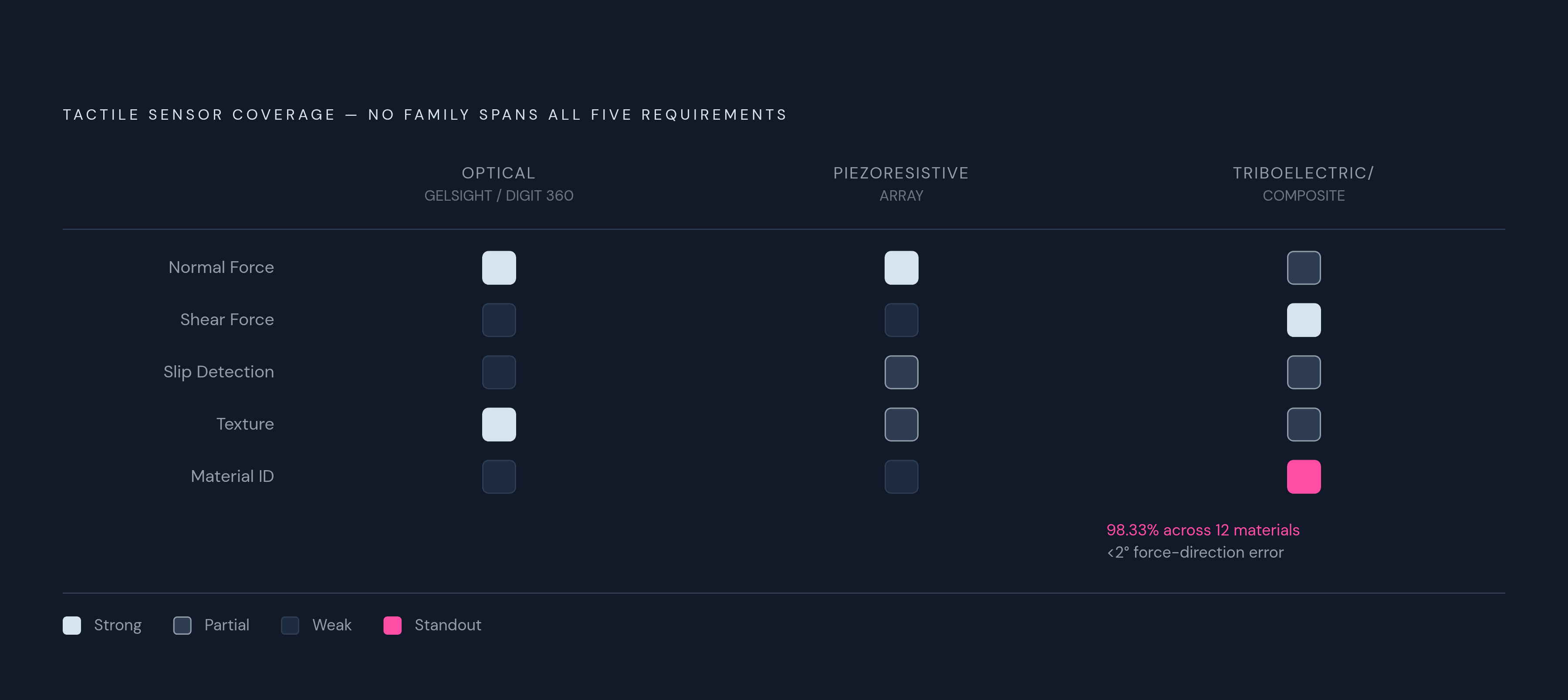
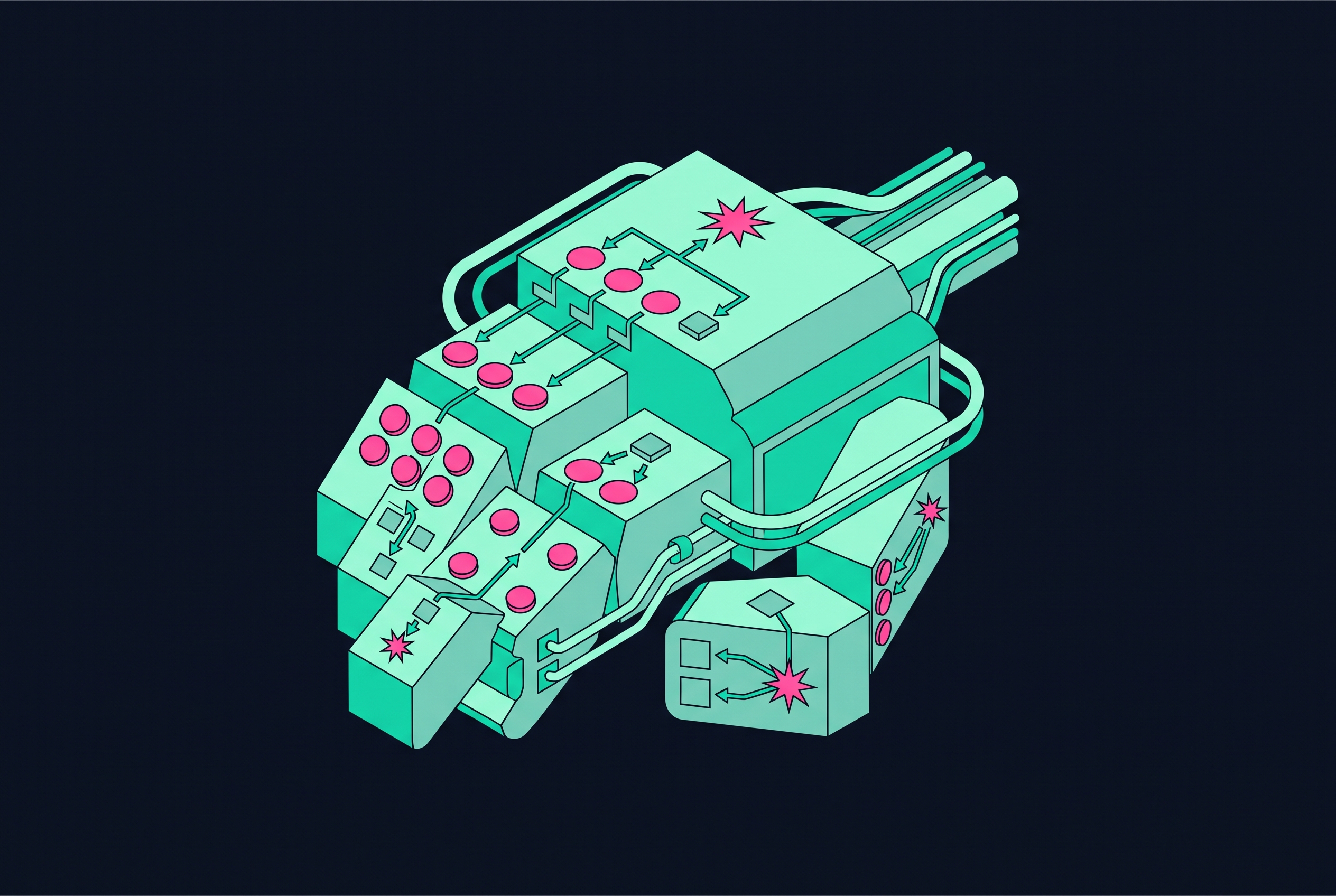
Three sensor families, three distinct profiles of strength and weakness. Optical sensors deliver detail and texture resolution but need volume a compact finger may not have. Piezoresistive arrays deliver coverage and conformability but struggle to resolve direction. Triboelectric and composite sensors deliver direction and material identification but remain less mature in production integration. None of the three satisfies all five requirements at once, and that is not a matter of engineering maturity catching up over time. It reflects a set of physical trade-offs built into the different transduction principles themselves: high spatial resolution favors large camera-based systems, conformability favors thin flexible arrays, and direction or material sensing favors composite elements, and a single compact fingertip cannot optimize for all three simultaneously. Combining sensing principles inside one fingertip is, by that logic, not a compromise but the direct response the physics demands.
A 2026 paper in Results in Engineering shows what that combination looks like in practice. The design combines rigid PLA, soft PDMS, and flexible TPU within a single fingertip to split normal and shear forces into separate channels that can be read independently. Splitting the channels this way means the sensor reports both force magnitudes on their own terms, something a single-modality array cannot do without inferring shear indirectly from pressure gradients. That fingertip design was embedded into the ARAtronica humanoid robot, where it demonstrated stable grasping, slip detection, and real-time haptic control during CNC and lathe machine operation, a working case of hybrid sensing performing under actual mechanical task conditions rather than only on a bench.
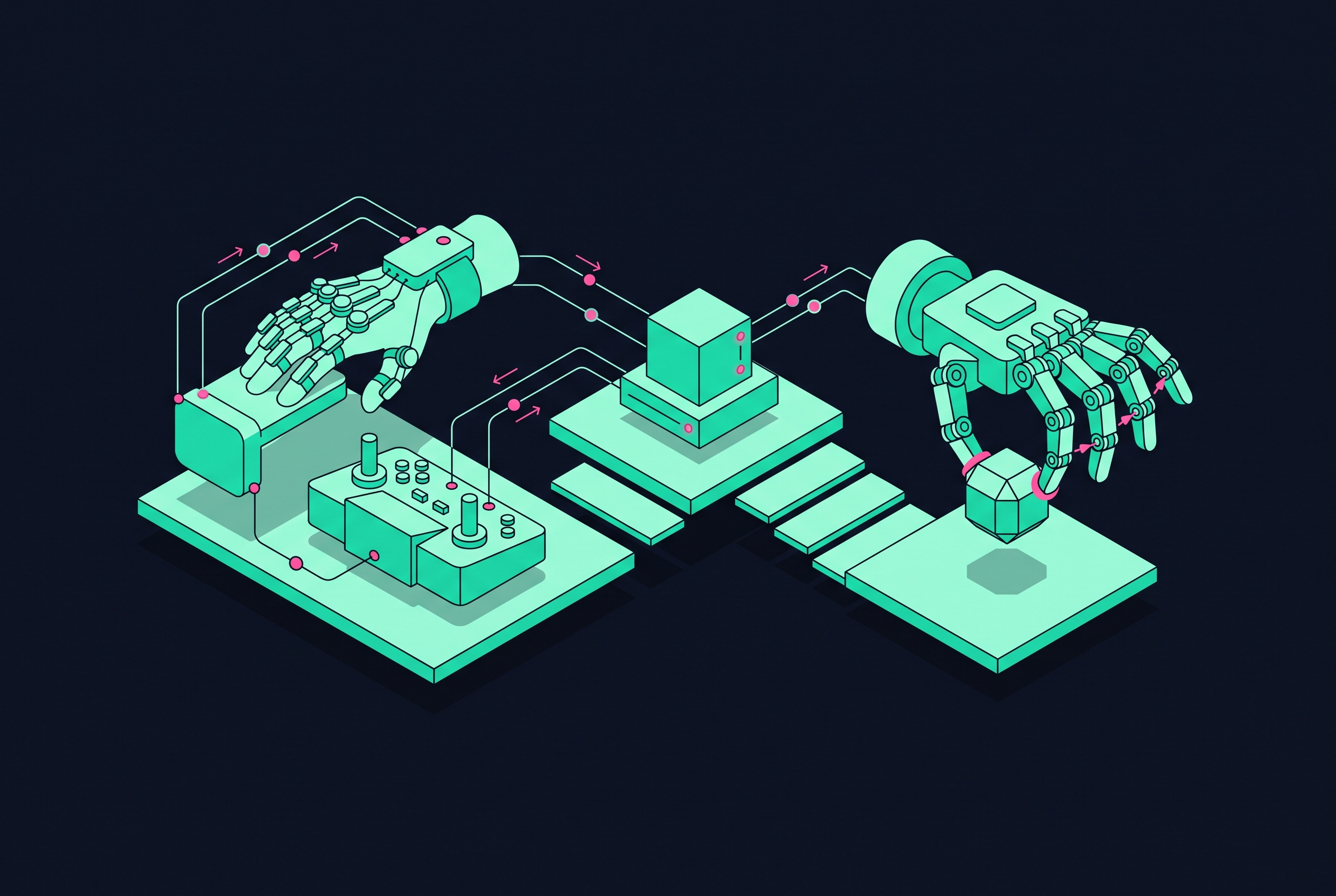
Speed is its own form of hybrid problem, and electronic textiles point to one answer. A Nature Communications paper from 2025 describes an electronic textile that enables robots to detect pressure and slippage with response times as fast as 0.76–38 ms, comparable to human touch receptor response times, achieving slip detection speed that optical processing pipelines currently cannot match. The F-TAC Hand, published in Nature Machine Intelligence in June 2025, is the most complete published answer to achieving full-hand coverage: high-resolution tactile sensing at 0.1 mm spatial resolution spans the majority of the hand's surface area, enabling grasping that behaves in a human-like, adaptive way. The project was developed primarily at Peking University and the Beijing Institute for General Artificial Intelligence, with tactile-sensor contributions from Professor Althoefer's group at Queen Mary University of London. Between ARAtronica's channel-splitting fingertip and the F-TAC Hand's full-surface coverage, hybrid integration stops looking like an add-on to a single sensor family and starts looking like the baseline approach for any hand that needs to satisfy more than one or two of the five requirements at once.
What AI inference adds to dense sensor arrays
Dense tactile arrays produce far more raw signal than fixed-function processing can turn into a decision in real time. Converting a map of pressure readings into a grasp correction, a slip prediction, or a material classification requires a system that generalizes across objects and conditions, something a hardwired signal-processing pipeline cannot do on its own. That is the gap neural network inference is built to close.
The F-TAC Hand system illustrates the point directly: its AI layer mimics human-like grasping by combining full-hand tactile sensing with a sensory-motor feedback mechanism, and that layer is what turns the sensor array's raw output into adaptive grip adjustments rather than a static force reading. Meta's Sparsh, released in 2024, takes the idea further by functioning as what is described as the first universal encoder for visual tactile sensors, trained on more than 460,000 tactile images using self-supervised learning so that it works across different sensor hardware without needing adjustments for each one. That universality solves a cost problem that had locked sensor development to AI development: previously, every new piece of sensor hardware needed its own bespoke training pipeline, and a universal encoder lets the sensor hardware and the AI model evolve on separate timelines.
The FELT framework, developed at USC with collaborators, pushes the same logic a step further. It synthesizes per-finger tactile pressure images from fisheye RGB camera views, after training on paired visual and tactile data, which allows visuo-tactile manipulation policies to be trained and run even on hands that have no physical tactile sensors installed at all. The AI layer, in that case, substitutes for hardware it was never even trained against directly, extending tactile-like capability to systems that never had the sensors to begin with.
None of this comes free. Market research on tactile sensors for humanoid robots finds that a single hand fitted with high-resolution tactile sensors can generate over 1 terabyte of tactile data every day, a volume that forces edge computing into the design and adds both cost and energy demand. That data volume is the strongest practical argument against full-hand, high-density sensing at scale, and it is precisely the problem universal encoders like Sparsh are built to reduce, by compressing sensor output into compact representations that can be reused across tasks instead of processed from raw arrays every time. Good sensing, by this point in the field's development, depends as much on how well that inference layer compresses and generalizes signal as it does on how many sensing points sit inside the fingertip itself.
Sensing trade-offs in production humanoids
Deployed humanoid hands do not settle on one sensor family or one standard level of coverage. Instead they spread across a spectrum running from minimal sensing suited to gross manipulation up to near-full-hand coverage built for fine dexterous work, and where any given hand lands on that spectrum follows directly from cost, weight, and the tasks it is actually built to do.
Sanctuary AI's Phoenix, in its seventh and eighth generations as of 2026, is toward the high-coverage, high-cost end of that range. Its hydraulically actuated hands use micro-barometer-based tactile arrays with 7 cells per finger pad and a sensitivity of 5 millinewtons, a combination capable of handling most of the manual tasks found in warehouse work. That design choice, dense sensing paired with hydraulic actuation, reflects a bet that warehouse manipulation justifies the added cost and complexity. Other production hands, built around piezoresistive arrays like the Psyonic Ability Hand inside Apptronik's Apollo, make a different bet, trading some of that density for sensors already proven in prosthetic use and ready for mass deployment. Neither choice is more correct than the other in the abstract. Each represents a different answer to the same five-requirement standard, shaped by what the robot actually needs to pick up, press, or hold onto on a given day.
Sources
- Humanoid hand
Provided figures on degrees of freedom in robotic hands, details on the Psyonic Ability Hand's sensor configuration, and Sanctuary AI Phoenix's micro-barometer-based tactile arrays.
- Tactile perception and object grasping of a dexterous hand in a humanoid robot
Provided the finding that pressure-only sensors leave dexterous hands prone to slip on smooth surfaces, and demonstrated piezoresistive array coverage across palm and finger digits.
- A Passively Bendable, Compliant Tactile Palm with RObotic Modular Endoskeleton Optical (ROMEO) Fingers
Described the ROMEO finger design using optical tactile sensing scaled across underactuated two-segment soft fingers and a compliant palm.
- FELT: Generating Tactile Signals from Vision for Visuo-Tactile Manipulation
Described the FELT framework, which synthesizes tactile pressure images from camera views to enable visuo-tactile manipulation without physical tactile sensors.
- Design and integration of a multi-axial tactile sensor for dexterous manipulation by humanoid robots for industrial applications - ScienceDirect
Described the hybrid fingertip design combining PLA, PDMS, and TPU to separate normal and shear force channels, deployed in the ARAtronica humanoid robot.
- Embedding high-resolution touch across robotic hands enables adaptive human-like grasping
Described the F-TAC Hand's AI layer that combines full-hand tactile sensing with sensory-motor feedback to enable adaptive human-like grasping.
- Robotic hand with unprecedented tactile sensitivity achieves human-like dexterity in real-world tasks
Provided details on the F-TAC Hand's spatial resolution, institutional contributors, and full-surface tactile coverage enabling human-like dexterity.
- Finger-shaped tactile sensor advances robotic touch with multi-directional force detection and material identification
Provided the 98.33% material recognition accuracy figure for the Chinese Academy of Sciences triboelectric finger sensor across twelve distinct materials.