Humanoid Hand Degrees of Freedom and Grasping Performance
More degrees of freedom matters less than where they're located on the hand.

Degrees of freedom in a humanoid hand is not a spec sheet vanity number. It decides which grasps a hand can physically pull off, how well it adapts to an object it has never touched before, and where an engineer has to cut a corner to hit a weight or cost target. The human hand is the reference point everyone measures against, and it carries roughly 27 degrees of freedom, with 21 of those belonging to the fingers alone https://en.wikipedia.org/wiki/Humanoid_hand https://journals.sagepub.com/doi/pdf/10.5772/56809. The rest come from the palm, which translates and rotates rather than simply hinging the way a finger joint does. Break it down finger by finger and the pattern holds: four degrees of freedom per finger, one of which spreads the fingers apart, while the thumb carries five because its job is harder.
Even that number isn't settled. Some anatomical models count closer to 30 once wrist and palm articulation get folded in, depending on where the researcher draws the line between a true joint and a coupled motion https://www.researchgate.net/figure/A-simplified-kinematic-structure-of-the-human-hand. So the benchmark moves depending on who's counting, and DoF count, however you tally it, only describes the skeleton of the problem. The human hand also carries thousands of tactile receptors, applies force with a precision no current robot hand matches, and shrugs off water exposure that would short out most electronics packed into a robotic finger. No robot hand on the market touches that combination, and none is close.
How DoF count maps to what a hand can do (the GRASP Taxonomy as a measuring stick)
Robotics researchers needed a standard way to judge what a hand can do, and the field settled on the GRASP Taxonomy: 33 canonical grasp types, pulled from a comparative review of 211 grasp examples across the literature. It's become the closest thing to a common yardstick for evaluating a robotic hand's dexterity, and most serious hand designs get benchmarked against it in one form or another.
The taxonomy splits into three families. Power grasps wrap the whole hand around an object, with the palm doing a good share of the force-bearing work. Precision grasps put the load on the fingertips instead, covering things like a tip pinch, a tripod grip between thumb and two fingers, or a lateral pinch.
Each family makes different demands on the joints underneath it, and the demands are not close to equal. Power grasps are the forgiving case: if the fingers curl together in a coordinated way, a hand can manage a solid power grasp without needing many independently controlled joints. Precision grasps demand the opposite, an exact, independent landing spot for each fingertip, and the outcome hinges on per-finger DoF and, above all, on the thumb's ability to properly oppose the other fingers. Intermediate grasps are the hardest bucket to satisfy on a limited DoF budget, since they need both the compliant wrapping of a power grasp and the fine positioning of a precision grasp, at the same time.
Thumb opposability is the real gatekeeper here, more than raw joint count, and this is where most spec-sheet comparisons go wrong by treating every degree of freedom as interchangeable. Most of what makes the human hand so prehensile traces back to thumb opposition and repositioning, combined with the palm's own ability to deform underneath the fingers. Finger DoF alone was never going to close that gap. A rigid robotic palm cannot replicate the mechanical work a human palm does simply by changing shape, no matter how many joints get stacked into the fingers above it.
Palm DoF as a design dimension most spec sheets ignore
Almost no commercial spec sheet lists palm degrees of freedom, and that omission hides more than it saves in column space. Palm motion affects thumb opposability more than one extra finger joint does, and adding DoF to the palm measurably improves it, with the effect strongest for the ring and little fingers, since their base position is what actually moves. Palm motion repositions where a finger starts, while finger DoF only extends how far it reaches from wherever it started. Those are two separate mechanical jobs, and a hand that pours its whole DoF budget into the fingers is solving half the problem. The fourth and fifth CMC joints, at the base of the ring and little fingers, allow a substantially larger range of motion than the second and third, and most robotic designs that skip palm DoF lose the most capability in exactly those two fingers.
The trade-off appears once total DoF is capped, which, given cost and mass limits, is basically always. Shift some of that budget from fingers into the palm and opposability climbs, but the hand loses kinematic redundancy: the extra joint paths that let a fingertip reach the same point several different ways. A designer can't buy both gains without adding total DoF outright, and that drags mass and cost right back into the equation.
Human anatomy explains why this trade cuts as deep as it does. The carpometacarpal joints at the base of the ring and little fingers allow a noticeably wider range of motion than the equivalent joints at the base of the index and middle fingers. Those are exactly the two fingers that lose the most capability when a robotic hand skips palm articulation, the same two fingers biology gave the most freedom to move.
The landscape of commercial and research hands, from 6 DoF to 27
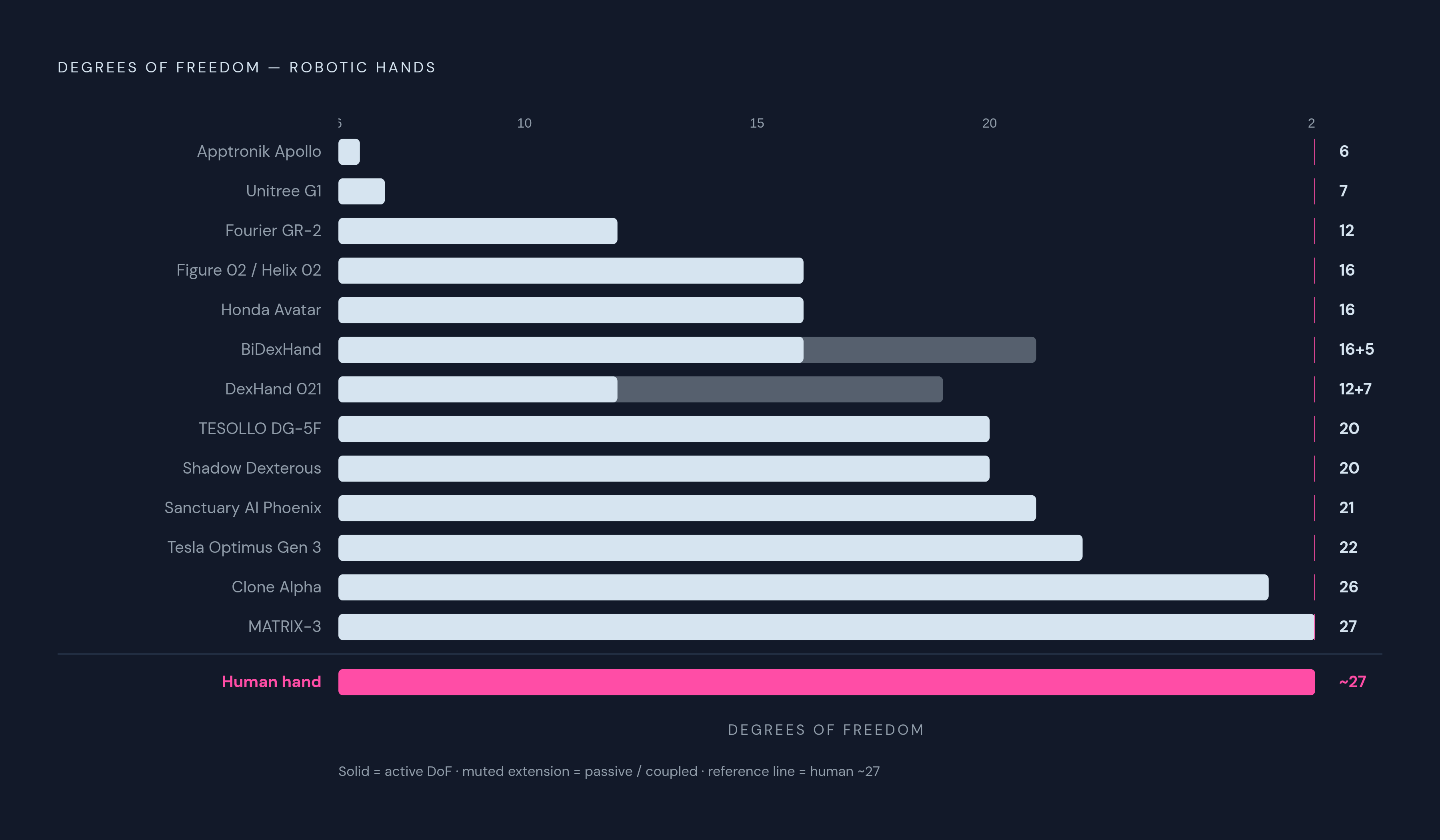
As of 2026, AI Wiki's tracking counts 120 humanoid robots fitted with some kind of hand or gripper system, and 86 of them carry a full five-finger hand rather than a simpler gripper https://aiwiki.ai/wiki/humanoid_robot_hands. That's a real signal: the industry has converged hard on the human hand's basic shape as the right form factor. What it hasn't converged on is capability, and the spread is wide. The documented field spans everything from two-finger grippers with no independent DoF at all up through designs that clear 20 degrees of freedom https://aiwiki.ai/wiki/humanoid_robot_hands.
The Shadow Dexterous Hand anchors the high end: 20 actuated degrees of freedom, four additional under-actuated movements, 24 joints total, and 129 sensors, running control loops at 1 kHz https://aiwiki.ai/wiki/humanoid_robot_hands https://store.clearpathrobotics.com/products/shadow-dexterous-hand. It costs $110,000 and drives its fingers with 36 air-powered tendon muscles https://www.roboticscenter.ai/blog/best-robot-hands-dexterous-2025. That price tag is the honest cost of chasing anatomical fidelity, and almost nobody else in the field has followed it there, for good reason.
Sanctuary AI's Phoenix hand runs 21 degrees of freedom with a seven-cell tactile array sensitive down to 5 millinewtons, actuated through miniaturized hydraulic valves the company has tested past 2 billion cycles https://aiwiki.ai/wiki/humanoid_robot_hands https://sanctuary.ai/news/. Sanctuary reports the hand covers 98% of warehouse manual tasks with high fidelity. Tesla's Optimus Gen 3 hand carries 22 degrees of freedom across 50 actuators, using a cable-and-tendon system with the actuators relocated into the forearm and a purpose-built wrist cable transition mechanism https://www.basenor.com/blogs/news/tesla-optimus-gen-3-hands-22-dof-50-actuators-explained. Figure's 02/Helix 02 hand takes a different path: 16 degrees of freedom with self-contained electric motor-and-sensor units built into each finger, rated for a 25 kg payload and able to detect fingertip forces as small as 3 grams.
Apptronik's Apollo uses the Ability Hand from Psyonic, a plain 6 active-DoF design with 37 tactile and positional sensors, including six force-sensitive resistors, that closes in about 200 milliseconds and weighs roughly 500 grams in carbon fiber. The same hardware serves both prosthetic wearers and robots, and that dual use says something real about how far a modest DoF count can stretch when the mechanical design earns its keep. Boston Dynamics keeps exact hand DoF undisclosed for Atlas, beyond the robot's overall 56 DoF, but the hand integrates tactile sensing across fingers and palm and handles a 50 kg payload, built from 3D-printed titanium and aluminum for industrial durability.
Further down the field: Fourier's GR-2 runs 12 DoF with real-time grip adaptation aimed at healthcare and industrial work. Honda's Avatar uses 16 cable-driven joints in a conservative, reliability-first design. TESOLLO's DG-5F offers 20 DoF across five fingers with four joints each, sold in matched left and right units and on the market since March 2025 https://www.therobotreport.com/tesollo-unveils-dexterous-robot-hand-for-humanoids/. Unitree's G1-paired hand takes the opposite bet entirely: three fingers, seven motor-driven DoF, and 33 pressure sensors, betting on sensing density over joint count https://robozaps.com/categories/robotic-hands.
Research platforms push further still. BiDexHand combines 16 independently actuated DoF with five mechanically coupled joints and has been validated across all 33 GRASP Taxonomy grasp types, reaching 9 of 11 positions on the Kapandji thumb opposition test with fingertip force of 2.14 N, and it can lift a 10 lb weight. DexHand 021 reaches 19 degrees of dexterity from just 12 active DoF plus 7 passive ones, all packed into a 1 kg hand. ILDA delivers 15 DoF and 34 N of fingertip force at 1.1 kg. MM-Hand runs 21 DoF through a remote tendon-driven, modular design with multimodal sensing validated for friction, fingertip force, and joint control. The MATRIX-3 uses cable-driven hands with 27 degrees of freedom. The Clone Alpha uses water-powered artificial muscles that replicate human hand anatomy, reaching 26 degrees of freedom.
How actuation method shapes what DoF can deliver
DoF count alone tells you nothing without knowing how each joint gets driven. The field runs on tendon, gear, link, fluid (hydraulic and pneumatic), belt, chain, and screw-drive actuation, and each one trades off differently even bolted onto an identical joint skeleton.
Tendon drive dominates high-DoF hands for a plain reason: it lets the motors sit in the forearm instead of the hand itself, keeping the hand light while still packing in plenty of joints. Tesla's Gen 3 hand runs this way, and so do a lot of research platforms. Figure 02 breaks from that pattern, using self-contained electric actuators built into each finger rather than a tendon-driven forearm system. Gear drive makes a different bet: bigger torque ratio, stronger output torque, good for grip strength, at the cost of extra weight that makes fine fingertip manipulation harder to pull off.
Sanctuary AI's hydraulic approach sits apart from both, in a field where the biological hand has approximately 27 DoF total, with 21 DoF in the fingers alone, and the remaining DoF coming from palm translation and rotation. Its miniaturized hydraulic valves push power, speed, strength, control, durability, and thermal management all at once, and the resulting force density supports in-hand manipulation tasks that purely electric hands still struggle with. The actuation layer decides how much of a hand's DoF budget shows up as usable grip strength and control bandwidth, more than the joint count sitting on top of it. Two hands with identical DoF numbers on paper can behave nothing alike once tendons, gears, or hydraulic lines get involved.
Where DoF count predicts performance
BiDexHand offers the cleanest positive result in the field. Sixteen independently actuated DoF, plus five mechanically coupled joints, produced coverage of every one of the 33 GRASP Taxonomy grasp types. That's a strong hint of a real threshold buried in the data: below some DoF count, full grasp coverage isn't achievable, and above it, coverage becomes realistic.
The counter-evidence matters just as much, and it's arguably more useful to a designer choosing where to spend a budget. Apptronik's Apollo runs on 6 active DoF and still handles automotive manufacturing demonstrations without trouble. For tasks that only need gross manipulation and power grasps, piling on extra DoF adds cost and complexity the task never asked for, and that's the mistake to avoid: buying joint count a job doesn't need. Boston Dynamics makes the same point from a different angle. Atlas's exact hand DoF has never been published, yet the robot hits a 50 kg payload and operates in fenceless factory settings anyway. Industrial performance can be met without maximizing, or even disclosing, DoF. DoF is not always the spec that decides the outcome for a given task class.
The thumb opposition research is what really breaks any attempt to rank hands by raw DoF count alone, and this is the finding spec sheets hide best. A hand can carry a high total DoF number and still deliver weak precision grasp coverage if the thumb's kinematic architecture and placement were never designed for opposition in the first place. Count matters, but where that count sits, and how the joints are arranged relative to each other, matters just as much. Treating DoF as a single scalar ranking is the mistake most buyers make when comparing hands off a spec sheet alone.
The engineering trade-offs that force designers to leave capability on the table
Packing actuators for 20-plus degrees of freedom into something the size of a human hand is, by most accounts, the hardest subsystem problem in humanoid robotics. The Shadow Dexterous Hand's $110,000 price tag and its 36 air-powered tendon muscles are what that difficulty looks like once someone actually builds it https://www.roboticscenter.ai/blog/best-robot-hands-dexterous-2025.
Palm DoF compounds the same problem from a different angle. A fixed total DoF budget forces a straight choice between kinematic redundancy and thumb opposability, and there's no way to improve both without adding more DoF, which only drives mass and cost higher again. Relocating actuators to the forearm through tendon drive helps on the mass side, but it trades that gain for tendon routing complexity. Tesla's Gen 3 needed a dedicated wrist cable transition mechanism purely to keep tension stable during combined wrist yaw and pitch movement, its own distinct engineering headache, one that only gets worse as DoF count climbs.
Underactuation is the deliberate workaround here, and it's the right call for most tasks a hand actually needs to do, not a compromise to apologize for. DexHand 021 reaches 19 degrees of dexterity with only 12 actively driven joints, filling the rest with 7 passive, mechanically coupled joints. That trade buys back mass and cost at the price of independent control over every joint, a fine bargain for plenty of tasks and a dealbreaker for others. Every hand on the market is a version of that same negotiation: how much true independence gets sacrificed, and where, to make the thing light enough, cheap enough, and durable enough to actually ship.
A few more data points sharpen the picture. The MATRIX-3 runs cable-driven hands at 27 degrees of freedom https://aiwiki.ai/wiki/humanoid_robot_hands. The Clone Alpha uses water-powered artificial muscles at 26 degrees of freedom per hand https://aiwiki.ai/wiki/humanoid_robot_hands. A Swiss-made dexterous robotic hand offers 21 total degrees of freedom, with a steady-state power-grasp payload above 25 kg https://robozaps.com/categories/robotic-hands. The Shadow Dexterous Hand's 2026 Chiral variant has 12 degrees of freedom and weighs 4.1 kg https://www.robotsinternational.com/Shadow-Robot.htm.
Sources
- Humanoid hand - Wikipedia
Provided the baseline figure of roughly 27 degrees of freedom in the human hand, with 21 belonging to the fingers.
- TESOLLO unveils dexterous robot hand for humanoids
Sourced details on TESOLLO's DG-5F hand, including its 20 DoF, five-finger design, and March 2025 market availability.
- A Kinematic Analysis of Palm Degrees of Freedom for Enhancing Thumb Opposability in Robotic Hands
Provided the analysis of palm degrees of freedom and their effect on thumb opposability, including the finding that ring and little finger CMC joints benefit most.
- Robot Hands Compared: Dexterous Hand Specs & Prices (2026)
Provided specifications for Unitree's G1-paired hand and the Swiss-made dexterous hand's payload figure.
- https://aiwiki.ai/wiki/humanoid_robot_hands
Provided the count of 120 humanoid robots with hand or gripper systems, as well as specifications for Shadow, Sanctuary, MATRIX-3, and Clone Alpha hands.
- A simplified kinematic structure of the human hand having 23 Degrees of... | Download Scientific Diagram
Supported the discussion of varying anatomical DoF counts depending on how joints and coupled motions are defined.
- https://www.researchgate.net/publication/282399375_The_GRASP_Taxonomy_of_Human_Grasp_Types
Provided the GRASP Taxonomy of 33 canonical grasp types used as the benchmark for evaluating robotic hand dexterity.
- https://www.basenor.com/blogs/news/tesla-optimus-gen-3-hands-22-dof-50-actuators-explained
Provided specifications for Tesla's Optimus Gen 3 hand, including its 22 DoF, 50 actuators, and cable-and-tendon actuation system.