Fall Recovery Strategies in Humanoid Robots
Unified learning approaches coordinate all three phases of recovery for real-world deployment.
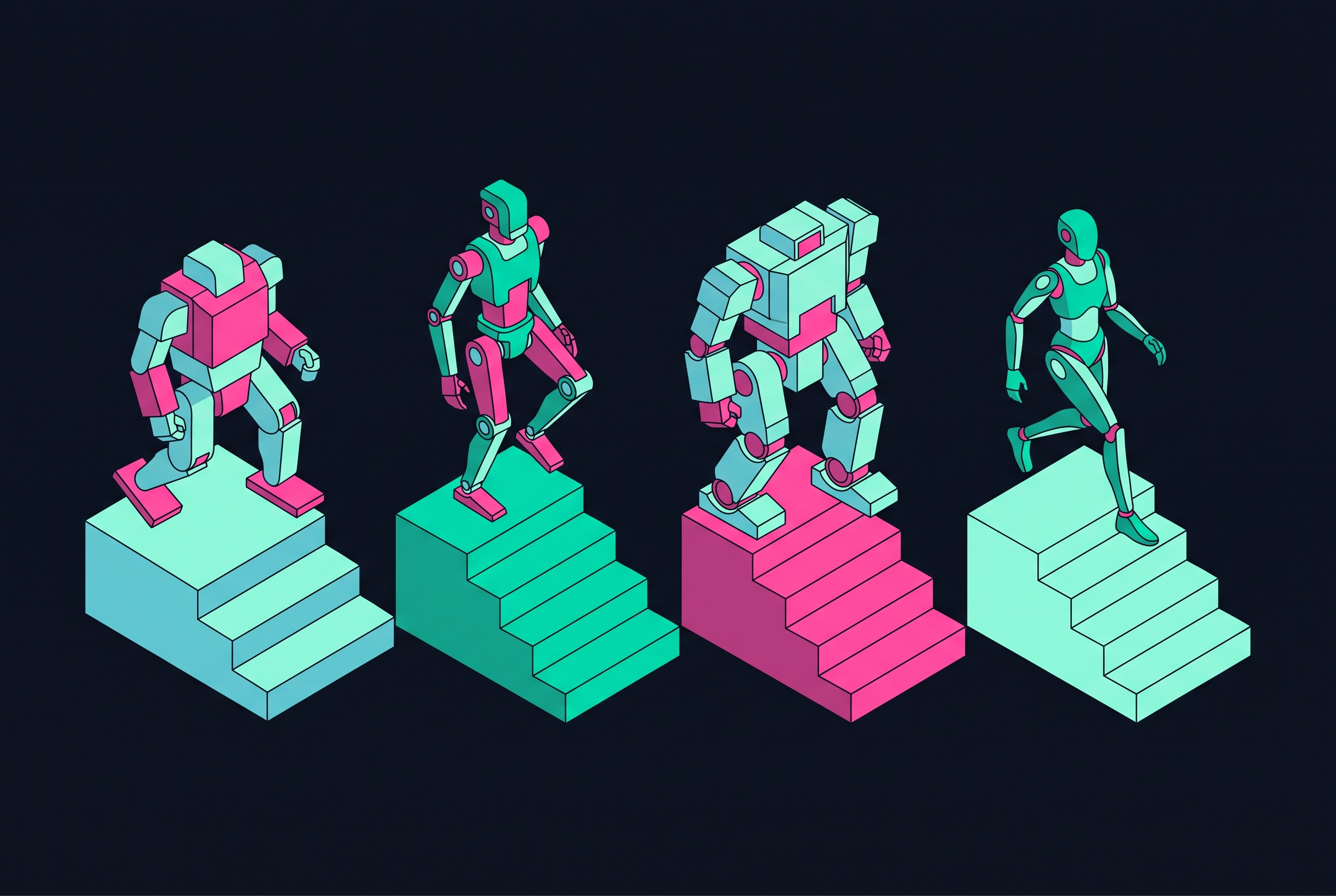
Fall recovery strategies in humanoid robots deal with three linked challenges: preventing a fall, limiting damage during impact, and getting back up. Each calls for different control behavior, but handling them separately can cause failures when one phase gives way to the next. The field is converging on unified learning-based approaches because safe recovery depends on coordinating the entire sequence.
Why fall recovery is a prerequisite for humanoid deployment, not a nice-to-have
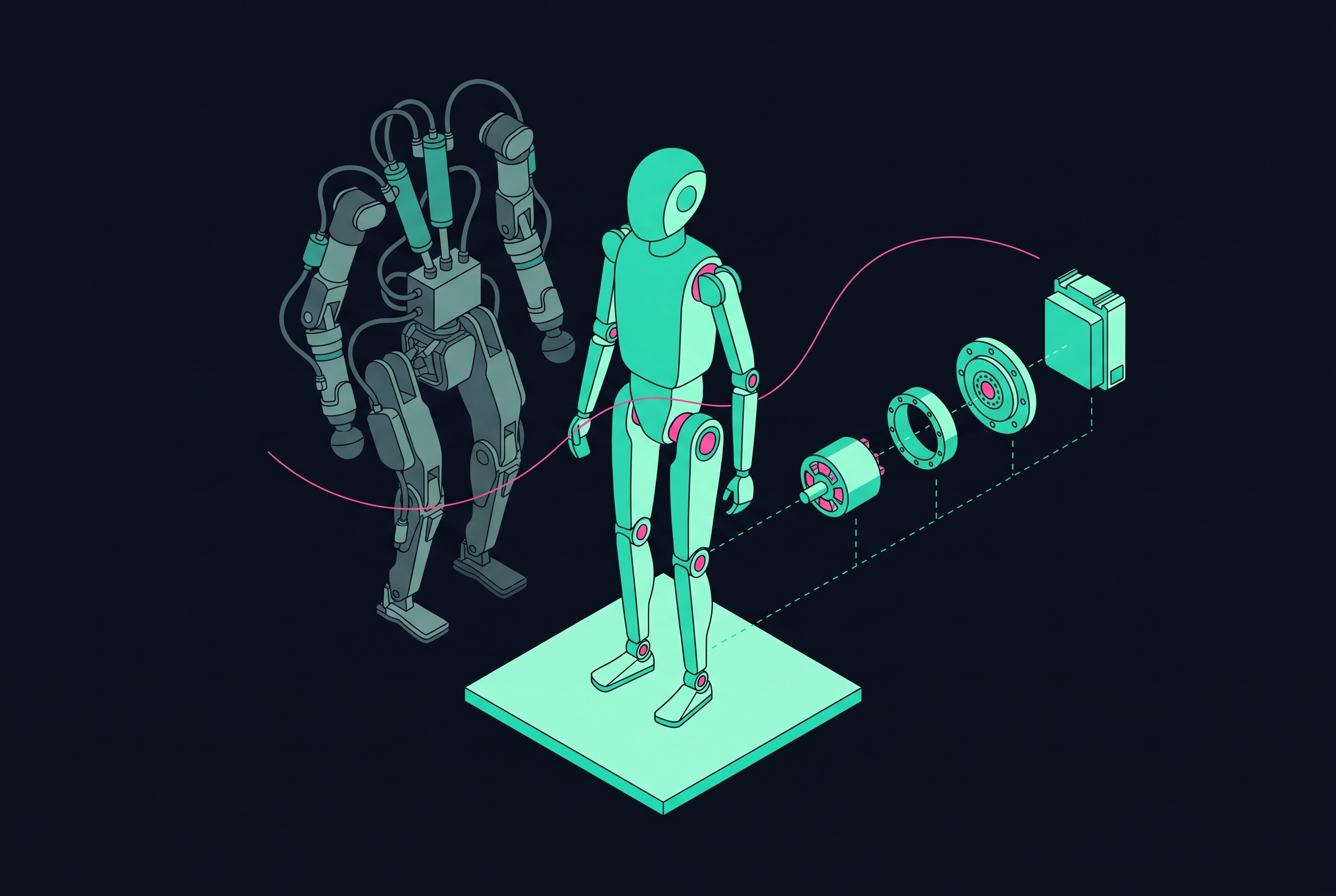
A humanoid that cannot recover from a fall is not ready for deployment in warehouses, construction sites, or homes. For a machine the size and weight of a Unitree G1, a topple can mean bent joints, cracked housings, and extended downtime. Its exposed sensors and actuators are also among its most expensive components. An unrecovered fall therefore becomes a hardware failure event.
The vulnerability begins with the robot’s physical structure. Tall, narrow frames and dozens of degrees of freedom create fall dynamics that wheeled and quadruped platforms do not face in the same way. Public falls in 2025 showed that weakness outside the laboratory, while researchers were already working on ways to use reinforcement learning to deal with it. Those efforts have produced a structured response covering what happens before, during, and after impact.
Why the fall problem resists a single controller — and why it was historically tackled in pieces
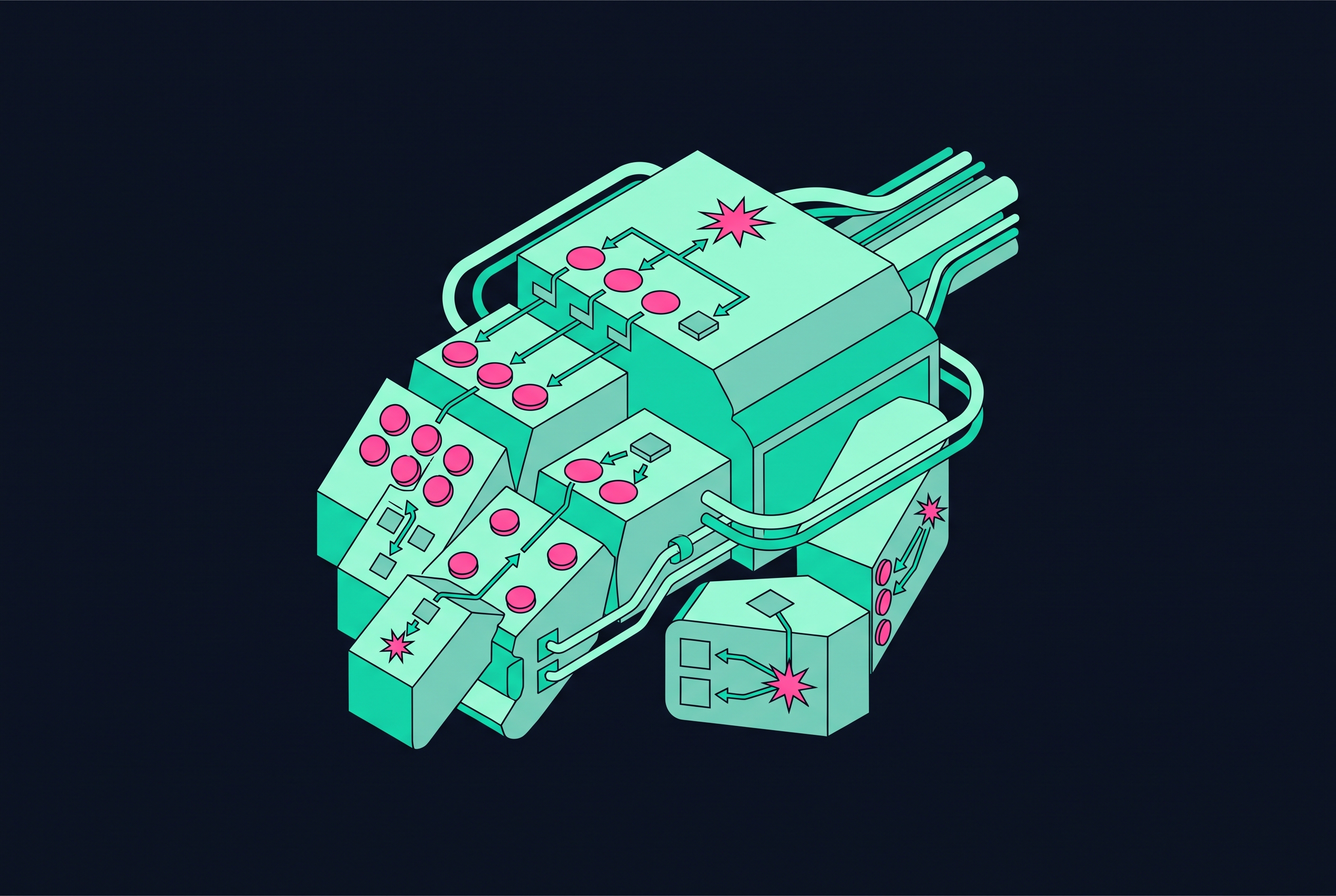
The three phases have different dynamics, time scales, and objectives. Before a fall becomes irreversible, control aims to preserve balance. During descent, the priority changes to protecting hardware. After impact, the robot must establish changing contacts with the ground and return to standing. A controller built around one objective does not automatically have the capabilities needed for the others.
Model Predictive Control and Key Frame Based routines could handle one phase at a time, but needed a great deal of fine-tuning and could not adapt in real time to different combinations of body configuration and terrain. Getting up was particularly difficult because its contact patterns change rapidly, unlike the more predictable patterns of locomotion. The collision geometry must also be accurate, while sparse training rewards make it harder to learn what works.
Specialization was therefore a reasonable engineering response. A predictor could misclassify a fall, or a protective maneuver could leave the robot in a pose outside the stand-up controller’s training. Making each specialist more capable must be accompanied by aligning their assumptions across the entire event.
Phase one: detecting and preventing falls before they become irreversible
Early detection gives the robot its best chance to act because correcting its balance avoids both impact and stand-up recovery. Timing determines which response remains physically available. Before balance is lost irreversibly, the controller can try to prevent the fall. Beyond that point, attempting to preserve the original motion must give way to protecting the machine.
SafeFall, submitted by Shandong University / BIGAI in November 2025, uses a lightweight recurrent neural network-based fall predictor to monitor the robot’s state continuously. Its protective policy remains dormant until the predictor identifies an unavoidable fall. Rather than planning a protective response from scratch during descent, the system hands control to an already trained policy.
Prediction nevertheless has a generalization problem of its own. Conventional classifiers are usually trained on rollouts from one nominal behavior policy, so changing that policy changes the distribution of failures. Moving from locomotion to motion tracking or manipulation can therefore require new failure data and retraining. Safe-Stop introduces a different question from simply predicting failure. In some operational states, gracefully stopping before a fall is preferable to attempting recovery, making safe cessation an explicit alternative to continued motion.
Phase two: minimizing hardware damage during the fall itself
Once a fall is unavoidable, active control during descent can protect hardware more effectively than passive structural protection alone. The robot must choose how to absorb the impact. SafeFall trains a reinforcement learning policy with a damage-aware reward that protects the head and hands while using more robust body parts to absorb energy. Its 2025 results reported large reductions in peak contact forces and joint torques, together with a 99.3% reduction in collisions with vulnerable components.
Disney Research’s 2025 work offers a concrete illustration of protective falling. It used thousands of simulated tumbles to train robots to shield sensitive parts. During a full day of repeated intentional falls, the robot was tripped from multiple angles with a stick. It showed no noticeable damage and continued functioning. The result makes the purpose of learned falling clear without requiring a detailed account of the reward function.
A protective action must execute in milliseconds once triggered, leaving no time to reason through fall geometry at runtime. An always-ready learned policy addresses that constraint. Yet minimizing impact alone is not enough, because the resulting body configuration also determines the difficulty of getting up. Protective control must therefore account for both the landing and what follows it.
Phase three: getting up from whatever configuration the fall left behind
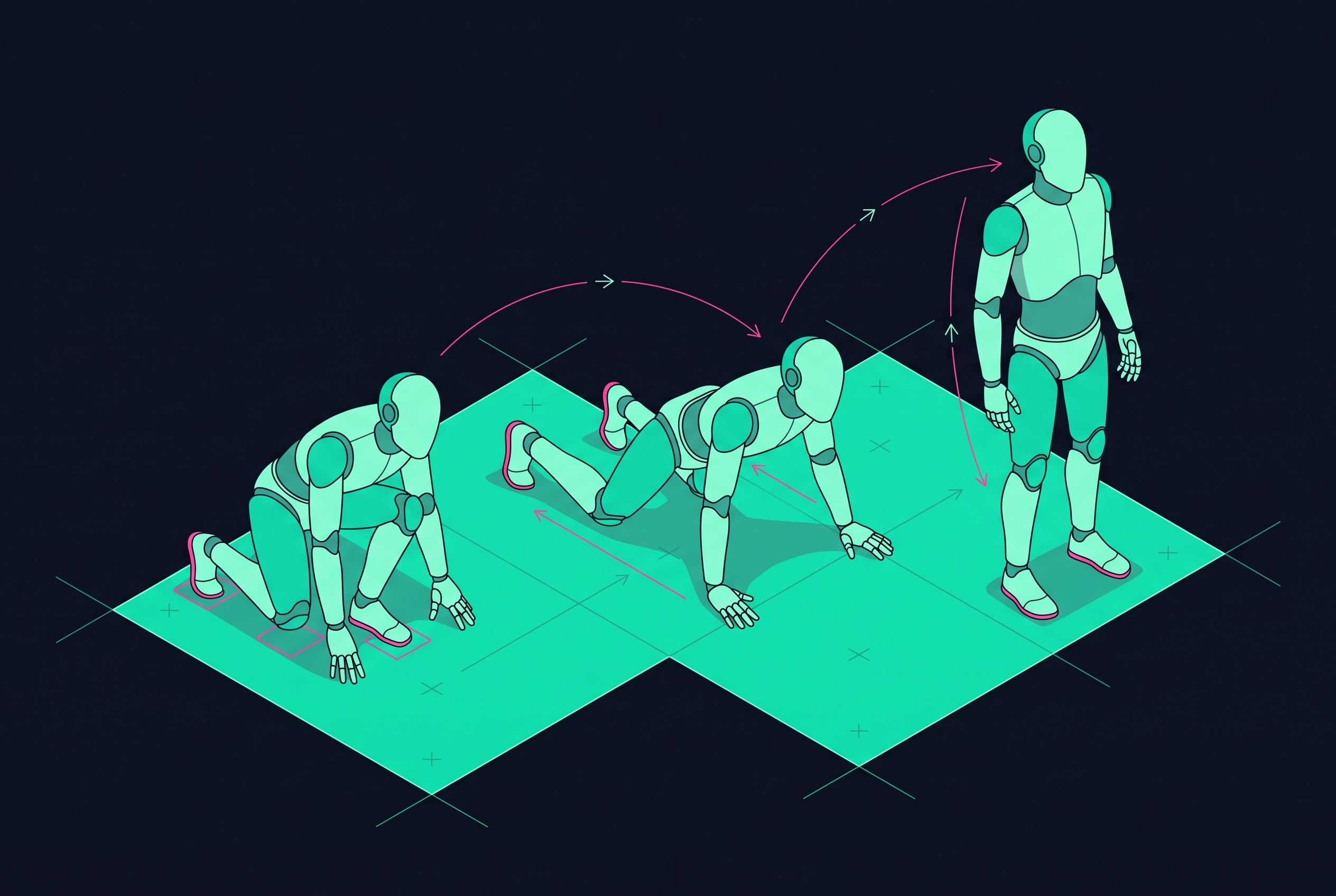
Stand-up recovery is the most configuration-dependent phase because its starting state is whatever the fall produced. The range of possible poses is vast. As the robot rises, contacts change continuously, and sparse rewards make it difficult to discover effective motions during training. A successful policy must solve these problems without assuming that the robot begins in a convenient, rehearsed posture.
HUMANUP, developed at the University of Illinois Urbana-Champaign in 2025, claimed one of the first successful real-world demonstrations of learned getting-up policies for human-sized humanoids. Its two-phase reinforcement learning process first identifies effective limb trajectories, then refines them into smoother, slower, and safer motions. It succeeded substantially more consistently than the Unitree G1’s built-in controller and handled terrains that controller could not. Other work targets the training process itself. FRASA, developed by Rhoban / Université de Bordeaux and presented at ICRA 2025, used CrossQ and robot symmetry to achieve a transferable stand-up task with around 30 minutes of training, unprecedented to the authors’ knowledge. HiFAR, using Booster Robotics hardware in 2025, instead used a staged curriculum that progressively introduced more complex, high-dimensional recovery tasks.
Transfer to hardware remains a separate test of success. FRASA’s initial transfers produced significant tremors on real robots because the MuJoCo friction model did not capture real actuator behavior. Even after that gap is addressed, reliable standing leaves another capability unresolved. A robot may regain its feet without controlling the direction it faces or the route it takes to get there.
What perception adds to stand-up recovery: choosing how to rise, not just whether to rise
Reliable recovery and steerable recovery are different capabilities. From the same fallen pose, a robot can rise in several ways, each with different support transitions, routes, and final headings. A warehouse humanoid needs to face the appropriate direction after standing so that it can resume its task. The recovery trajectory must also suit the surroundings and the work that follows.
RISE combines onboard egocentric depth perception with test-time steering of recovery trajectories. Its authors position it, to their knowledge, as the first framework to combine those capabilities specifically for fall recovery. Prior perceptive controllers addressed locomotion. This changes what the controller can select. Instead of merely executing a successful stand-up motion, it can use perceived terrain and a requested direction to steer how recovery unfolds.
To choose among recovery routes, the robot must anticipate what each motion would do in the space around it. A motion that restores balance does not necessarily satisfy that requirement. RISE makes terrain-aware, task-directed recovery a distinct requirement for safety alongside the ability to stand.
Why unified policies that span all three phases are becoming the dominant architecture
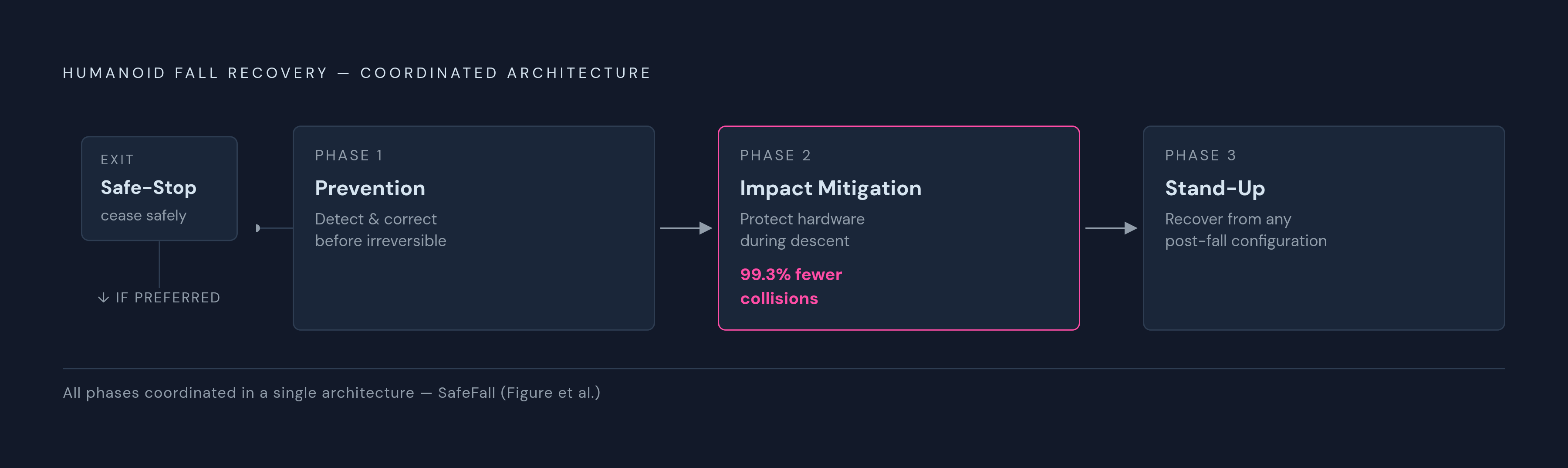
A protective motion changes the starting conditions for stand-up recovery. A recovery controller cannot fix every problem caused by how the robot fell. Training across these transitions allows the policy to coordinate decisions that a specialist chain treats separately. It also reduces dependence on clean handoffs between phases whose boundaries may be difficult to classify.
The University of Michigan’s unified fall-safety policy, introduced in November 2025, addresses prevention, impact mitigation, and getting up as one control problem. Its arm buffering and side-fall redirection illustrate the architectural benefit. These are not merely protective gestures considered in isolation. Their value lies in coordinating descent with subsequent recovery, so that impact handling and the return to standing do not work against each other.
Stubborn, from Southern University of Science and Technology in June 2026, extends unification to motion tracking. It trains a single policy with a probabilistic termination mechanism that allows episodes to continue after tracking fails. That training choice removes a specific barrier. Hard termination prevented policies from exploring what happened after failure, including the actions needed to recover. With soft termination, the policy can learn how to recover without a specialized recovery reward, a second policy, or separate multi-stage training.
RecoverFormer, from Stanford in April 2026, makes a different architectural contribution by unifying balance recovery with contact-aware decisions. Its causal transformer uses a 50-step observation history to learn when and how to switch among compensatory stepping, hand-environment contact, and center-of-mass reshaping. A contact affordance head predicts which candidate surfaces, including walls, railings, and table edges, can help stabilize the robot. This enabled zero-shot transfer from open-floor training to walled environments. Here, unification concerns the choice of stabilization strategy as well as the control of the resulting motion.
The three open problems that unified learning has not yet solved
Unified reinforcement learning policies succeed more often than specialist chains across a range of configurations, but designing the policy is only part of making simulation-to-hardware transfer work. FRASA’s tremors expose the practical constraint. A controller trained with an inaccurate actuator model can do well in simulation but move unsafely on the real machine. Finalizing training directly on the robot is one promising direction, but it introduces safety and cost concerns.
A second constraint is the character of the learned motion. End-to-end approaches are usually trained without visual terrain perception and need a great deal of reward engineering. They can produce effective but biomechanically odd movements. In spaces shared with people, successful completion is not the only relevant property of a recovery maneuver. Perception addresses part of this weakness by allowing motion to respond to terrain, but unified learning does not inherently produce natural behavior.
Zero-shot fall recovery across diverse humanoid morphologies has been demonstrated in simulation, but real-world generalization to unseen bodies without fine-tuning remains an active challenge. Robust transfer will require larger and more varied demonstration datasets. These limits are pushing the next architectures toward richer perception, better transfer, and a wider range of training experience.
Where the field is heading: perception, safe stopping, and the question of when recovery is the wrong answer
The developments of 2025–2026 change the definition of a fall-safe humanoid in three connected ways. Perception now allows recovery to be terrain-aware and task-directed. Unified policies increasingly coordinate behavior across loss of balance, impact, and recovery. Safe stopping adds an earlier decision about whether continued motion is justified at all. Together, these shifts broaden the objective from recovering successfully to selecting the safest available response.
Safe-Stop’s 2026 work and the accompanying “Learning safe-stoppability monitors” line of research give that earlier decision a distinct role. A task-agnostic stoppability estimator asks whether safe cessation remains possible before the fall begins. Future systems are therefore likely to integrate that estimate with unified fall-and-recovery control and perception-steered trajectory selection. These functions would operate as layers of one safety architecture, rather than as isolated controllers with fragile handoffs.
The sharpest change is in what counts as success. A humanoid still needs all three phases because not every fall can be prevented. The best response in that state is to stop while stopping is still safe.
Sources
- Stubborn: A Streamlined and Unified Reinforcement Learning Framework for Robust Motion Tracking and Fall Recovery for Humanoids
Described the Stubborn framework from Southern University of Science and Technology, including its probabilistic termination mechanism for unified motion tracking and fall recovery.
- Test-Time Motion Steering for Perceptive Humanoid Fall Recovery
Described the RISE framework combining egocentric depth perception with test-time steering of recovery trajectories, cited as the first to combine those capabilities for fall recovery.
- RecoverFormer: End-to-End Contact-Aware Recovery for Humanoid Robots
Described RecoverFormer from Stanford, including its causal transformer architecture with a 50-step observation history and contact affordance head for zero-shot transfer.
- [2511.18509] SafeFall: Learning Protective Control for Humanoid Robots
- FRASA: An End-to-End Reinforcement Learning Agent for Fall Recovery and Stand Up of Humanoid Robots
- Humanoid Safe Stop via Learned Stoppability Value
Provided the basis for the Safe-Stop concept discussed in the sections on fall prevention and the question of when recovery is the wrong answer.
- Unified Humanoid Fall-Safety Policy from a Few Demonstrations
Described the University of Michigan's unified fall-safety policy covering prevention, impact mitigation, and getting up as one control problem, including arm buffering and side-fall redirection.
- HiFAR: Multi-Stage Curriculum Learning for High-Dynamics Humanoid Fall Recovery
Described the HiFAR system using Booster Robotics hardware and a staged curriculum for high-dynamics humanoid fall recovery.