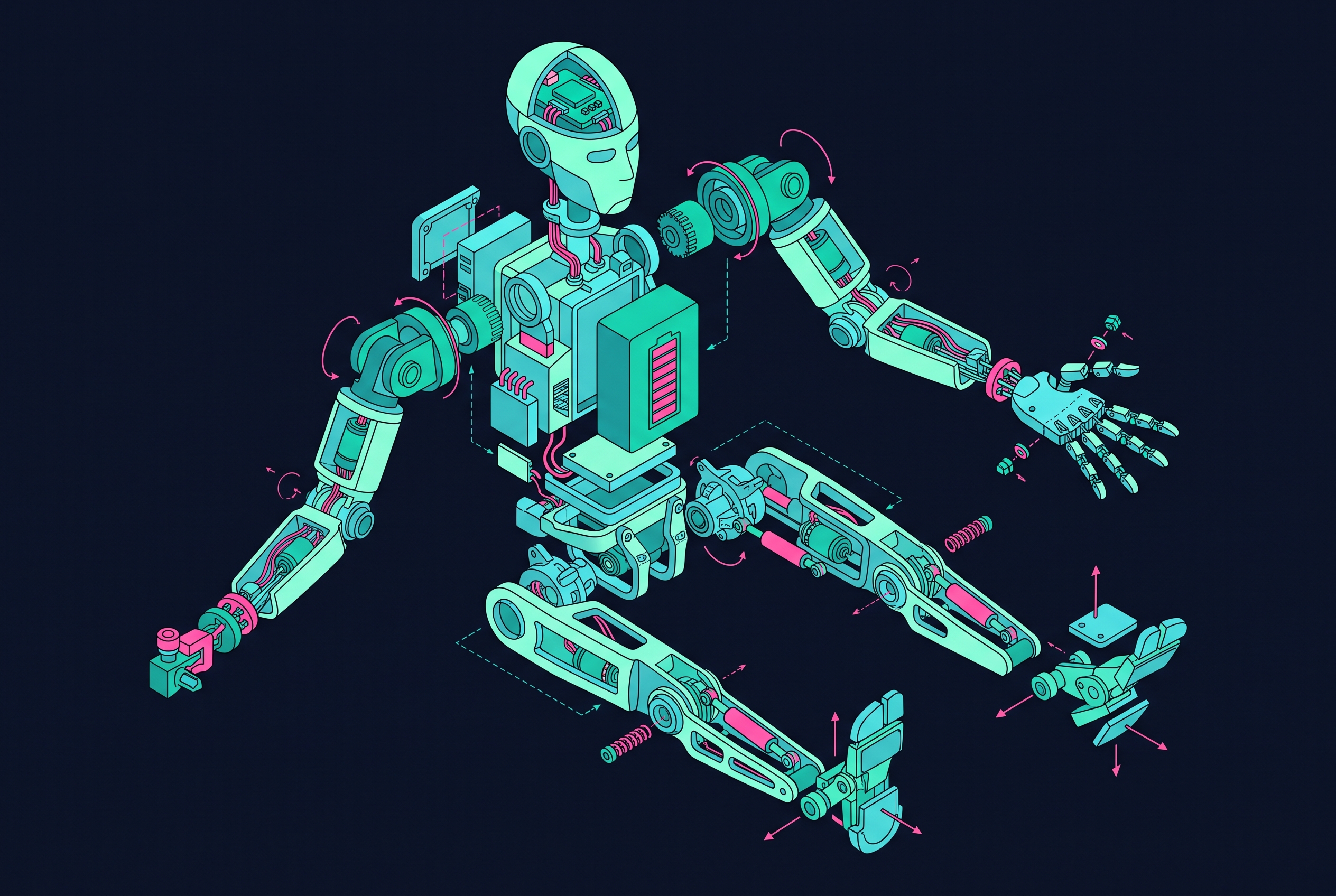
Boston Dynamics Atlas Transition to Electric Actuation
Electric motors replace hydraulics to make the robot factory-ready, not just acrobatic.
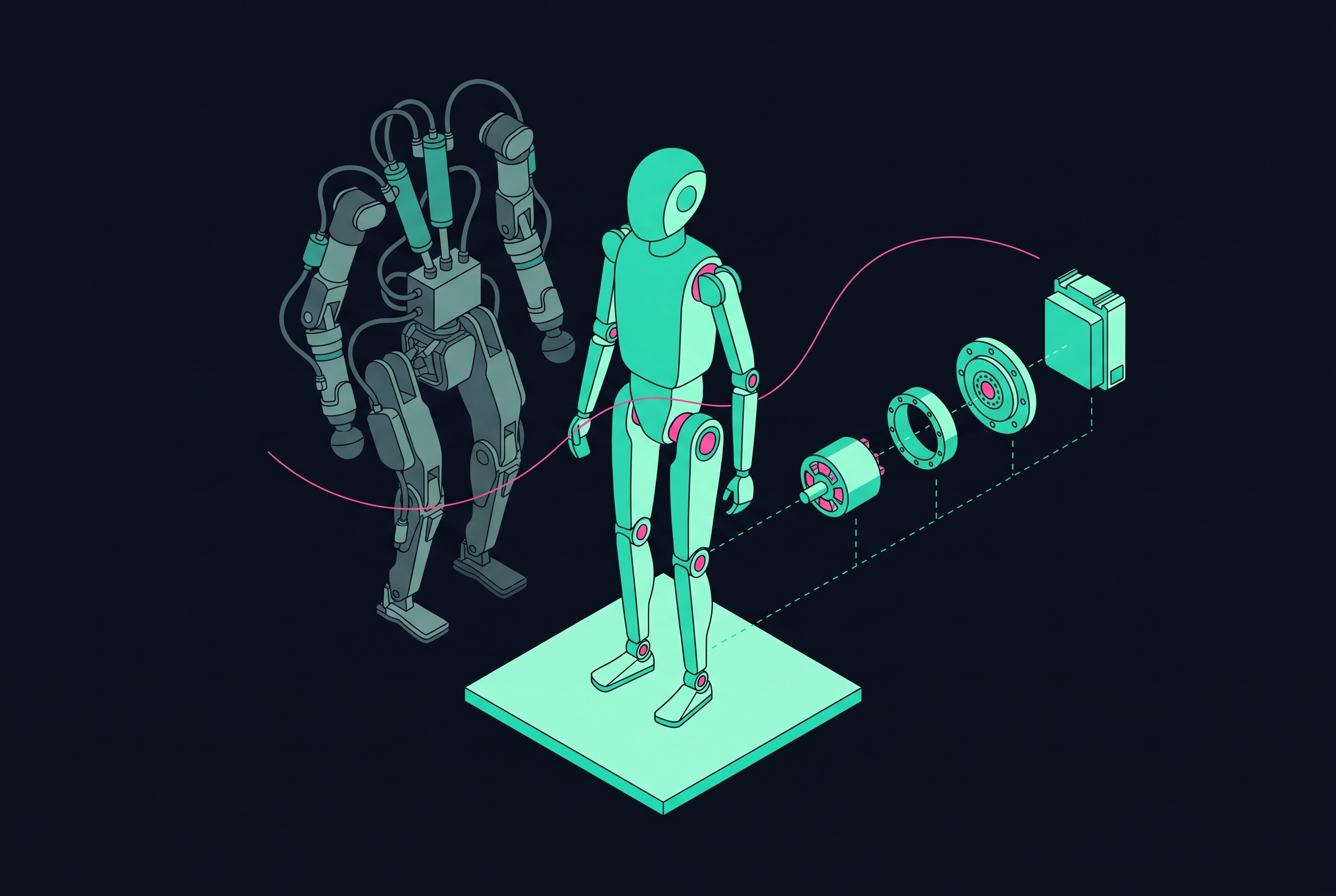
Boston Dynamics’ transition from hydraulic to electric actuation in Atlas is an engineering pivot from research performance to industrial usefulness. The change required more than replacing pumps with motors. It required actuation that could preserve demanding physical capabilities while supporting lower maintenance, efficient operation, and repeatable manufacturing. The production design makes that intent clear, although deployment has not yet established the commercial case.
Why hydraulic Atlas was always a research tool, never a product
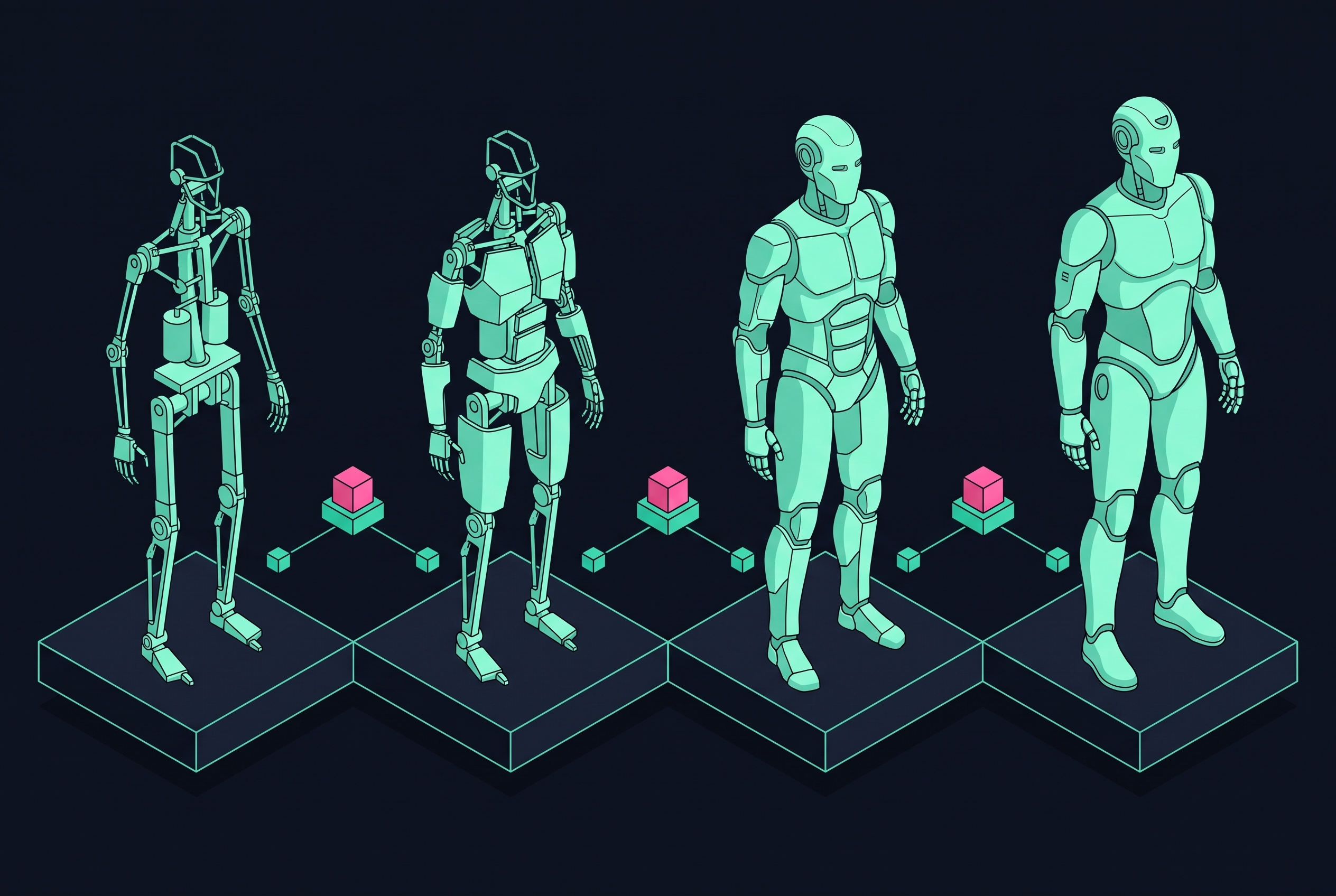
The original hydraulic Atlas appeared in 2013, followed by HD Atlas in 2016. Both were built to push the limits of dynamic motion. Their jumps, flips, and parkour demonstrated the force-density advantages of hydraulics, which electric systems of the time could not match. Those achievements answered a research question about physical capability. They did not establish a route to economical industrial operation.
Hydraulic systems require continuous pump operation, so they consume power even when the robot is not moving its joints. Fluid, seals, hoses, and pressure management also add ways for the robot to fail and maintenance work that becomes harder to handle outside a laboratory. Loud operation adds a separate obstacle in workplaces where people must work near the machine.
Boston Dynamics never put a hydraulic Atlas up for sale. That distinction is essential to understanding the transition, because the company was not replacing an established product with an unproven alternative. The challenge was to retain demanding motion capabilities without retaining the operating burden that had accompanied them.
What electric actuation required engineers to solve before the switch was viable
An electric replacement needed more than adequate motor power. It needed force density, controllability, and efficiency in a system that could tolerate impacts and manage contact with its surroundings. Early electric drives used high-reduction gearboxes that were precise but made the mechanisms rigid. They absorbed impacts poorly and could not sense or control contact forces well. A humanoid that must both walk and manipulate objects needed more than precision.
Series elastic actuators introduced compliance, but that improvement came with bandwidth limitations. Quasi-direct drive systems met a different set of needs by pairing high-torque motors with low-ratio gearing, roughly 6 to 1 through 10 to 1. With this setup, the systems have high back-drivability, impact resistance, and high force-control bandwidth. Those properties made demanding humanoid locomotion and manipulation viable electrically. The relevant advance was therefore not simply stronger electric motors, but electric actuation that could respond effectively to physical contact.
That evolution explains why replacing hydraulics became technically credible. It does not require treating every detail of quasi-direct drive theory as a disclosed Atlas specification. The important engineering bridge is the combination of strength and responsive force control that earlier electric systems could not provide. Once that combination became available, the efficiency advantages of electric actuation could be pursued without accepting the same constraints on physical performance.
Electric actuators draw current when under load, while a hydraulic pump runs all the time. Electric actuation removes the hydraulic requirement for continuous pump operation regardless of joint movement. Boston Dynamics’ CES announcement also named Hyundai Mobis as the actuator supplier, connecting component development to automotive-grade manufacturing standards. Technical viability and production viability were being addressed together.
What the electric Atlas can do that the hydraulic version physically could not
Removing hydraulic hoses eliminated routing constraints as well as an operating burden. The electric Atlas has 56 degrees of freedom and a 2.3-meter reach, allowing it to work in confined or unconventional postures that would have been impractical with hydraulic routing. That changes how the robot can occupy a workspace. Its useful motion is no longer constrained by the same need to accommodate fluid lines through a moving body.
Atlas has an instant payload of 50 kg and a sustained payload of 30 kg, exceeding the load-handling demands of the automotive parts-sequencing tasks selected for its initial deployment. The distinction between instant and sustained payload remains important. A brief capacity to handle a load and a capacity to maintain it describe different operating conditions, and the two figures should not be treated as interchangeable.
Industrial durability broadens the operating envelope in another direction. The electric Atlas has an IP67 rating, with spray- and wipe-down tolerance, and an operating range of –20°C to 40°C. These are industrial environment specifications that the hydraulic research platform never targeted.
Atlas has a four-hour battery runtime and can autonomously swap its battery in under three minutes. The swap enables continued operation without a person intervening to replace the battery, although it still introduces a brief interruption to productive work. This is a different requirement from completing a demanding demonstration.
The actuator transition also accompanied a broader physical and sensing redesign. Lightweight titanium and aluminum 3D-printed parts optimize the strength-to-weight ratio, while 360-degree camera coverage replaces the spinning LIDAR unit characteristic of the hydraulic version. Tactile sensors in the fingertips and palm add contact sensing at the manipulation surfaces. The vision change reduces mechanical complexity and cost while taking advantage of advances in computer vision.
How the production design encodes the commercial intent
The production Atlas uses just two actuator sizes across its body, or three if the manipulators are counted separately. Fewer component variants reduce assembly complexity, simplify repair, and make the supply chain more tractable. A research machine can have good reason to use parts made for specific experiments. A product intended for deployment at scale has to justify the burden those parts create.
Boston Dynamics’ announcement stated that every component was designed for compatibility with automotive supply chains. It also identified Hyundai Motor Group’s backing as an enabler of reliability and economies of scale. The commercial intent is visible in what the design avoids multiplying.
Orbit connects Atlas to MES, WMS, and other industrial systems, with workflow integrations including barcode scanning and RFID. Autonomous operation, teleoperation, and tablet steering let operators choose how closely to oversee the robot without needing to be experts in robotics. Once one unit learns a task, that task can be deployed across the fleet without individually retraining each robot. These features address integration and repeatability, rather than requiring each installation to become a bespoke research environment.
Human detection with fenceless guarding addresses another condition of industrial use. Atlas is designed to work without physical barriers separating it from workers, a prerequisite for the automotive assembly environments it targets. That design intent belongs with the manufacturing and software choices because all three concern how the robot fits an existing workplace. However, an architecture intended for human-proximate work is not itself proof that every close-working situation has been resolved. Deployment must establish how well the design performs under those conditions.
Where Atlas is actually deployed now and what the deployment schedule reveals
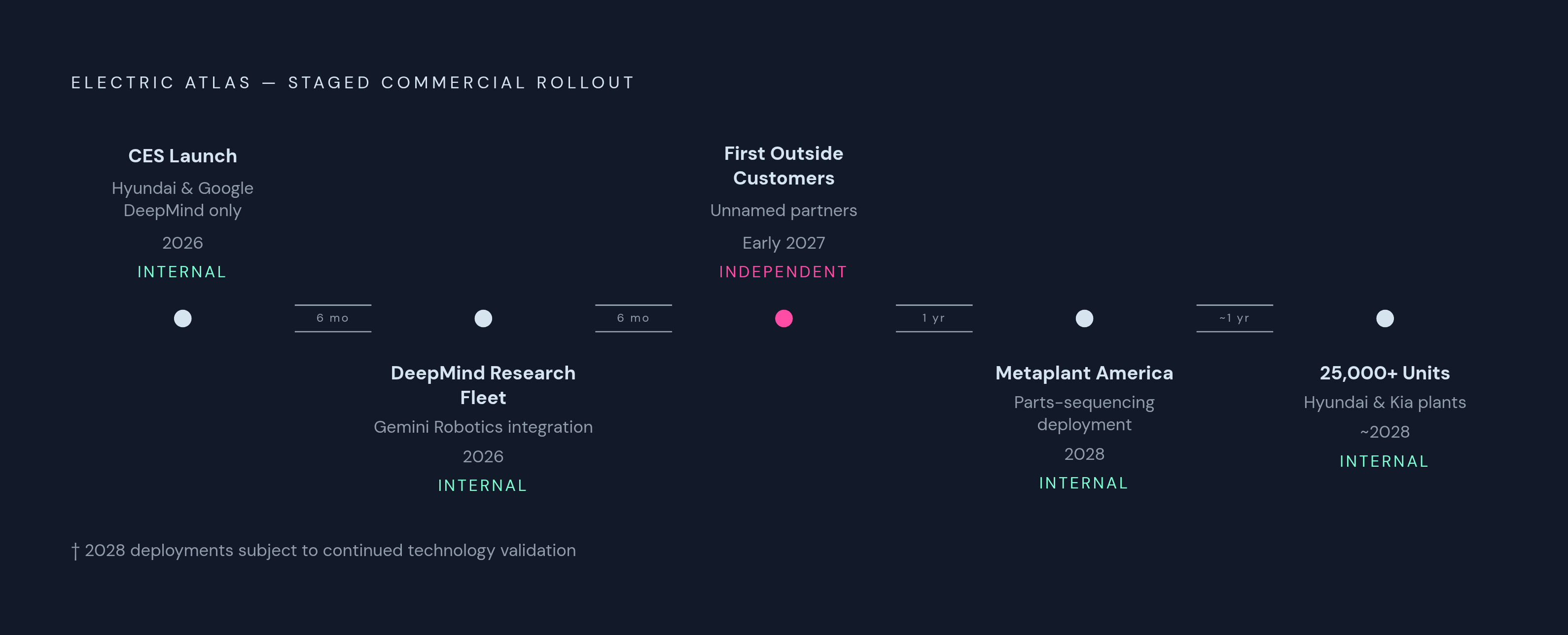
The production Atlas launched at CES 2026 is fully committed for the year, but that commitment is not open commercial availability. Access is confined to Hyundai and Google DeepMind, which are connected to Boston Dynamics through ownership and its AI partnership respectively. This is a deliberately constrained introduction. It provides a setting for development and validation before the customer base broadens, rather than demonstrating demand fulfilled across independent industrial operators.
Google DeepMind’s research fleet is receiving Atlas units in 2026 to bring Gemini Robotics foundation models into the robots. Boston Dynamics’ announcement said the partnership aims to help Atlas think through more of what it does. Putting robots into research and putting them on a production line are different stages. The former supports the development of capabilities that may underpin industrial use, but it does not establish performance on a customer’s production line.
The next commitments follow a staged schedule. Additional unnamed customers are expected in early 2027, while Hyundai has committed to parts-sequencing deployment at Metaplant America in 2028, subject to continued technology validation. That condition is part of the commitment. It makes the production-line schedule dependent on demonstrated progress rather than turning the date into an unconditional statement of readiness.
Hyundai Motor Group’s broader plan calls for more than 25,000 Atlas units across Hyundai and Kia plants. A planned U.S. robotics facility is intended to provide substantial annual production capacity by approximately 2028. Neither statement describes current output or completed sales. The fleet plan describes intended adoption, while the facility plan describes the capacity intended to support production.
The RMAC “data factory” model supplies the operational logic behind this sequence. Atlas is trained inside Hyundai’s own manufacturing environment before being deployed back into it. That creates a close relationship between the setting where skills are developed and the setting where they will first be used. It also narrows what early success can establish. Performance within that environment will not, by itself, demonstrate reliable transfer to factories in which Atlas was not trained.
What the transition still has not resolved
Both 2026 customers are structurally connected to Boston Dynamics, with Hyundai as majority shareholder and DeepMind as AI partner. No third-party operating-cost data or independent performance evaluation exists yet. Consequently, the present evidence cannot establish how the product performs economically for an industrial customer outside those relationships.
Boston Dynamics aims for most customers to see a return on investment within two years, consistent with its target for Spot in inspection use cases. That remains an unvalidated target for Atlas under industrial conditions. A return achieved or targeted in one application cannot establish the economics of another robot performing different work. Whether the complete deployed system produces the expected return remains unresolved.
Safety presents a separate validation requirement that efficiency cannot answer. The productized Atlas is dynamically stabilized and will collapse if it loses power. Human detection and fenceless guarding therefore do not constitute a complete answer to safe operation in high-mix automotive environments. Working confidently close to human colleagues remains a capability that will develop after launch.
Nor does Atlas establish that hydraulics have no remaining role in robotics. Some designs continue to use hydraulic or fluid-based actuation for specific manipulation problems. The Atlas transition is a strong engineering and commercial argument for its intended industrial role.
The most consequential uncertainty is still the transfer of learned skills. The RMAC model puts training close to Hyundai’s intended work, but customers outside Hyundai will need capability that extends beyond that setting. Fleet-wide task replication does not settle this question, because distributing a learned task and making it work in an unfamiliar factory are different achievements. The decisive test is whether Atlas can generalize reliably to environments in which it was not trained.
Sources
- Hello, Electric Atlas - IEEE Spectrum
Provided details on the electric Atlas hardware specifications, actuator design, deployment plans, and Boston Dynamics' commercial intent.