Physical Intelligence PI Zero Policy Model Architecture
Splitting semantic reasoning from motor control unlocks robot precision.
Generalist robot policy models that came before PI Zero ran into a mismatch, and no amount of scale could fix it on its own. They asked one piece of representational machinery to handle both semantic understanding, figuring out what a task means, and precise continuous motor control, figuring out how to move a joint or a gripper to accomplish it. A single module forced to do both ends up compromising on each. Earlier vision-language-action models tokenized actions the same way they tokenized words, slotting continuous joint positions and end-effector deltas into a finite vocabulary built for language. That process introduces quantization error: a continuous motion gets rounded off to the nearest available token, and fine motor precision suffers for it. The insight behind PI Zero's design is that deciding what to do and figuring out how to move are different problems, operating on different representations and different timescales, and cramming them into one module penalizes both.
How the two-component architecture divides responsibility
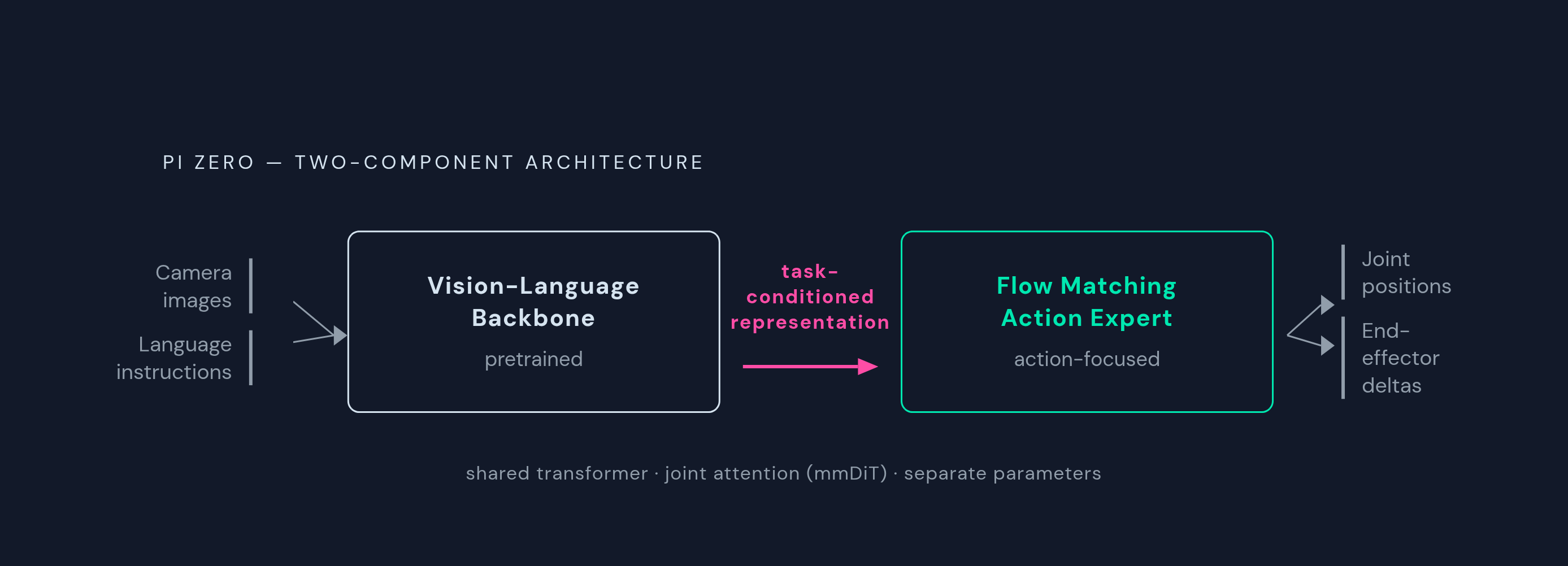
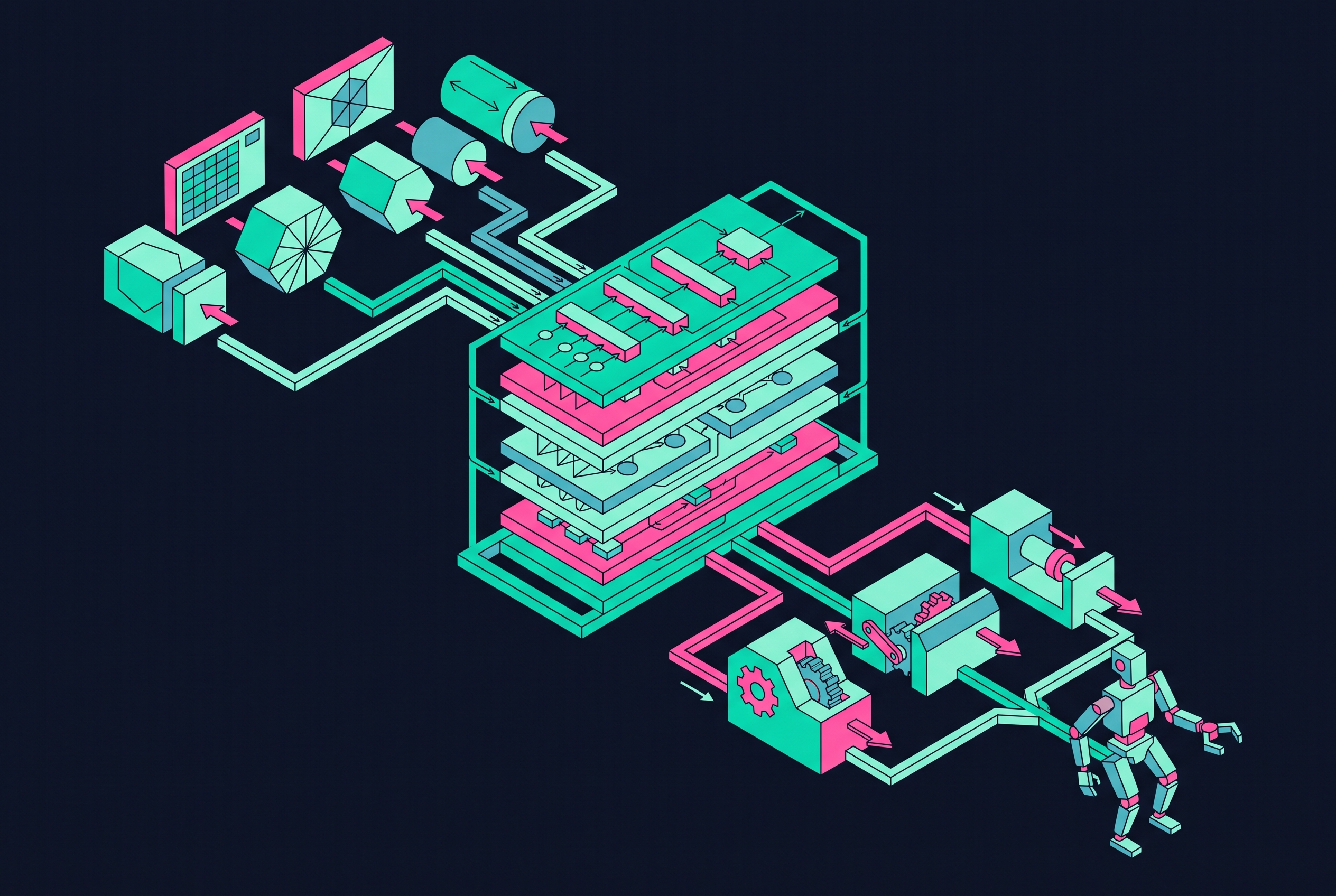
So PI Zero splits the work across two purpose-built components, and they trade information through a defined interface instead of competing for the same parameters. A vision-language backbone takes in camera images and natural language instructions and produces a task-conditioned representation, a dense encoding of what the robot sees and what it's being asked to do. A flow matching action expert takes that representation as a condition and generates the actual motor commands, without ever needing to parse a sentence or figure out what "cup" refers to in a scene, because that work is already finished upstream. The two components share a single transformer and talk to each other through joint attention, following the mmDiT pattern from Stable Diffusion 3 (Esser et al.), but their parameters stay separate. Neither module has to optimize for the other's objective in the same gradient step in the base design. The architecture draws directly on Transfusion (Zhou et al.), so if you know that line of work, you'll recognize where PI Zero sits in its family tree. The division of labor is the point: semantic reasoning lives in one place, motor precision lives in another, and the interface between them is narrow and well defined.
Why the backbone uses a pretrained vision-language model
The backbone starts from a pretrained vision-language model rather than an encoder built from scratch for robotics, and that choice carries most of the system's generalization power. Learning visual and linguistic grounding from robot demonstration data alone would take an enormous amount of robot-specific data collection, more than is practical to gather. Starting from a VLM sidesteps that cost. The logic follows a data pyramid: at the base, internet-scale vision-language pretraining, built from billions of image-text pairs, establishes the visual and linguistic grounding the backbone needs, and PI Zero inherits all of it without collecting a single frame of robot data for that tier. The next tier is cross-embodiment robot data, gathered across different physical platforms, and it adapts that grounding to the specifics of manipulation; it can be far smaller than the base tier because the semantic representations are already rich by the time robot data enters the picture. PI Zero is pretrained on data spanning 7 distinct robot configurations and 68 tasks, covering single-arm robots, dual-arm robots, and mobile manipulators, each with different configuration spaces and action representations. That breadth is only feasible because the backbone doesn't have to relearn basic visual object recognition every time a new robot platform enters the mix. The pretrained VLM is the resource the entire system depends on protecting, a point that matters once training begins to put pressure on it.
Why flow matching suits the action expert
The action expert's use of flow matching is not an interchangeable choice among similar generative methods. It solves the specific problem of representing continuous, multi-modal action distributions without the quantization error that discrete tokenization introduces, and it does so with less computational overhead than standard diffusion. Diffusion models work by reversing a stochastic noise-adding process one step at a time. Flow matching instead learns a continuous vector field that carries a Gaussian base distribution directly to the target action distribution along straighter paths, so it needs fewer integration steps to reach a usable sample. In practice, the action expert produces continuous action chunks, spanning multiple timesteps of joint positions or end-effector deltas, through ODE integration over that learned velocity field, conditioned on the representation the VLM backbone hands it. Many manipulation tasks have more than one valid way to execute them: a grasp can approach from several angles, a sequence of subtasks can be ordered more than one way. Flow matching represents that full range of valid strategies instead of collapsing to a single average outcome, and discrete tokenization can't do that at the resolution dexterous manipulation demands. This only matters in practice if it's fast enough to run on a real robot loop, and the numbers bear that out, a point taken up directly when weighing flow matching against discrete alternatives later in this piece.
Action chunking as the mechanism that bridges planning frequency and motor fluency
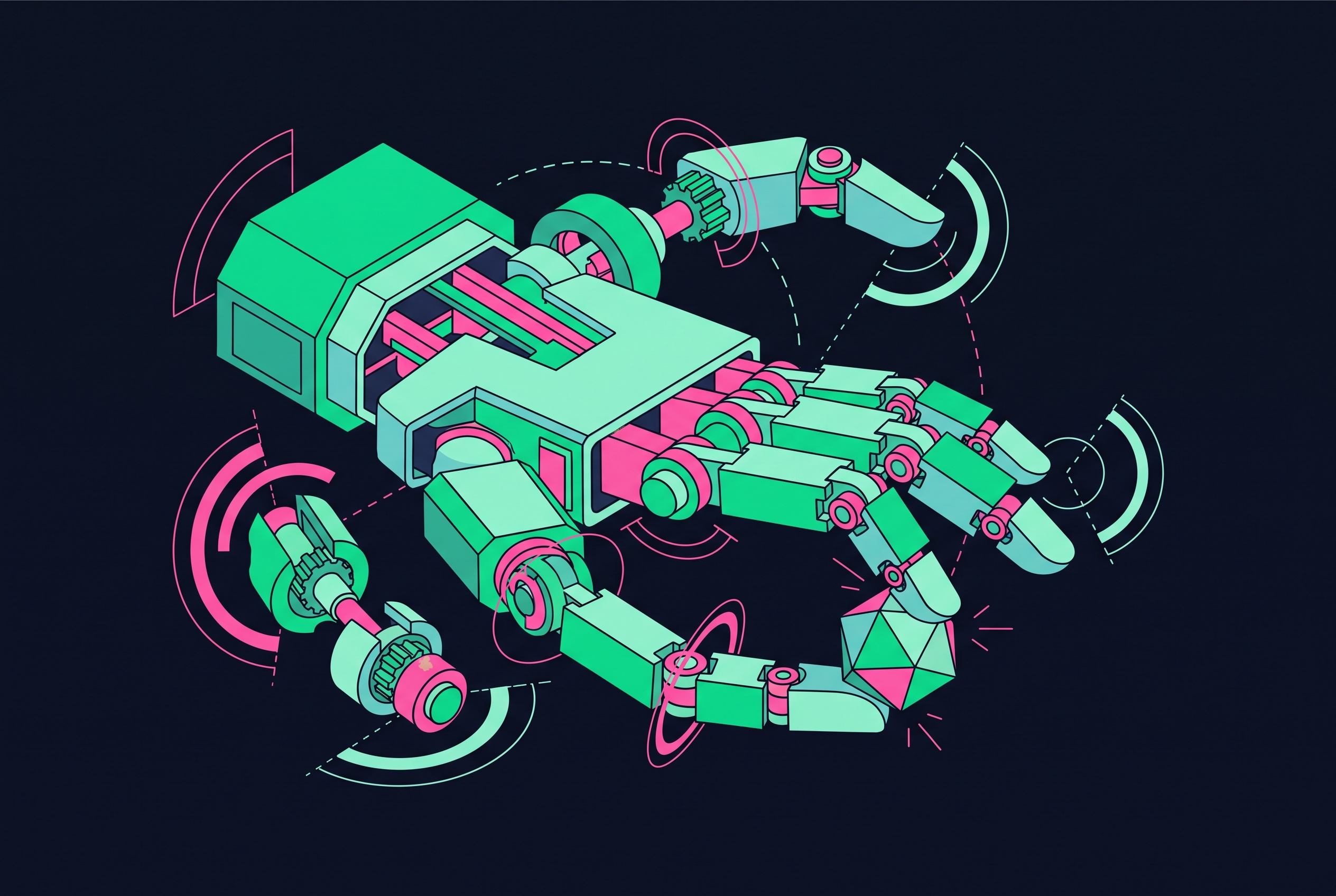
Action chunking is the structural hinge that connects the VLM backbone's slow, semantic reasoning to the action expert's fast, continuous output. Rather than predicting one motor command at a time, the action expert generates a chunk, a sequence of commands spanning multiple timesteps, from a single conditioning pass over the backbone's representation. That matters because a sentence like "fold the sleeve" or "place the cup" decomposes into a string of motor primitives that unfold over a second or more. Chunking also makes the underlying flow matching objective easier to learn. Fitting a velocity field to single-step residuals tends to produce noisy, poorly conditioned targets, while learning a trajectory-level distribution over an entire chunk gives the model a smoother, more learnable signal from demonstration data. The chunk size is a deliberate match between the timescale at which a semantic intention gets issued and the timescale at which that intention breaks down into fluent motion.
The architecture's practical performance across tasks and robot types
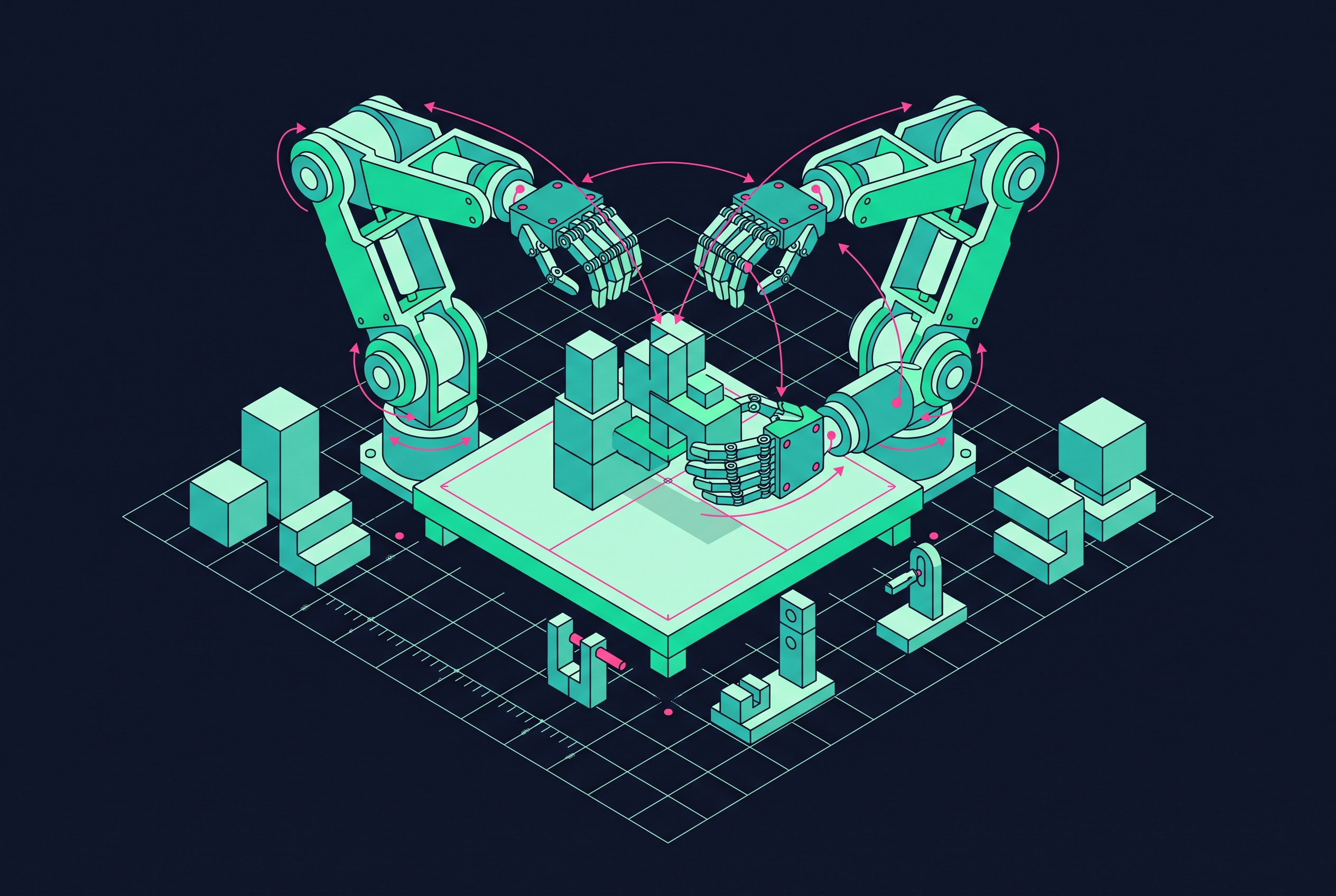
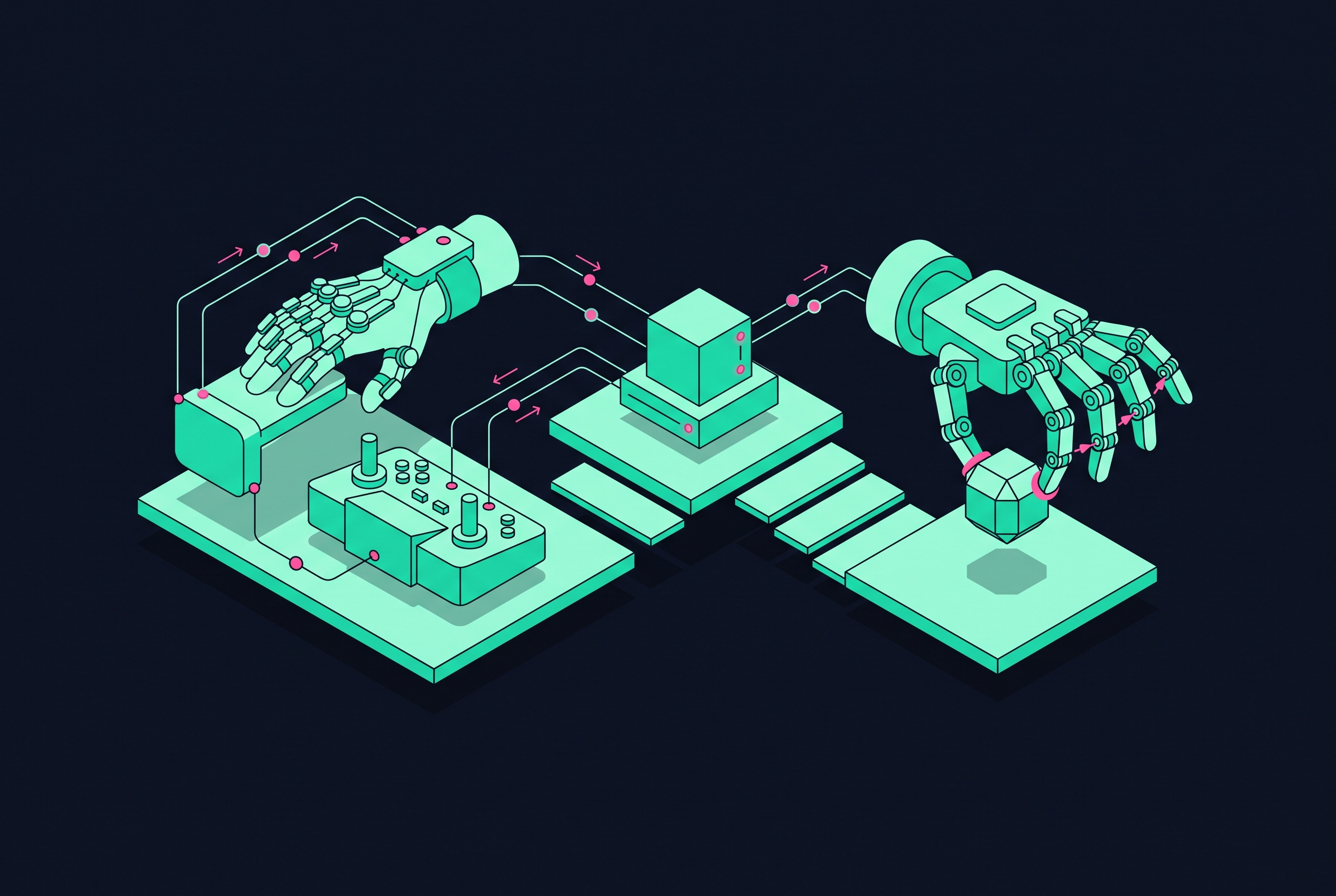
You can see the division of labor between semantic understanding and motor control directly in benchmark results. PI Zero outperformed every prior open generalist robot policy tested against it, across two different kinds of comparison. OpenVLA and Octo were fine-tuned generalist models, trained with broad pretraining much like PI Zero itself, while ACT and Diffusion Policy were trained from scratch using only the fine-tuning data, with no broader pretraining behind them. That split matters: it isolates how much of PI Zero's advantage comes from the architecture itself rather than from simply having more data to train on. The tasks chosen to probe this gap, folding multiple articles of laundry, assembling a box, busing a table, are exactly the tasks that expose what a single-module architecture struggles with. Each demands long task horizons, handling of deformable objects, or coordination between two arms, so each punishes a model that can't ground the semantics of a multi-step task or can't produce fluent continuous motion once it has. PI Zero also works directly from a prompt without any fine-tuning, and it can be fine-tuned further on high-quality demonstrations for more complex multi-stage tasks. The same architecture supports both modes because the VLM backbone's semantic grounding is general enough to interpret instructions it has never seen phrased that way before. None of this is surprising given the design: a backbone that already understands language and scenes, paired with an action expert that already handles continuous motion well, should outperform models forcing one module to do both.
The gradient interference problem that the clean design creates
The clean separation between backbone and action expert does not eliminate every tension in the design, it relocates one. When the flow matching action expert is coupled to the backbone naively during training, the action expert's gradients flow backward through the shared transformer and degrade the backbone's pretrained representations. The direction of the damage matters: the backbone's pretrained weights encode rich visual-linguistic knowledge built from internet-scale data, and backpropagating the action expert's loss through those weights pulls them toward the action objective instead, at the cost of language-following ability and training speed. The π₀ recipe, used without further modification, shows this degradation directly, not as a hypothetical risk but as an observed property of the base design. The two components can't simply share gradients freely: the action expert needs the backbone's representations to condition on, but the very backward pass that lets training happen also contaminates those representations. This is the direct consequence of the architecture's own ambition: inheriting a VLM's semantic knowledge while simultaneously training a continuous action generator attached to the same weights.
Knowledge insulation as the fix that preserves what pretraining built
π₀.5 resolves this tension with a technique called knowledge insulation, which takes the separation of concerns from an architectural intention to a structurally enforced rule. Rather than training the backbone and action expert jointly from the start, the VLM backbone is first pretrained on discretized actions and general vision-language data to build the transferable representations the whole system depends on. Only after that is a randomly initialized action expert added and trained separately with flow matching on continuous actions. At inference time, the frozen backbone still contributes its broad visual-linguistic understanding, while the lightweight action expert generates the continuous output, and the separation of concerns that the original architecture only intended is now enforced at the level of gradients rather than left to the optimizer's discretion. This is the mechanism that actually protects the base-tier inheritance the data pyramid depends on: the billions of image-text pairs baked into the backbone survive the process of training an action generator on top of them, instead of being slowly overwritten by it. The payoff shows directly in training speed and in preserved language-following capability, because the backbone's weights are never pulled toward the action objective.
The continuous-versus-discrete tradeoff that knowledge insulation does not fully settle
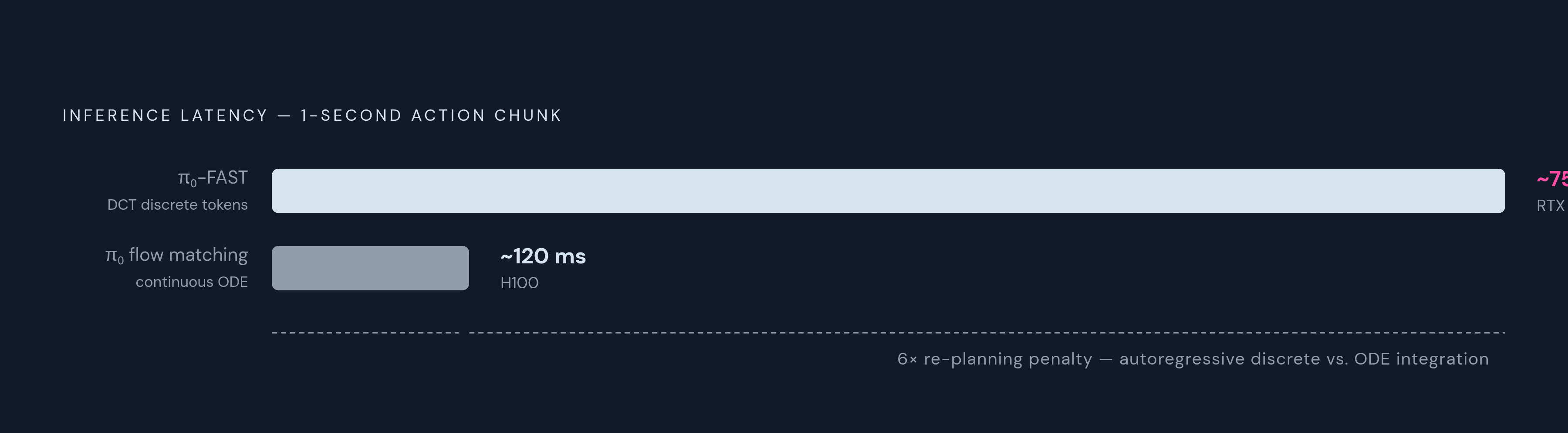
Knowledge insulation fixes gradient interference, but it doesn't settle a separate and older disagreement: whether continuous flow matching or discrete tokenization is the better way to generate actions. Both solve real problems and introduce different costs, and the PI Zero lineage's own evolution shows that neither one wins. π₀-FAST, released in February 2025, takes a different route to avoiding gradient interference by encoding action chunks with a discrete cosine transform rather than naive binning, reaching token compression of up to 13.2× along with smoother trajectories, at the cost of autoregressive inference and weaker performance on delicate, fast-changing tasks. The inference time for π₀-FAST to predict a one-second action chunk runs around 750 ms on an RTX 4090, against substantially less for the flow matching variant running on an H100, a gap that counts heavily for tasks that depend on fast re-planning. The DCT approach is cleaner for training stability, but it gives up the continuous, multi-modal representation that flow matching offers. The tradeoff shifts from one problem to another rather than disappearing. π₀.6, released in November 2025, responds by refusing to choose: it generates action chunks using both flow matching and tokenized discrete outputs within a single architecture. That hybrid stance is itself evidence that the field hasn't landed on a single correct answer yet, and it says something favorable about the underlying architecture that it can absorb either strategy, or both at once, without abandoning the backbone and action-expert split that defines it.
Extending the lineage toward longer horizons and reinforcement learning
Every major extension beyond the original PI Zero design, hierarchical subtask prediction, multi-scale memory, reinforcement learning post-training, builds on top of the backbone and action-expert split rather than replacing it, which is itself a strong vote of confidence in the original separation of concerns. π₀.6, from November 2025, keeps the hierarchical structure introduced in π₀.5: the backbone handles high-level subtask prediction, while the action expert handles low-level continuous action generation. It adds RL post-training through a method called RECAP, which improves success rate and throughput on real-world tasks, and the base pretrained model shows stronger generalist performance even without task-specific fine-tuning. The backbone in this version initializes from a Gemma3 model, and the action expert is built with the same number of layers as the backbone it pairs with. π₀.7, dated April 2026 (arXiv:2604.15483), adds Multi-Scale Embodied Memory, a memory system Physical Intelligence published separately in March 2026 (arXiv:2603.03596), giving the model both long-term and short-term memory so it can handle tasks that run past ten minutes. The sources describe this as enabling emergent generalization capabilities in what they call a steerable generalist robotic foundation model. None of these additions touch the basic division between semantic understanding and continuous motor control that PI Zero established. They extend it, which is the clearest sign that the original separation was the right one to build on.
Sources
- $π_0$: A Vision-Language-Action Flow Model for General Robot Control
Provided details on the PI Zero vision-language-action flow model architecture, including the two-component design and flow matching action expert.
- Physical Intelligence (π)
Served as the primary source for details on PI Zero extensions including π₀.7 and its memory capabilities enabling tasks past ten minutes.
- 𝜋_0: A Vision-Language-Action Flow Model for General Robot Control
Primary technical source for the PI Zero architecture, covering the mmDiT-style joint attention, Transfusion lineage, action chunking, and benchmark comparisons against OpenVLA, Octo, ACT, and Diffusion Policy.
- π0: A Vision-Language-Action Flow Model for General Robot Control
The official PI Zero paper providing architectural specifics including the data pyramid, cross-embodiment pretraining across 7 robot configurations and 68 tasks, and the gradient interference problem.