1X Technologies NEO Robot Hardware Architecture
Safety through biomimicry: how 1X built compliance into every layer of NEO.
Most humanoid robots on the market today are built around rigid, high-torque actuators tuned for speed and strength, because speed and strength are what sell a demo reel. The tradeoff is a machine that, if something goes wrong near a person, can cause real harm. 1X built NEO around safety as the starting point, with every structural decision answering to that one constraint. The company's engineers looked to the human body itself for the template, since muscles don't bolt directly onto joints: they pull on tendons, which transmit force at a distance and with give. That indirection is what makes a human arm compliant and a direct-drive robotic arm stiff, and it's the reason 1X chose tendon-based transmission as NEO's foundational mechanism rather than an afterthought bolted onto a stronger, faster frame.
The Revo2 actuator: biomimicry in physical hardware
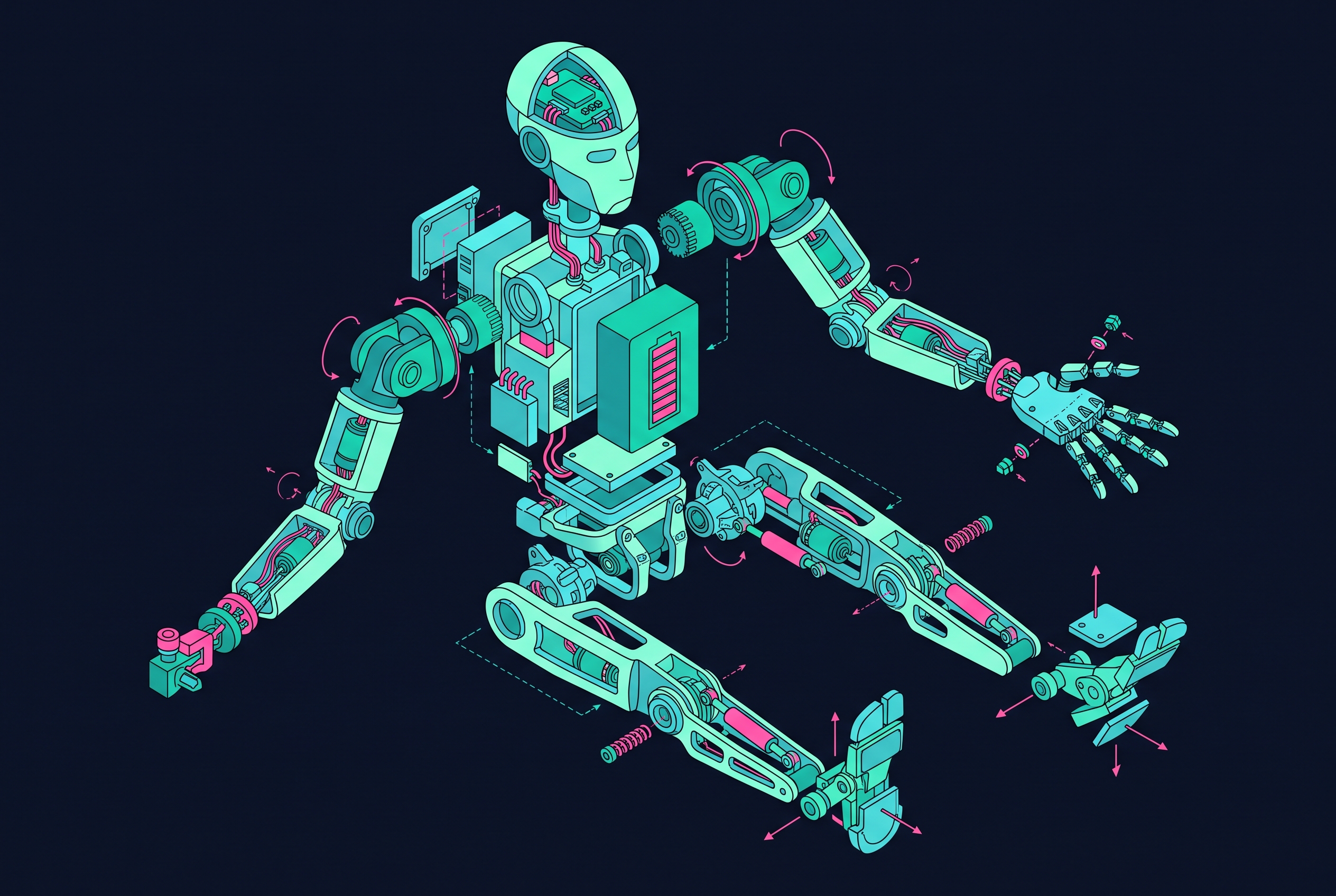
The patented Tendon Drive system is where you can see that safety-through-biomimicry idea become physical hardware. NEO's joints don't couple a motor directly to a joint; instead, tendon-based transmissions drive them, the same basic arrangement that lets a human elbow give way before it breaks something. At the center of this system is the Revo2 motor, which 1X describes as among the highest-torque-density motors built anywhere, and it is assembled from raw copper spools wound on machines that 1X's own engineers designed and built in-house. Backdrivability of 95% means the joint yields when it meets resistance, the same property that lets a human limb absorb an unexpected impact. Positional repetition of 0.1 mm means NEO can still handle precise manipulation without needing the stiffness that makes conventional rigid actuators dangerous around people. Acoustic noise measured at 22 dB, quieter than a modern refrigerator, follows directly from the low inertia of a tendon drive rather than the gearing found in conventional actuators. None of this came together quickly: 1X states the Revo2 has been in development since 2015, starting in Moss, Norway, well before the current wave of consumer humanoid companies existed. That timeline matters, because it signals the actuator wasn't reverse-engineered to hit a launch date. It was built first, and the rest of the robot was built around it.
From actuator-level compliance to full-chassis safety
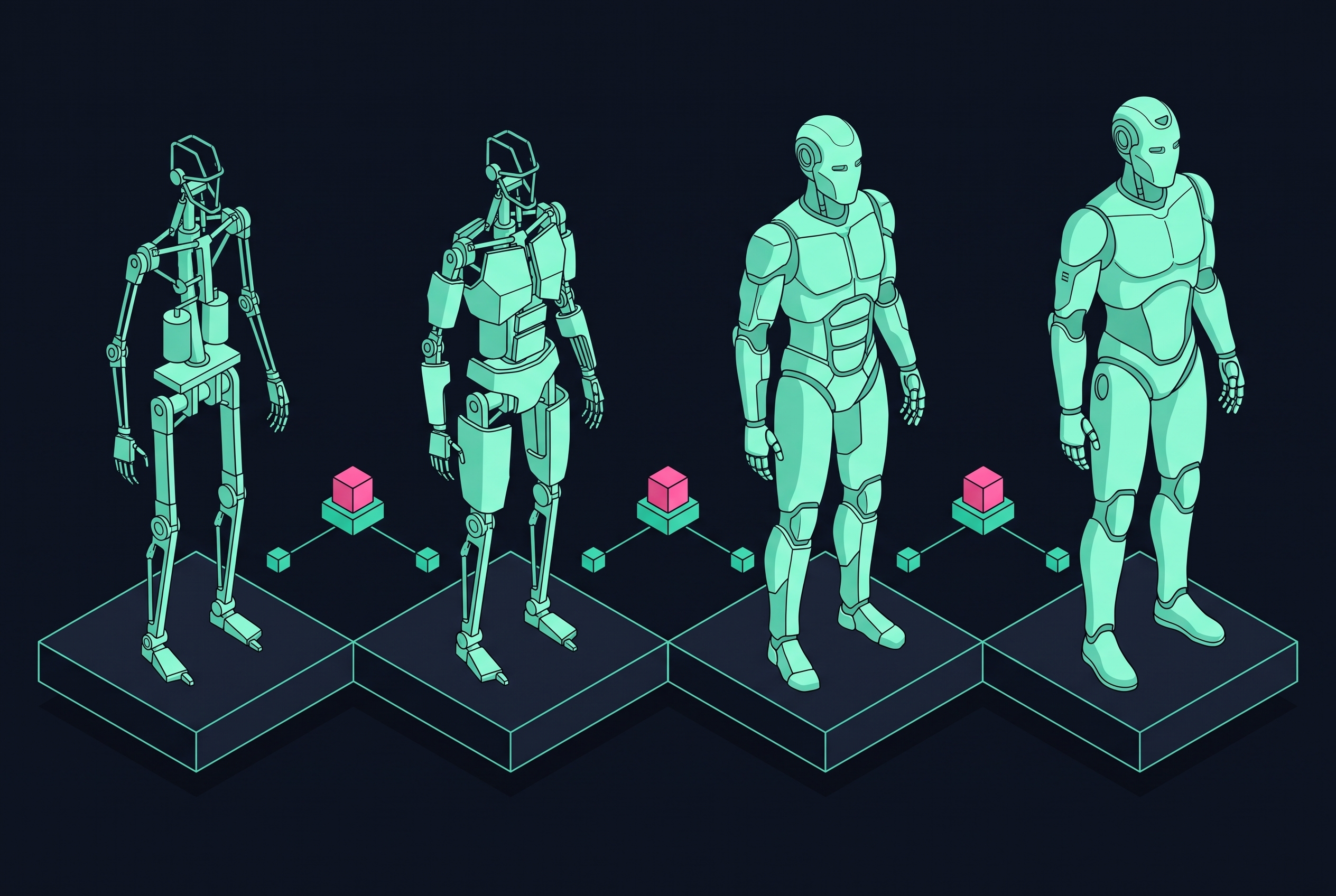
The compliance built into the Revo2 at the joint level doesn't stop there. It carries through into how the whole body is constructed. NEO is wrapped head to toe in custom 3D lattice polymer structures that cushion contact and hide pinch points, so the same yield-on-contact logic from the actuator extends out to the skin of the robot. A Head Injury Criterion rating below 250 and a pinch-proof joint design are the measurable result of combining a soft exterior with backdrivable tendon actuation. The joint layout follows the same reasoning: 22 degrees of freedom per hand, 7 per arm, 3 in the neck, 2 in the spine, and 6 per leg, adding up to 75 degrees of freedom across the body. That distribution mirrors how joints are arranged in a human body instead of chasing an industrial task's narrow set of motions, and that choice is itself a biomimicry decision as much as the tendon drive is. The body's relationship to its environment carries the same logic forward: an IP68 rating on the hands and IP44 on the body, plus a machine-washable knit suit and shoes, treat NEO as something that will get wet, dirty, and handled around children and pets, the way any object living in a house gets treated. The lattice polymer, the joint layout, and the overall weight of the robot all point back to the same single argument: a body engineered to yield.
The sensor array and runtime safety enforcement
A compliant body only matters if the robot knows, moment to moment, what's happening to it. The sensor array described in 1X's patent filing is what turns the mechanical safety properties built into the Revo2 and the chassis into something enforced in real time. Torque cells sit inside the actuators and measure the force applied at each joint, and they feed that reading back to a whole-body controller the way proprioception feeds a human limb its own sense of position and load. That torque feedback is what makes the 95% backdrivability figure from the Revo2 operational rather than theoretical: the joint doesn't just have the physical capacity to yield, it has the sensing to know it needs to. IMUs configured in a "linkwise differential" arrangement track velocity and acceleration across individual links rather than only at the body's center of mass, with AI-based continuous adaptation keeping that tracking current as conditions change. Vision, hearing, touch, proximity, and environmental sensors round out the rest of the perceptual stack. On the compute side, the 1X NEO Cortex platform is built around the NVIDIA Jetson Thor architecture, so it gets the throughput it needs for local, real-time reasoning and for fusing input from multiple sensor types at once. Vision itself comes from dual 8.85 MP, 90 Hz stereo fisheye cameras paired with four beamforming microphones, a combination suited to reading a cluttered living room. Wi-Fi, Bluetooth, and 5G round out the communication layer, so the compute loop can reach beyond the robot's own hardware when latency allows. This is the nervous system that makes the mechanical safety properties built into the actuators and the chassis actually hold up once the robot is moving around a real room.
The July 2026 hand upgrade: a generational shift
The most significant hardware change since NEO's October 2025 launch arrived in July 2026, when 1X introduced a new hand with 25 actuated degrees of freedom, up from the 22-DOF hands shown at launch. The bigger change sits in where the actuators live: they're placed in the forearm rather than the hand itself, copying the same muscle-proximal, joint-distal arrangement found in a human forearm and hand. That relocation isn't a cosmetic choice. It reduces mass and inertia at the fingertip, which improves both the safety and the speed of finger movement, following the same backdrivability logic that defines the Revo2 at the shoulder or elbow. It also mirrors how human hand muscles split between the palm and the forearm, so the biomimicry argument carries down to the level of individual fingers. Sensors embedded in the hand's skin, concentrated at the fingertips, detect pressure and contact, so the same torque-cell sensory logic described in the body extends out into the fingertips themselves. What this new hand can actually do demonstrates that the added degrees of freedom aren't just a bigger number on a spec sheet: assembling LEGO structures, picking up individual screws, spinning in and installing light bulbs, operating a screwdriver, zipping a jacket, plugging in a USB-C charger, and communicating in sign language. That range, from high-precision fine motor work to gentle, compliant handling, is the clearest evidence that the DOF increase bought real task capability. None of it reads as a correction of something that didn't work in the original hand. It reads as the same design principle, applied with more completeness the second time around.
Vertical manufacturing control and real-world delivery
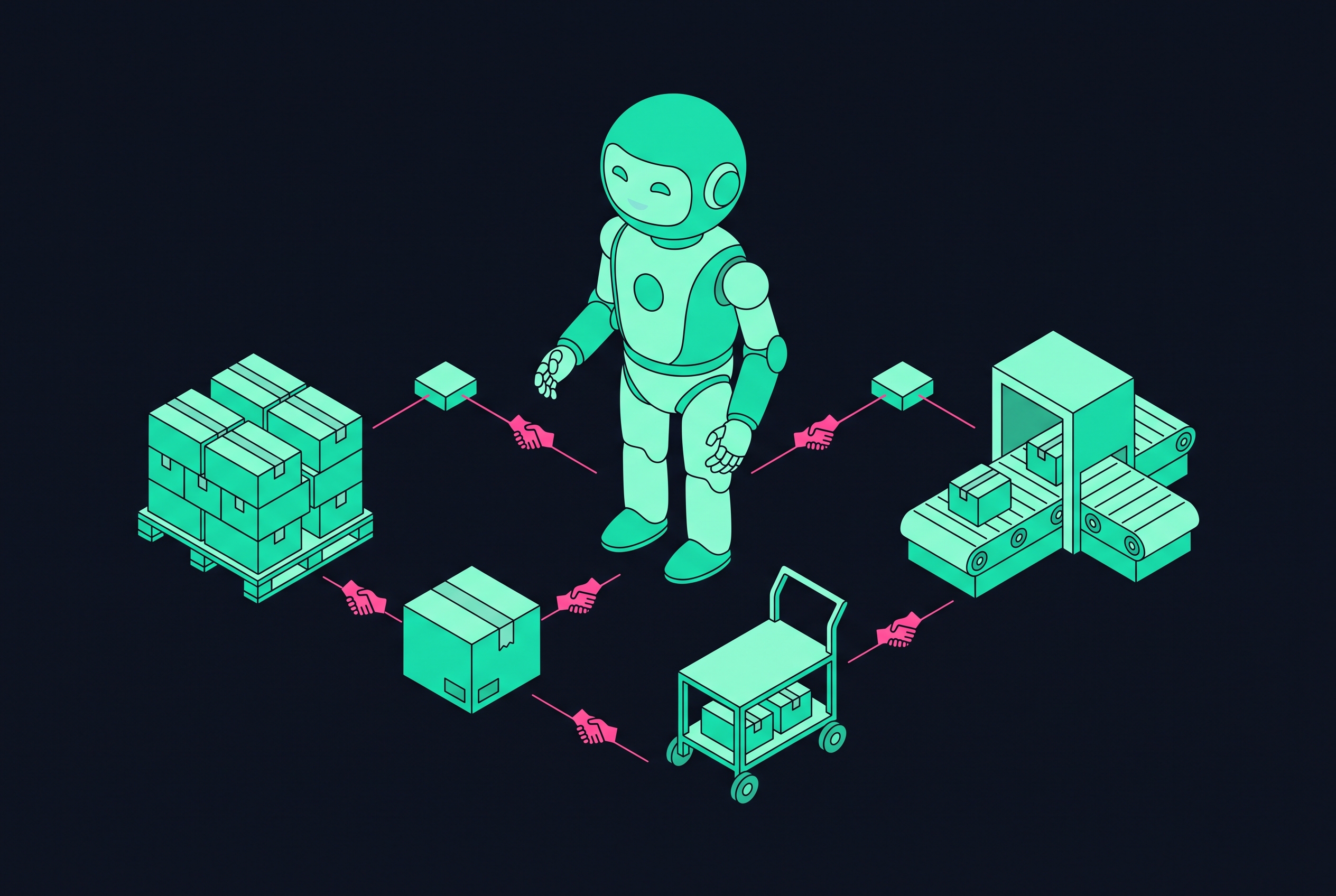
None of the architecture described so far works as a shipping product unless 1X also controls how its parts get made. Because custom Revo2 motors, 3D lattice polymer body panels, tendon transmission systems, and purpose-built sensors aren't off-the-shelf components and won't scale if outside suppliers make them, 1X designs and manufactures its own motors, batteries, structural parts, transmission systems, soft goods, and sensors in-house. The company's Hayward factory has already produced a substantial number of motors on fully automated lines that wind copper coils from raw material, a level of manufacturing depth that few consumer robotics companies attempt to build themselves. Owning that process pays off directly for the safety argument made throughout this piece: in-house production lets 1X iterate quickly on safety-critical parts and hold a line on quality that would be far harder to guarantee through outside vendors. Every unit built is designed to be fully traceable digitally, and the factory runs on continuous flow with components arriving pre-kitted, instead of being organized into the traditional departments that slow iteration down. 1X states it expects to build around 10,000 hands in-house in 2026, a number that sets a hard ceiling on production for a robot that took 10,000 pre-orders in five days starting in October 2025. Production capacity and order volume line up almost exactly, but only if 1X hits that manufacturing target. That gap between what the factory is built to produce and what customers have already asked for is where this architecture meets its first real-world test.
The architecture's limits: autonomy, teleoperation, and the training data gap
Hardware built for safety around people solves one problem, not all of them. Moving safely is not the same as knowing how to do every task a home might ask of a robot, and a substantial but incomplete autonomy rate has circulated in coverage of NEO's launch, though 1X itself has not published that figure directly. For whatever a robot can't yet do on its own, 1X built the Expert Mode teleoperation system: an operator connects through a VR headset during windows the user schedules, with the user approving each session individually. That system does two things at once. It completes the task the robot couldn't manage alone, and it generates the training data that lets the autonomy system eventually learn to do that task without a human in the loop. There's a hard limit built into the economics of this approach: each robot can only absorb a fixed amount of paid human operator time per day before the monthly subscription stops making financial sense, and that limit functions as a real design boundary, as concrete as anything written into the Revo2's spec sheet. 1X's answer to that limit arrived in January 2026 with the 1X World Model, a video model grounded in real-world physics, and it lets NEO learn new tasks from text-conditioned video generation instead of relying only on teleoperated demonstrations recorded by a human operator. The point of the World Model is to cut the dependence on live human demonstration by generating synthetic rollouts of what might happen next, rather than requiring a person to show the robot every task by hand. None of this points to a weakness in how NEO's safety hardware is built. It's the expected shape of what happens when a safety-first hardware platform reaches people's homes before the AI stack driving it has fully caught up, and both teleoperation and the World Model are structural features 1X built into the system for exactly that reason, not patches covering for something that failed.
The coherence of the architecture: competitive strength and defining bet
The Revo2's tendon drive, the 3D lattice polymer body, the 75-degree-of-freedom joint layout, the linkwise-differential IMUs, the forearm-actuated 25-DOF hand, and the in-house motor manufacturing in Hayward all trace back to one design principle: safety achieved by copying the structure of a human body. That coherence is what sets NEO apart from humanoid platforms built the other way around, where speed and payload come first and safety gets added in afterward as a constraint on top of an already-finished design. It's also what makes the commitment so difficult to walk back. If a company starts with raw torque and bolts on safety later, it can swap components without rethinking the whole machine. A company that builds every layer, actuator, chassis, hand, sensor suite, and factory floor around a single founding principle has tied its fate to that principle holding up at every layer, all the way down to the copper coil winding machines on the Hayward factory floor.
Sources
- NEO Home Robot
Served as the primary source for NEO's hardware specifications, sensor array, and Expert Mode teleoperation system details.
- Bipedal action model for humanoid robot
Provided technical details on the sensor architecture, including the linkwise-differential IMU configuration and torque cell arrangement described in the patent filing.
- 1X NEO Home Robot
Supplied specifications for the Revo2 actuator, degrees of freedom, IP ratings, and manufacturing details including the Hayward factory.
- 1X Unveils NEO Beta, A Humanoid Robot for the Home
Provided context for NEO's October 2025 launch, pre-order figures, and the initial hardware configuration including the 22-DOF hands.