Agility Robotics Digit Factory Deployment at Amazon
Digit proved useful at Amazon, but safety approval blocked scale.

Amazon’s work with Agility Robotics’ Digit shows how humanoid robots earn a place in logistics through a specific task. Tote recycling showed that the robot could do useful work, but safety requirements kept the pilot from growing into a scaled commercial deployment. Operational usefulness and permission to work near people are separate tests, and humanoid automation must pass both.
Why warehouses turned to humanoid robots for tote recycling
Logistics operators face rising throughput demands while struggling to retain workers for repetitive physical tasks. Tote recycling sits directly at that intersection. Once pickers empty a tote of inventory, someone must collect and return the container, and that loop runs around the clock in a large fulfillment center. Traditional automation has limits here because fixed arms need changes to the infrastructure, while single-purpose autonomous mobile robots, or AMRs, can move totes but cannot pick them up from different places on the floor. Warehouses already have shelving, conveyors, and aisles arranged for people, so a robot that can use those spaces offers a route to automation without rebuilding the facility.
What Digit is and how it was designed to fit human-built spaces
Digit’s humanoid form is a deployment strategy intended to let it operate in existing facilities and handle several steps within a workflow. Those steps include transferring totes between AMRs and conveyors and stacking them in different locations. Amazon Robotics Director of Engineering Emily Vetterick expressed the customer’s rationale directly. “Digit's size and shape are well-suited for buildings that are designed for humans”.
The control stack supports that physical flexibility. Agility blends traditional control methods with teleoperated demonstrations, policy training, reinforcement learning, and simulation to develop skills and refine them for real-world conditions. This approach is intended to make learned behavior usable in an industrial workflow, rather than establish performance through a demonstration alone. Agility Arc provides the cloud-based platform for deployment, fleet orchestration, and operational management across multiple facilities. Together, the robot and management platform address both the individual handling task and the coordination needed for broader operations, although neither by itself establishes that a deployment meets a customer’s safety requirements.
How the Amazon pilot actually unfolded — and what it did not become
The Amazon Industrial Innovation Fund’s public disclosures place Amazon’s $150 million investment in 2022. In October 2023, Amazon said it would test tote recycling at a robotics R&D facility in Sumner, Washington. Digit did useful work in those tests, showing that it could handle tote recycling. The relationship did not become a commercial rollout. Amazon showed Agility what it had taken to certify its own wheeled robot through years of safety review and said it did not know how a balancing biped would reach the same standard.
An Agility spokesperson described the relationship in June 2026. “We have been actively engaged with Amazon since their investment in 2022 and have completed multiple pilots with them. We are looking forward to working with them again once we launch the next generation of our robot.” As of mid-2026, Amazon remained a pilot partner with conversion to a commercial robotics-as-a-service, or RaaS, customer relationship still pending, and a public multi-site Amazon commercial deployment remained unestablished as of November 2026. The pilot clarified the obstacle to expansion rather than showing that Digit could not perform the task.
What safety certification actually requires in a live industrial environment
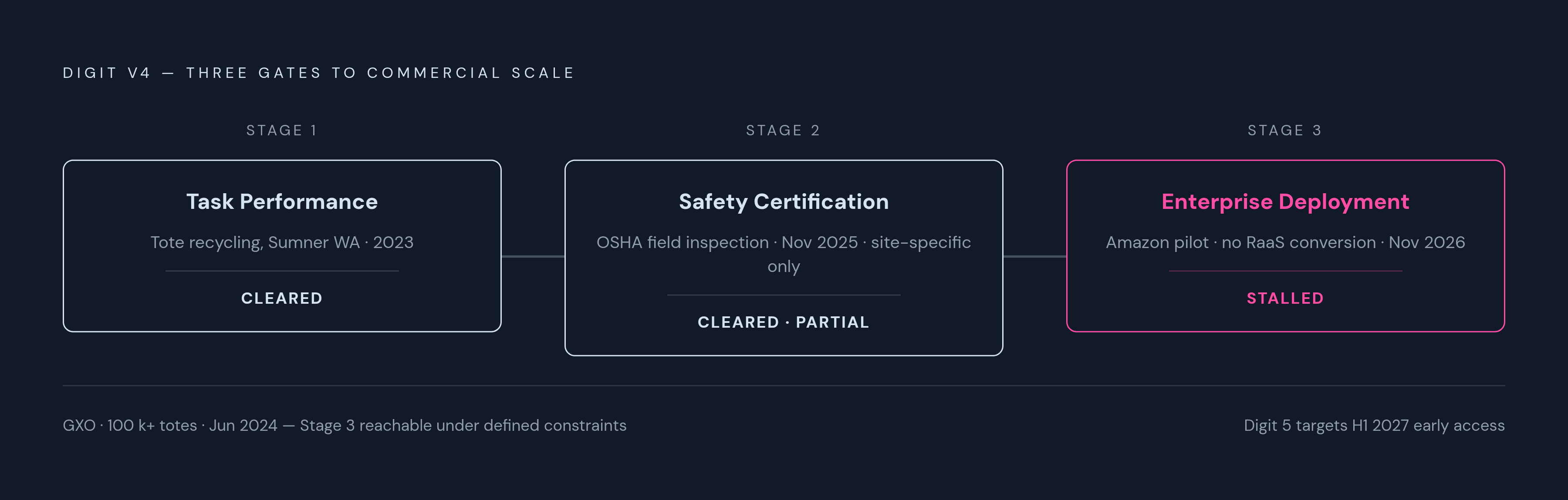
A balancing humanoid presents a harder industrial safety problem than a wheeled robot. Digit v4 nevertheless had a genuine industrial safety architecture, including a CAT1 stop, Safety PLC at PL d, E-stops, and FailSafe over EtherCAT. In November 2025, Digit became the first humanoid to pass an independent field evaluation on a customer production line for industrial safety standards administered by OSHA.
The scope of that assessment is decisive. A field inspection establishes safety for the configuration at the inspected site, with product certification for fence-free deployment wherever a customer wants to use the robot remaining outside its scope. Earlier versions of Digit required physical separation from workers, restricting both their placement and their usefulness in collaborative workflows. Passing the inspection was therefore a step forward, but it still fell short of Amazon’s broader requirement. The remaining barrier was not simply another task to learn, but the safety basis on which a legged robot could operate near people across demanding industrial environments.
What GXO's deployment revealed about where Digit v4 actually works
GXO Logistics had a different result under set conditions for how the robot could work. Its multi-year commercial RaaS agreement in June 2024 was the first formal deal to put a humanoid robot to work in live commercial operations. At its Flowery Branch, Georgia facility, Digit has moved more than 100,000 totes. The deployment established that tote handling could move beyond an R&D setting when the workflow and safety conditions supported it.
As the world’s largest pure-play contract logistics provider, it has a large workforce spread across hundreds of facilities. Agility’s strategy is to establish value in an initial deployment and then expand across a customer’s operations, making that footprint commercially significant. But the Flowery Branch result does not show that the same robot can meet every operator’s requirements. It demonstrates useful work within defined constraints that Amazon’s safety review process had not accepted for a legged robot at scale.
How Amazon's safety feedback shaped the design of Digit 5
Agility co-founder Jonathan Hurst credits lessons from Amazon, GXO, Toyota, and Schaeffler with shaping Digit 5. Agility unveiled the robot on September 15, 2026, from Salem, Oregon, describing it as its first humanoid engineered for cooperatively safe work at scale. Cooperative safety means designing the robot to work in close proximity to people without the separation required by traditional automation. Its independent safety controller and cooperative-safe architecture therefore aim to solve the problem Amazon raised, going beyond better performance within the earlier limits on where it could work.
Digit 5 has a new leg design engineered for repetitive lifting and powered by proprietary cycloidal actuator technology. It can lift loads up to 50 lb (22.7 kg) over and over, a payload increase of roughly two-fifths over what it could lift before, so it can cover the full range of single-person lift tasks in OSHA-regulated facilities. Agility also announced more than $300 million in committed multi-year orders with the unveiling. These changes give substance to the spokesperson’s earlier reference to returning to Amazon with the next generation, but design intent and orders do not establish a certified outcome. Cooperative safety still needs to be proven at commercial scale.
What the revenue gap reveals about where humanoid deployment actually stands
Agility’s financial filings provide a necessary counterweight to those commitments. The company generated minimal revenue during 2025 against a $138.1 million net loss, with more than half of that revenue coming from five robots bought by one of its own investors. Revenue in the first half of 2026 was a small fraction of the prior full year, while the net loss grew sharply year over year. Operational progress had not yet produced revenue at scale. The SPAC valuation therefore prices in a scale-up that the operating business has not yet realized, rather than reflecting an already established revenue base.
Digit v4 has accumulated substantial operating hours across nine committed customer deployments, while Amazon, the largest potential account, has not converted to a commercial relationship. In that account, certification was the documented constraint on expansion after successful tote-recycling tests. The distinction explains why evidence of useful work can coexist with limited revenue, although it does not prove how quickly sales will grow. Digit 5’s early customer access is planned for the first half of 2027, with general availability targeted for the end of 2027, placing the investment thesis on a product whose broader validation is still to come.
What the broader customer base reveals about where humanoids fit in real operations today
Agility’s October 2026 filing describes a customer base spanning commercial deployments and earlier-stage programs. GXO’s expansion to Statesville, North Carolina and Lebanon, Tennessee is planned for early 2027. Toyota Motor Manufacturing Canada reached a commercial agreement following a successful pilot, while Schaeffler, an Agility investor, is deploying Digit in automotive manufacturing operations. Mercado Libre, Latin America’s leading e-commerce and fintech company, is also part of the customer base.
AGCO’s agreement illustrates that distinction particularly clearly. Its commercial agreement, announced October 20, 2026, covers a Digit pilot at its Hesston, Kansas production facility expected to begin in 2027. Three additional enterprise manufacturing customers are in paid programs and have chosen not to be identified publicly. They are a major global automaker selling more than three million vehicles annually worldwide, one of the world’s largest developers of automotive technology and components, and a leading global consumer products manufacturer with a diverse portfolio of well-established brands. Two potential subcontract engagements supporting a branch of the U.S. Armed Services are at an early stage, with no agreements signed.
Across the customer base, the opportunity centers on repetitive, physically demanding material handling in human-built facilities where task variety makes fixed automation impractical. Agility’s Customer Acceleration Program gives customers a set process to test whether Digit meets their needs on the job before they commit to putting it to work more widely. Its pipeline of more than 30 prospective customers spans manufacturing, automotive, aerospace, defense, logistics, and consumer products, reflecting the breadth of that problem across sectors where adoption remains prospective. Digit 5 is also planned for commercial deployment outside North America for the first time, including the European Union and United Kingdom, extending the proposed market without yet establishing results there.
What the Amazon deployment — pilot, constraint, and redesign — actually teaches about humanoid automation
The Amazon engagement’s most consequential output was a safety problem stated clearly enough to become an engineering target. Tote-recycling tests established compatibility with human-built warehouse infrastructure, while the certification discussion exposed the gap between useful task performance and permission for enterprise-scale operation. GXO showed that the robot could do commercial work under set conditions. Digit 5 now attempts to broaden those conditions through a different safety architecture, but that attempt cannot yet be treated as a validated answer to Amazon’s requirements. The distinction is between a capability demonstrated in operation, a constraint addressed in design, and an approval still to be earned.
RoboFab’s Salem, Oregon facility has annual capacity for up to 10,000 robots, a bet on certification and demand, while Agility Arc and the Pittsburgh service and software expansion support the intended growth in operations. It is not evidence that either will arrive at the scale planned, just as a successful site inspection cannot stand in for product-level acceptance. As of November 2026, the unresolved question is whether Digit 5’s architecture will satisfy Amazon’s certification standard when early customer access begins in 2027.
Sources
- Churchill Capital Corp XI - Form 425 - FY2026
Supplied details on Agility's Digit 5 launch, committed orders, and customer base from the merger communication.
- Churchill Capital Corp XI - Form DRS/A - FY2026
Provided early disclosures on Agility's financials, Amazon relationship, and customer deployments.
- Churchill Capital Corp XI - Form S-4/A - FY2026
Contributed the revenue, net loss, customer pipeline, and safety-certification details in the amended merger filing.
- Churchill Capital Corp XI - Form S-4 - FY2026
Supplied the Amazon pilot history, customer programs, and risk discussion from the original S-4 registration.
- Churchill Capital Corp XI - Form 424B3 - FY2026
Provided the final prospectus figures on customers, the Digit 5 timeline, and RoboFab capacity.
- DCVC
Described Digit's human-form design rationale and Agility's strategy for human-built facilities.