Apptronik Apollo Commercial Partnerships and Use Cases
Human-scale robots avoid costly factory redesigns by fitting into existing workflows.
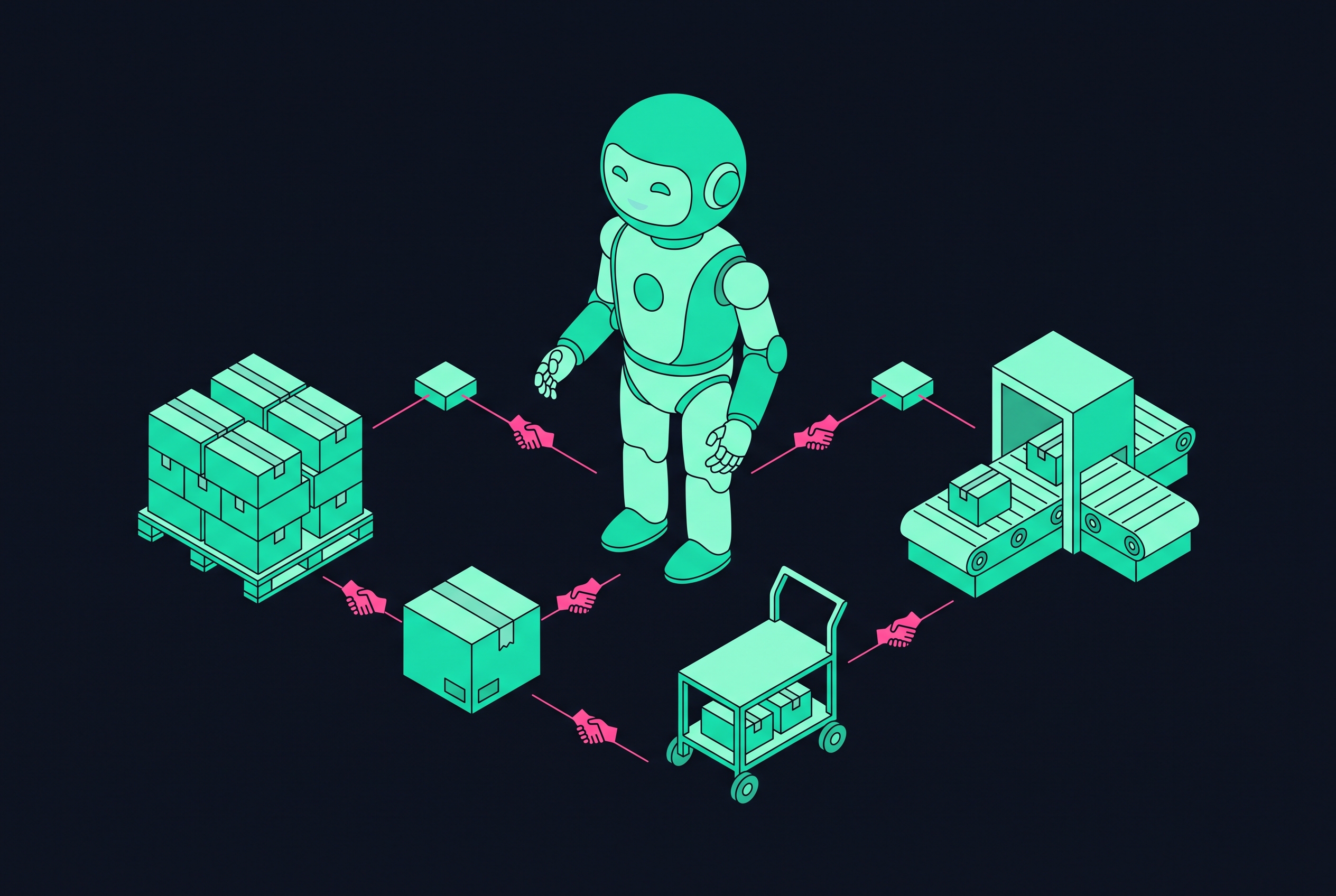
Apollo's commercial premise rests on a simple constraint: factories and warehouses are built around human dimensions, and any robot that cannot match those dimensions forces costly retrofits. Apptronik's partnership strategy is a deliberate sequence designed to prove that a human-scale robot can slot into existing workflows without rebuilding the facility around it. The argument begins with the physical world. Aisle widths, shelf heights, workstation geometry, the height of a conveyor, the reach needed to place a tote on a cart: all of these were specified for human operators decades ago. Reconfiguring a production line to accommodate an oversized machine can cost more than the machine itself, and it disrupts production while the retrofitting happens.
Apollo is sized to avoid that tax. At 5 feet 8 inches tall and 160 pounds, the robot occupies roughly the footprint of an adult worker. It is not stronger than a forklift. It is deliberately matched to the envelope of a human body, and the consequence is that it can operate in spaces where a person already operates, reaching the same shelves, walking the same aisles, and working at the same workstations. The Mercedes-Benz agreement framed this directly: Apollo enables automation "without full-scale facility redesigns that are built around robots rather than people."
That sentence is the core of the commercial thesis. The obstacle to industrial automation is not capability. It is the cost of changing the environment to suit the machine. A robot that fits the environment as it exists removes that obstacle at the source. The force-control architecture reinforces the same point. Apollo is designed for collaborative safety around people, analogous to a collaborative robot rather than a caged industrial machine. A robot that must operate behind fencing reintroduces the redesign problem in a different form. A robot that can work alongside people, slowing or stopping as needed, inherits the factory's existing layout without modification.
The versatility argument follows from the form factor. A robot matched to human scale can address thousands of tasks across a facility. A specialized machine addresses one. CEO Jeff Cardenas stated the contrast cleanly: "one robot to do thousands of tasks, versus a thousand robots doing a single task." If the robot's physical form matches the environment, then the marginal cost of teaching it a new logistics task is software, not facility engineering. The partnerships that follow are each a test of that claim in a different industrial setting.
How the Mercedes-Benz agreement defined the template for every partnership that followed
The Mercedes-Benz agreement, announced in March 2024, crystallized the specific use case Apollo was built to own: delivering kitted parts to the production line without touching the line itself. Neither task displaces a skilled assembler. Both remove the dead time of walking to storage and back.
The structural logic is precise. Mercedes-Benz board member Jörg Burzer framed the goal as filling "labor gaps in areas such as low skill, repetitive and physically demanding work" while freeing skilled workers for higher-value assembly tasks. Apollo handles interstitial logistics, the unglamorous movement of parts between storage and the line, while humans perform the assembly that requires judgment and dexterity. The division of labor is not about replacing people. It is about removing the parts of the job that no one is available to do.
The agreement was framed as a mutual first. For Mercedes-Benz, it was the first application of humanoid robotics. The financial relationship reinforces the operational one: Mercedes-Benz is a repeat investor, participating in Apptronik's Series A funding.
The current status of the engagement is pilot work, and the sources are explicit about that. Apollo units operate at Mercedes-Benz sites collecting task data through teleoperation, with autonomous operation stated as the next step. The digital-twin step added in February 2025, using NVIDIA Omniverse's Mega blueprint to simulate fleets of Apollo robots before physical deployment, shows the de-risking discipline: model the integration before committing physical robots to the facility floor. The template established here, use-case definition, pilot deployment, teleoperated data collection, simulated fleet planning, carries through every partnership that follows.
What GXO Logistics added: testing Apollo in the use case where labor pressure is most acute
The GXO partnership shifted Apollo's proving ground from a controlled manufacturing line into contract logistics, where labor turnover is high and task variability is greater. A distribution center is less predictable: the mix of cases changes, the trailers arrive on irregular schedules, and the workforce churns. GXO is the test of whether the same logic holds where the labor pressure is most acute.
The June 2024 press release described GXO as "the world's largest pure-play contract logistics provider" and framed the engagement explicitly as an "early-stage proof-of-concept program." The program was structured as multi-phase R&D beginning before any distribution center work. Apollo 2 units have since moved to GXO sites and participate in Robot Park data collection, but the sequence matters: announce the intent, build in the lab, earn the move to a live facility. The discipline is to avoid claiming a deployment before the robot is ready for it. The tasks under test at GXO are the hard ones in logistics. If it cannot, the automotive use case remains the only proof point.
What Jabil brings that Mercedes and GXO cannot: a path from prototype to manufactured product
The Jabil collaboration addresses a different problem. Mercedes-Benz and GXO test whether Apollo can do useful work in real facilities. Jabil tests whether Apptronik can build enough Apollos to matter. Jabil is the partner that closes that gap.
The February 2025 press release describes the arrangement plainly: Jabil will build, test, and deploy Apollo humanoid robots under a pilot and strategic collaboration. The logic is a flywheel. Robots built in Jabil's facilities perform tasks in those same facilities, generating both production learning and operational data simultaneously. A manufacturer that builds the robot in the facility where it is deployed gets immediate feedback between the production floor and the product design, shortening the loop between manufacturing defect and design correction.
On Jabil's own sites, Apollo performs a broader set of tasks than the Mercedes kit-delivery use case: inspections, sorting, kitting, lineside delivery, fixture placement, and sub-assembly. Each new task that holds in a real facility adds to the evidence that the form factor generalizes. And if the Jabil deployments succeed, the stated plan is for Apollo units to move downstream to Jabil's customer sites, giving the partnership a built-in expansion mechanism that neither an automaker nor a logistics provider could offer.
The cost problem is explicit in the sources. CEO Jeff Cardenas acknowledged that Apollo 3 is "much more scalable and much more focused on BOM cost." Bill of materials cost is the pragmatic measure of whether a humanoid can be sold at a price that makes sense against the labor it replaces or augments. The partnership solves the supply-side problem that the demand-side partnerships expose.
What Google DeepMind adds to the partnership stack: the AI layer that generalizes across all the use cases
The Google DeepMind partnership is structurally different from the three operational partnerships. Mercedes-Benz, GXO, and Jabil are environments. Google DeepMind is the layer that makes the data collected across all three environments compound. The agreement, announced in December 2024, is not a use-case test. It is an AI development arrangement meant to make every other partnership smarter over time.
The December 2024 press release described the agreement as bringing "best-in-class artificial intelligence with cutting-edge hardware and embodied intelligence" to advance humanoid robots that can be "more helpful to people in dynamic environments." The June 2026 Robot Park press release makes the data loop explicit: fleets of Apollo 2 robots continuously collect real-world data across multiple Robot Park locations and customer sites to develop AI models for future humanoid systems, in partnership with Google DeepMind. More varied data produces more generalizable models.
The March 2025 framing tied the effort to a specific AI platform: Google partnering with Apptronik "to build the next generation of humanoid robots with Gemini 2.0." It is positioned as a next-generation platform, the software substrate on which the robot's versatility depends. Google is also a financial investor, participating in Apptronik's Series A rounds, so the strategic and capital relationships are aligned.
The crucial clarification is Apollo 2's role. The Mercedes-Benz, GXO, and Jabil sites are not just customer engagements. They are the field laboratories generating the training data that feeds the DeepMind partnership. The four partnerships form a system: the environments prove the form factor, the data proves the use cases at scale, and the AI layer turns that data into generality.
The honest gap between the partnership narrative and commercial readiness
The partnership portfolio is real and strategically coherent, but the distance between a pilot program and a purchasable product in volume is the central unresolved question. The sources are candid about this. The commercial vehicle is Apollo 3, which does not yet exist in deployable form. A reader examining the partnership announcements would be justified in asking what is actually proven.
The autonomy status reinforces the point. At customer sites, Apollo currently operates behind light curtains, external sensors that pause the robot when a human crosses a defined boundary. True collaborative safety, a robot that slows, stops, or maneuvers alongside people without external fencing, is described as a future engineering goal. The distinction matters because the Mercedes-Benz pitch was about working alongside people without facility redesign. Light curtains are a step toward that, but they are not yet the collaborative operation the value proposition promises.
CEO Jeff Cardenas has acknowledged the tension directly. On the product timeline: "I don't know that I would wait another 18 months to launch a robot again because the company has gotten a lot of questions about Apollo 2 over the last year. On unit economics: "Apollo 3 will just be much better, it's much more scalable and much more focused on BOM cost." The current generation's cost structure is not the commercial one. Both statements suggest a company aware that the market is watching and that the proving window has limits.
The objection to answer is straightforward: if the partnerships are all pilots and Apollo 2 is a prototype, what is actually being proven? The answer the sources support is that real-world task data at scale, across automotive, logistics, and electronics manufacturing, is being collected and fed into AI development in a way no lab simulation can replicate. The April 2026 executive hires signal the same trajectory from the commercial side: former Waymo, Boston Dynamics, and Amazon leaders joining, with Dan Chu appointed Chief Product Officer. That is infrastructure for closing the gap, not just technical capability.
What the sequencing of partnerships reveals about Apptronik's commercialization logic
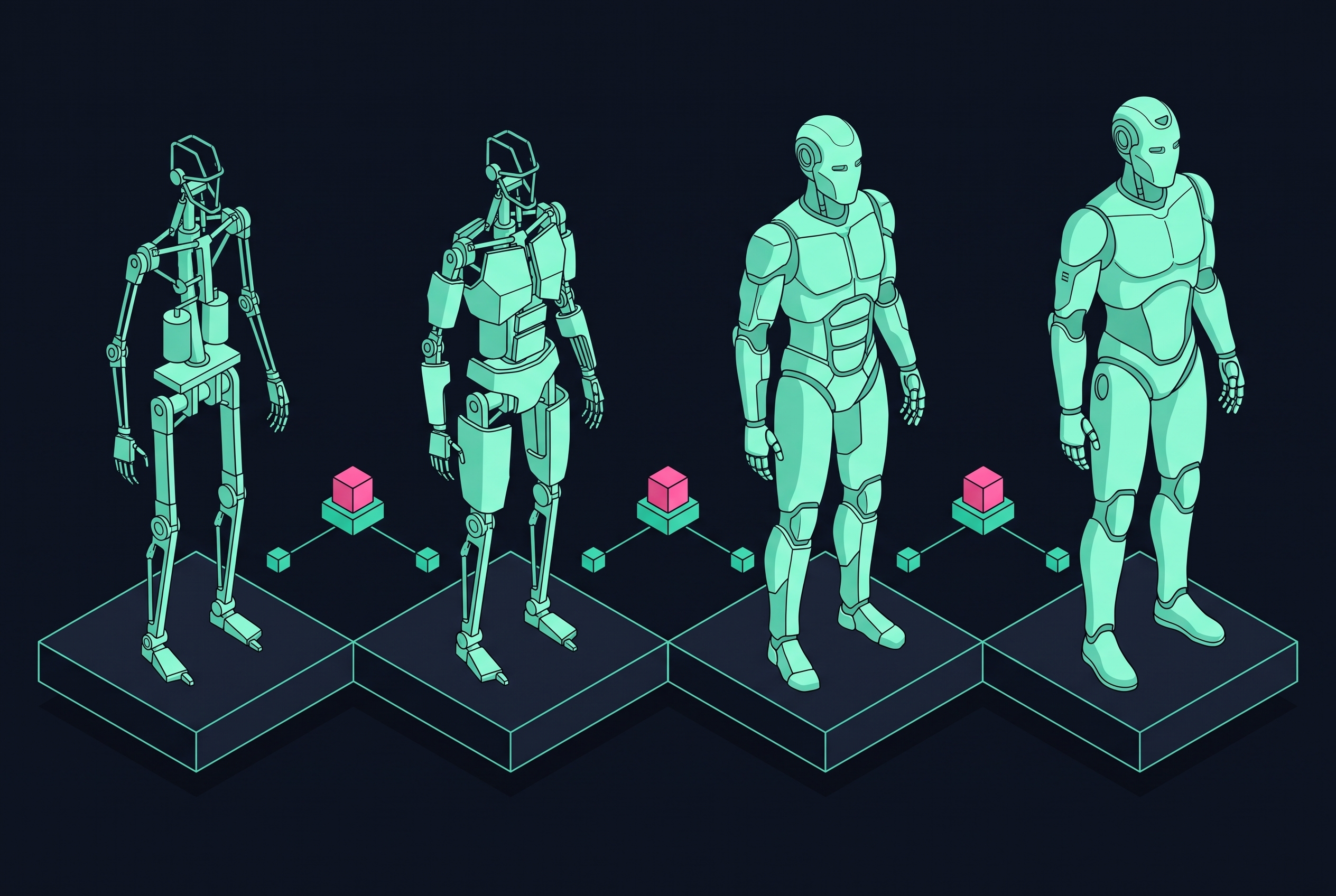
Apptronik's partnership strategy is best understood as a staged proof-of-concept architecture. Each partnership was chosen to validate a different dimension of commercial viability, and together they are meant to produce a robot that needs no special pleading to justify its cost. Jabil proved the supply chain: a global manufacturing services partner can deploy Apollo as a customer while simultaneously building the production infrastructure that drives unit costs toward viability.
Google DeepMind proved the intelligence flywheel. Data collected across the three operational environments feeds AI model development, meaning every deployment makes the next deployment smarter. That is the compounding logic the portfolio is built around. The sequence proves that the proof itself generalizes.
The funding record suggests the sequencing has convinced sophisticated investors. The February 2026 press release lists repeat investors including Google, Mercedes-Benz, B Capital, and PEAK6, alongside new investors including AT&T Ventures, John Deere, and QIA, backing the most recent round totaling over $935 million in Series A funding. The investors with operational knowledge of Apollo, the partners who have watched it work in their own facilities, are the ones who continued to back it. That is a meaningful signal, not a guarantee.
The future expansion follows the same logic. The creation of Elevate Robotics in June 2025, a wholly owned subsidiary extending Apollo's reach to "automating industrial tasks beyond the limits of the human form," suggests the partnership model is already informing how Apptronik thinks about the next ring. What makes the strategy distinctive is not any single partnership but the deliberate way they fit together: the environments generate the data, the data trains the intelligence, the intelligence expands the use cases, and the manufacturing partner closes the cost gap. Each stage depends on the one before it, and that dependence is the architecture of the commercial case.
Sources
- Apptronik - In The News
Provided the CEO quote about one robot doing thousands of tasks versus many robots doing a single task.
- Apptronik - Press Releases
Supplied details from multiple press releases covering the GXO, Jabil, Google DeepMind, and Series A funding announcements, as well as executive hire and Elevate Robotics announcements.
- Apptronik and Mercedes-Benz Enter Commercial Agreement
Provided the specifics of the Mercedes-Benz commercial agreement including Apollo's dimensions, the facility-redesign framing, and the pilot deployment structure.