Figure AI Robot Development Timeline
Each robot generation solved the specific failures its predecessor encountered in the field.
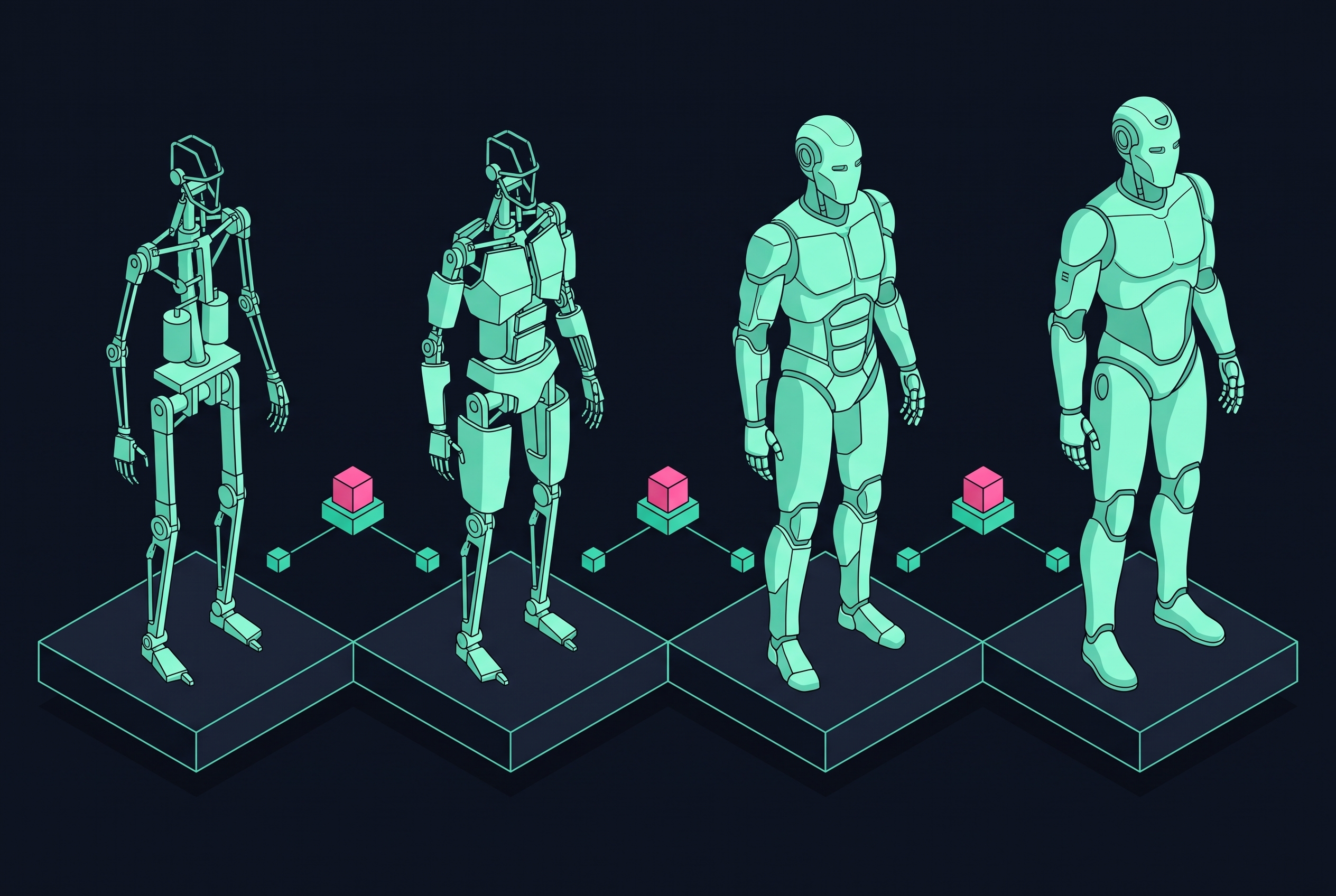
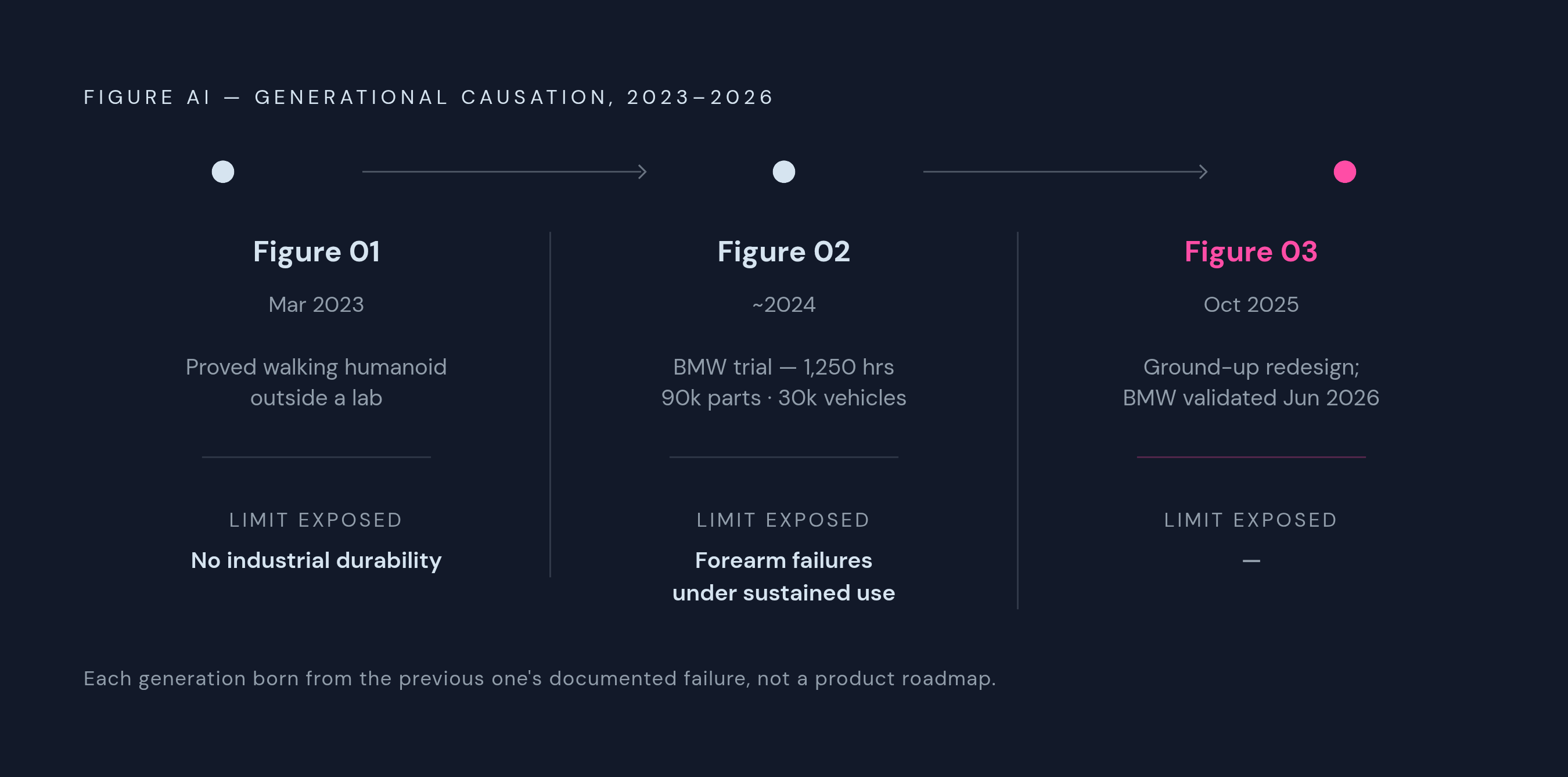
Figure AI's timeline is unusual for a reason that has nothing to do with the number of robots it has built. Founded in 2022 by Brett Adcock, the company moved from zero hardware to three distinct robot generations and multiple AI model iterations in roughly three years, a cadence closer to a software release schedule than to the tooling and validation cycles that normally govern physical products. Each generational leap arrived as a direct response to a hard limit the previous generation ran into, not as a scheduled refresh on a product roadmap. That distinction matters because it changes what the sequence of robots actually proves. A scheduled refresh tells you a company can ship on time. A sequence of generations each built to solve a specific, documented failure tells you something about how the organization learns, and what follows asks the same question of each leap: what drove it, and what does the full sequence add up to.
Figure 01 as proof-of-concept
Figure 01 emerged from stealth in March 2023, and its job was never to work on a factory floor. Its job was to show that a walking, talking humanoid could exist outside a research lab and be demonstrated to an industrial partner, which it did: early demonstrations paired the robot with OpenAI-powered conversation, and the effort produced the company's first agreement with BMW. Judged against that mission, Figure 01 was a success, and judging it against a harder mission it was never built for misses the point of what it was supposed to establish.
What Figure 01 also made clear was the size of the gap still ahead. Walking and basic manipulation turned out to be solvable problems. Durable, repeatable performance under real industrial conditions, hour after hour, shift after shift, was a different problem entirely, and a proof-of-concept robot had no reason to be built to withstand it. That gap between "can walk and pick things up" and "can survive a production environment" is what gave the BMW relationship its next phase, and it's what turned Figure 02 from an upgrade into a test.
The BMW Spartanburg trial
The Figure 02 program at BMW's Spartanburg body shop ran for roughly 11 months, and it stands as the closest thing Figure AI has to a controlled field experiment. The results were not staged for a press event. Figure 02 logged more than 1,250 hours of operation and moved more than 90,000 parts across a production run of more than 30,000 BMW X3 vehicles. A demonstration robot gets a few minutes on a stage; keeping a humanoid on a live automotive production line for nearly a year is a different order of commitment, and BMW's willingness to do so is itself a data point about how close Figure 02 came to operational viability.
The trial's value wasn't limited to the hours logged. Spartanburg generated failure data, including documented forearm failures under sustained industrial use, and that data became a direct input into the structural redesign that followed. The BMW program functioned simultaneously as a commercial proof point and as an engineering study, with the robot's breakdowns treated as information. Figure 03's hardware decisions trace back to what broke, and where, during those 1,250 hours, making Spartanburg the evidentiary core of the entire generational argument: it's the one place the record shows what the previous generation couldn't handle, and what the next one had to fix.
The decision to build AI in-house
In February 2025, Figure ended its collaboration with OpenAI and introduced its own Vision-Language-Action model, Helix, built upper-body control around full individual finger actuation, multi-robot coordination on complex tasks, and the ability to handle previously unseen objects through natural-language instruction. The OpenAI relationship matters here only as the thing the company stepped away from. What matters more is what stepping away made possible.
Figure ran the AI stack internally, so hardware revisions could be informed directly by model performance data, and model revisions could be informed directly by hardware constraints, in both directions at once. An external AI partnership cannot support that loop structurally, because the two sides are optimizing against separate roadmaps, separate priorities, and separate release schedules. Once Figure owned the model, hardware and software stopped being sequenced, one completed before the other began, and started being co-designed, developed together against the same operational data. That shift is the mechanism behind the compressed timeline. Each robot generation now carries its own AI iteration built specifically for it, and the tight coupling between the two tracks is what let the interval between hardware generations shrink.
Figure 03 as a ground-up redesign
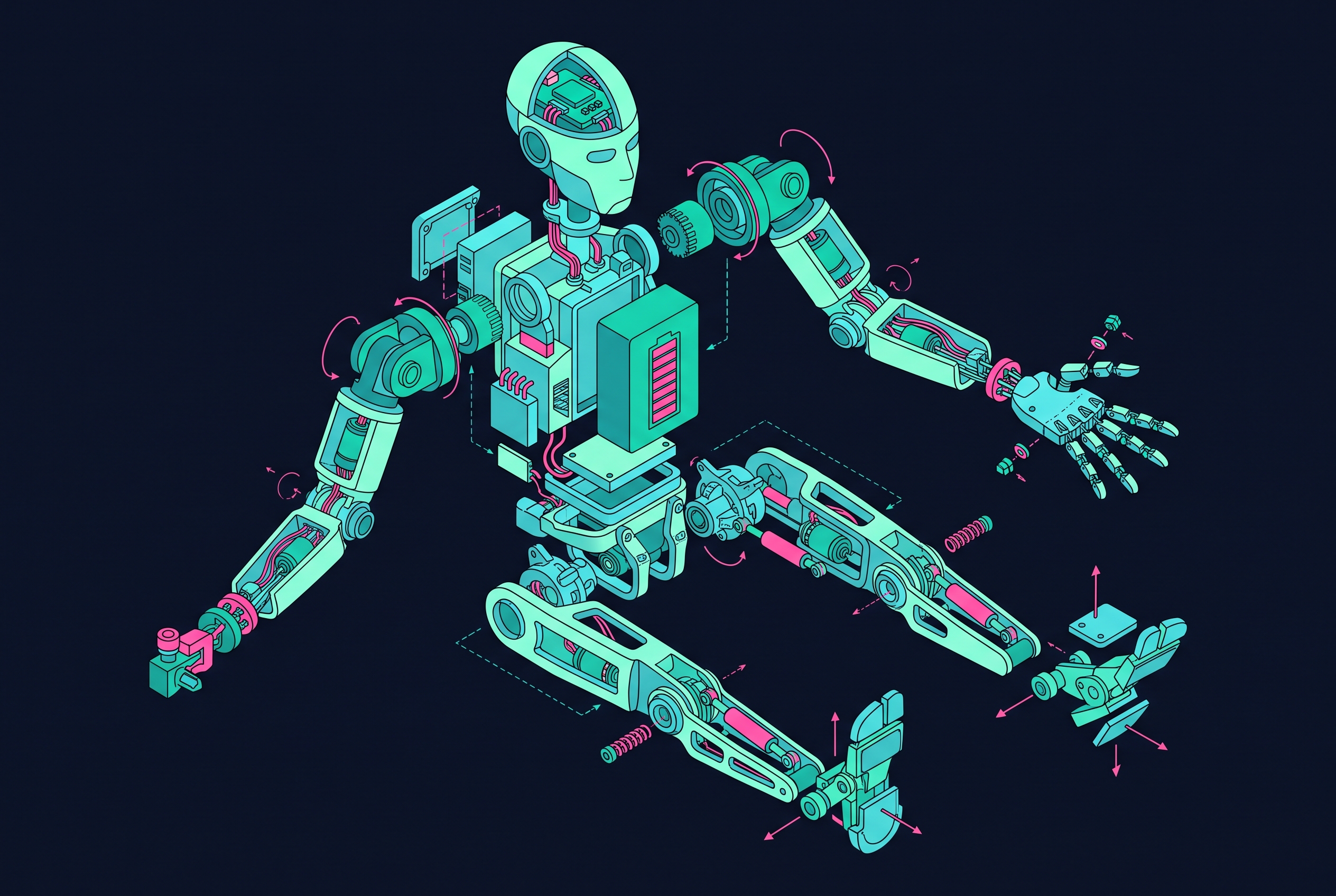
Figure 03, introduced in October 2025, was not Figure 02 with upgraded parts. It was a ground-up redesign, and its specifications read like a direct response to what Spartanburg exposed about durability, payload limits, and the demands of continuous industrial work. The robot stands 5 feet 8 inches tall and weighs 61 kg. Figure AI has not officially published its degrees of freedom, but third-party sources most commonly cite 16 degrees of freedom per hand. It carries a 20 kg payload capacity, it walks at 1.2 metres per second, and it runs on a 2.3 kWh swappable battery that supports up to five hours of operation at peak performance through a hot-swap design.
The perception upgrades solve a specific problem that body-shop environments create: a humanoid working close to fixtures, parts, and moving equipment needs to see more of its surroundings, faster, with less delay between seeing and reacting. Figure 03 answers that with twice the camera frame rate of its predecessor, a quarter the latency, a substantially wider field of view, and a camera built into each hand. Tactile sensors in the fingertips can detect forces as small as 3 grams, a sensitivity that matters for handling delicate components without crushing them or dropping them. None of these are abstract performance metrics. Each one maps onto a concrete failure mode that a robot doing unstructured industrial work actually encounters.
Serviceability and safety got equal attention in the design. Soft materials, a protected battery, removable and washable textiles, and wireless inductive charging all point toward a robot meant to work near people and to be maintained at scale, not a one-off showcased in a lab. The clearest validation of the redesign came in June 2026, when Figure 03 arrived at the same BMW Spartanburg facility that stress-tested Figure 02, this time deploying a cohort of units for a logistics sequencing task. Returning to the exact environment that exposed the previous generation's limits, and succeeding there, is the strongest evidence available that the redesign addressed what it was built to address.
BotQ: why manufacturing scale is itself a generational commitment
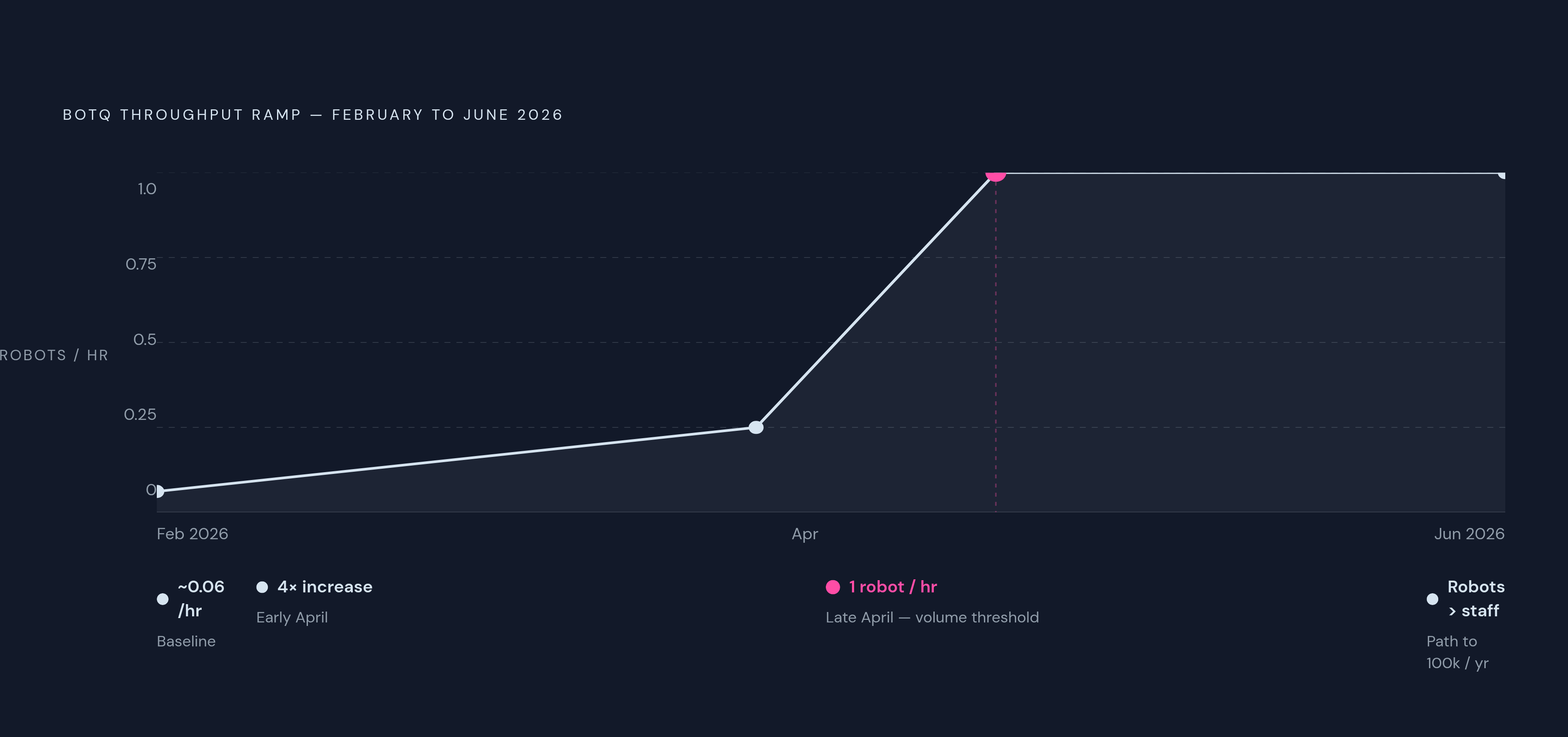
A robot design only matters if it can be built in volume, and Figure's manufacturing ramp at its BotQ facility represents a leap just as significant as the hardware changes themselves. Going from one robot built per day to one robot built per hour within months is not just a logistics detail. It marks a change in what kind of company Figure AI is, from a robotics developer producing demonstration units to a volume manufacturer producing an industrial fleet.
The documented trajectory shows how fast that shift happened: throughput rose roughly fourfold between February and April 2026, and by late April 2026 the company announced it had reached a rate of one robot per hour. By the end of June 2026, the number of robots Figure had built exceeded the number of people it employed, a milestone that carries symbolic weight but also reflects a production rate well beyond what conventional hardware scaling timelines would predict. BotQ's initial configuration targets a stated path to 100,000 units per year, and sizing a supply chain for that volume is itself a bet that the current platform will remain in production across multiple years.
This manufacturing commitment connects directly back to the lesson Spartanburg taught. A robot that exists only as a handful of units cannot generate operational data at the scale the next AI model needs to improve. Production volume and AI learning are linked: more units deployed in the field means more hours of real-world data flowing back into Helix's training pipeline. Manufacturing scale functions as a third axis of generational development, alongside hardware and software.
Commercial deployments and the AI iteration they are generating
Figure's commercial deployments do more than generate revenue. Every unit operating in a real facility is also generating the operational data that feeds the next layer of Helix's capability. Deployment scale and AI development now run on the same clock. BMW Spartanburg remains the anchor: Figure 03's arrival there in June 2026 for logistics sequencing work extends an operational relationship that now spans two robot generations in the same facility.
The Catalyst Brands agreement moves that footprint into a new domain, distribution and logistics, starting at Catalyst's Reno, Nevada Distribution Logistics Center. Catalyst operates JCPenney, Aéropostale, and Brooks Brothers, and bringing Figure's hardware into a distribution network rather than an automotive body shop tests the platform against a different set of tasks and a different physical environment.
The clearest sign that deployment and AI development are now coupled came on September 17, 2026, with the announcement of Helix 2.5. Where the original Helix handled upper-body control for industrial tasks, Helix 2.5 extends into unstructured home environments: tidying toys, folding towels, making beds, running on the existing Figure 03 hardware. Helix 2.5 is pretrained on data from the Index platform, launched in late August 2026. It is a gig-economy system in which participants called Creators use their own smartphones to record everyday household tasks on camera in exchange for pay. Index exists to feed Helix training at a volume that structured industrial deployment alone could never supply, because body-shop and warehouse work covers only a narrow slice of the tasks a home robot would need to handle. Helix 2.5 is an AI generation layered onto existing hardware, not a new robot generation, and that distinction shows the two development tracks, hardware and AI, now advancing on independent schedules. Adcock has pointed to consumer lease pricing as a directional signal of where the commercial strategy is heading, context for the trajectory.
The compute bet
In September 2026, Figure committed an initial $3.5 billion to secure up to 100,000 NVIDIA Vera Rubin GPUs, and it made that commitment while it remains pre-revenue. Spending at that scale before revenue exists is a statement about what leadership expects the next phase of development to cost, specifically that the compute needs of training future AI generations will outpace what organic revenue could fund in the near term.
Nscale announced the partnership behind the deal on September 3, 2026, and it targets GPU deployment starting in late 2027. Measured against Figure's total funding raised across every round to date, the compute commitment is large enough that it tells you something on its own: Figure's leadership sees the binding constraint on future capability as compute availability, not capital efficiency or hardware iteration speed. Figure is committing resources years ahead of the deployment date, for infrastructure that supports AI training rather than robot manufacturing, so it expects future generations of Helix will need training runs substantially larger than what has powered the models to date.
Figure 04 and the question of whether the generational cycle is accelerating or stabilizing
Figure completed the critical design review for F.04 and began shipping parts roughly seven months after Figure 03's October 2025 unveiling. That interval, measured against the gap between earlier generations, points toward a development cycle that keeps compressing. Adcock has described F.04 as the company's biggest leap yet, though the sources behind that claim do not specify what the leap consists of; this account holds that line.
Figure has also teased a seventh-generation hand, featuring finger abduction and adduction along with a rotating thumb capable of touching each fingertip, aimed at approaching the dexterity of a human hand. That hand development track runs on its own schedule, separate from robot-body generations, and a seventh-generation hand says nothing about whether the robot it attaches to is F.04 or a later platform. Some reporting has suggested F.04 could be the first Figure robot available to consumers rather than a dedicated consumer-only platform, but F.04's final specifications and release timeline are not confirmed in the available record, and claims circulating about broad home availability by late 2026 do not originate from Figure itself.
What the record from F.01 through F.03 supports is a pattern, not a prediction: each generation has been shaped by specific, documented operational failures from the one before it, and the gap between generations has shortened as the company has scaled its manufacturing and brought its AI model development in-house. Whether F.04 confirms that pattern or breaks it is not yet answered by the available evidence. The pattern itself, three generations each built from the hard data the last one generated, compressed into roughly three years, is what the evidence does support, and it is the standard against which F.04 will be measured once its specifications become public.
Sources
- Figure AI
Provided key specifications for Figure 03 including weight, payload capacity, degrees of freedom, and details about Helix, as well as general company background.